Thank you for visiting SNEWPapers!
Sign up free
Gazette Of The United States, & Philadelphia Daily Advertiser
Philadelphia, Philadelphia County, Pennsylvania
What is this article about?
Article details concessions made by Mr. Gallatin in the House of Representatives regarding US policy toward Britain and France, criticizes pro-French political factions for inconsistency, praises Adams' steadfastness, and includes a correspondent's historical overview of US-France relations from 1763 onward, expressing astonishment at recent French depredations.
Clipping
OCR Quality
Full Text
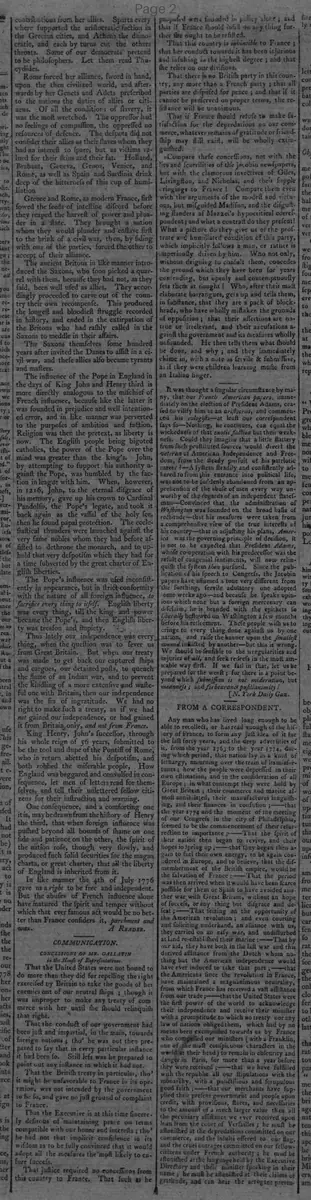
CONCESSIONS OF MR. GALLATIN in the House of Representatives.
That the United States were not bound to do more than they did for repelling the right exercised by Britain to take the goods of her enemies out of our neutral ships; though it was improper to make any treaty of commerce with her until she should relinquish that right.
That the conduct of our government had been just and impartial, in the main, towards foreign nations; tho' he was not then prepared to say that in every particular instance it had been so. Still less was he prepared to point out any instance in which it had not.
That the British treaty in particular, tho' it might be unfavorable to France in its operation, was not intended by the government to be so, and gave no just ground of complaint to France.
That the Executive is at this time sincerely desirous of 'maintaining peace on terms compatible with our honor and interests; tho' he had not that implicit confidence in its wisdom as to be fully convinced that it would adopt all the measures the most likely to ensure success.
That justice required no concessions from this country to France. That such as he proposed were founded in policy alone; and that if France should insist on any thing further he ought to be resisted.
That this country is invincible to France that her conduct towards it has been injurious and insulting in the highest degree; and that she relies on our divisions.
That there is no British party in this country, any more than a French party; that all parties are disposed for peace; and that if it cannot be preserved on proper terms, the resistance will be unanimous.
That if France should refuse to make satisfaction for the depredations on our commerce, whatever remains of gratitude or friendship may still exist, will be wholly extinguished.
Compare these concessions, not with the lies and scurrilities of the jacobins newspapers, but with the clamorous invectives of Giles, Livingston, and Nicholas, and their apple cringings to France! Compare them even with the arguments of the mode and virtuous, but misguided Madison, and the disgusting Sanders of Mazzei's hypocritical correspondent; and what a contrast do they present!
What a picture do they give us of the prostrate and humiliated condition of this party. which implicitly follows a man, or rather is imperiously driven by him. Who not only, without deigning to consult them, concedes the ground which they have been for years contending, but openly and contemptuously sets them at nought! Who, after their most elaborate harangues, gets up and tells them, in substance, that they are a pack of blockheads, who have wholly mistaken the grounds of opposition; that their assertions are untrue or irrelevant, and their accusations against the government and its measures wholly unfounded. He then tells them what should be done, and why; and they immediately chime in, with a note as servile & submissive, as if they were children learning music from an Italian singer.
It was thought a singular circumstance by many, that our French American papers, immediately on the election of President Adams, ceased to vilify him as an aristocrat, and commenced his eulogies—at least our correspondent says so—Nothing, he continues, can equal the wickedness of that exotic faction but their weakness. Could they imagine that a little flattery from such prostituted sources would divert the veteran of American Independence and Freedom, from the steady pursuit of his patriotic career?—A system steadily and consistently adhered to from this entrance into political life, was not to be suddenly abandoned from an apprehension of the abuse of men every way unworthy of the regards of an independent statesman—Convinced that the administration of Washington was founded on the broad basis of rectitude—that his measures were taken from a comprehensive view of the true interests of his country—that in adjusting his plans, America was the governing principle of decision, it is not to be expected that President Adams, whose co-operation with his predecessor was the result of congenial sentiments, will now relinquish the system then pursued. Since the publication of his speech to Congress, the Jacobin papers have assumed a tone very different from the soothing, servile adulatory one adopted some weeks ago—and because he speaks opinions which none but a foreign mercenary can disclaim, he is branded with the epithets so liberally bestowed on Washington a few months before his retirement. These people wish us to cringe to every thing done against us by one nation, and raise the banner upon the slightest wound inflicted by another—But this is wrong.
We should be sensible to the irregularities and injuries of all, and seek redress in the most amicable way first. If we fail in that, let us be prepared for the worst; for there is a point beyond which submission is not moderation, but meanness; and forbearance pusillanimity!
[N. York Daily Gaz.
FROM A CORRESPONDENT.
Any man who has lived long enough to be able to recollect, or has read enough of the history of France, to form any just idea of it for the last forty years, and the deep adversities of it, from the year 1763 to the year 1774, during which period, that nation lay in a kind of lethargy, mourning over the train of its misfortunes; how the people were depressed in their own estimation, and in the consideration of all Europe; in what contempt they were held by Great Britain; their commerce and marine almost annihilated, their manufactures languishing, and their finances in confusion ;—that the year 1774 and the moment of the meeting of our Congress in the city of Philadelphia, seemed to be the commencement of their resurrection to importance—That the spirit of their nation then began to revive, and their hopes to spring up;—that they began then again to feel their own energy, to be again considered in Europe, and to believe, that the dismemberment of the British empire, would be the salvation of France:—That the period was then arrived when it would have been scarce possible for them or Spain to have avoided another war with Great Britain, without an hope of success, or any thing but disgrace and defeat ;That seizing on the opportunity of the American revolution; and even courting and soliciting underhand, an alliance with us, they carried on an easy war, and undisturbed at land re-established their marine:—That by our aid, they have both in the last war and this derived assistance from the Dutch whom nothing but the American independence would have ever induced to take that part ;—that the Americans since the revolution in France, have maintained a magnanimous neutrality, from which France has received a vast assistance from our trade;—that the United States were the first power of the world to acknowledge their independence and receive their minister with a promptitude to which no treaty nor any law of nations obliged them, which had by no means been exemplified towards us by France who compelled our ministers (with a Franklin, one of the most conspicuous characters in the world at their head) to remain in obscurity and danger in Paris, for more than a year before they were received ;—that we have fulfilled with the republic all our stipulations with the monarchy, with a punctilious and scrupulous good faith ;—that our merchants have supplied their present government and people upon credit, with provisions, stores, and necessaries to the amount of a much larger value than all the pecuniary assistance we ever received upon loan from the court of Versailles ; he must be astonished at the depredations committed on our commerce, and the insults offered to our flag. and the cruel outrages committed on our fellow-citizens under French authority ; he must be astonished at the language held by the Executive Directory and their minister speaking in their name; he must be astonished at their claims of gratitude, and can hear the arrogant pretensions
What sub-type of article is it?
What themes does it cover?
What keywords are associated?
What entities or persons were involved?
Where did it happen?
Story Details
Key Persons
Location
House Of Representatives, United States, France, Great Britain, Philadelphia
Event Date
Year 1763 To The Year 1774, Year 1774, Election Of President Adams
Story Details
Mr. Gallatin concedes US neutrality limits, government impartiality, no intent to harm France via British treaty, Executive's peace desires, no justice-based concessions to France, US invincibility against France, no partisan divides, potential end of friendship if no satisfaction for depredations; criticizes pro-French party's servility and flip-flopping post-Adams election; correspondent recounts France's decline 1763-1774, revival via American Revolution alliance, US magnanimous neutrality and aid to France despite French ingratitude and recent aggressions.