Thank you for visiting SNEWPapers!
Sign up free
Editorial
June 24, 1802
Alexandria Advertiser And Commercial Intelligencer
Alexandria, Virginia
What is this article about?
An editorial defending Federalism against Democratic-Republican accusations of favoring the rich and aristocracy. It critiques Jefferson's administration for hypocrisy on economic policies and taxes, contrasting with Washington and Adams' terms. Signed Fabricius.
Clipping
OCR Quality
95%
Excellent
Full Text
On the Gazette of the United States.
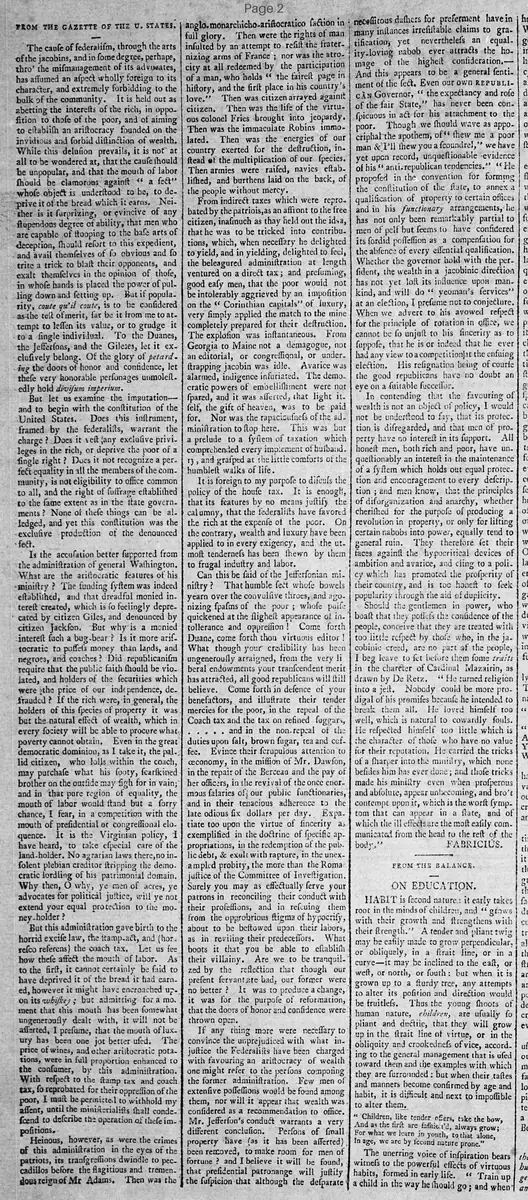
The cause of federalism, through the arts of the jacobins, and in some degree, perhaps, thro' the mismanagement of its advocates, has assumed an aspect wholly foreign to its character, and extremely forbidding to the bulk of the community. It is held out as abetting the interests of the rich, in opposition to those of the poor, and of aiming to establish an aristocracy founded on the invidious and morbid distinction of wealth. While this delusion prevails, it is not at all to be wondered at, that the cause should be unpopular, and that the mouth of labor should be clamorous against "a sect" whose object is understood to be, to deprive it of the bread which it earns. Neither is it surprising, or evincive of any stupendous degree of ability, that men who are capable of stooping to the base arts of deception, should resort to this expedient, and avail themselves of so obvious and so trite a trick to blast their opponents, and exalt themselves in the opinion of those, in whose hands is placed the power of pulling down and setting up. But if popularity, coute qu'il coute, is to be considered as the test of merit, far be it from me to attempt to lessen its value, or to grudge it to a single individual. To the Duanes, the Jeffersons, and the Gileses, let it exclusively belong. Of the glory of petarding the doors of honor and confidence, let these very honorable personages unmolestedly hold dividum imperium.
But let us examine the imputation-- and to begin with the constitution of the United States. Does this instrument, framed by the federalists, warrant the charge? Does it vest any exclusive privileges in the rich, or deprive the poor of a single right? Does it not recognize a perfect equality in all the members of the community, is not eligibility to office common to all, and the right of suffrage established to the same extent as in the state governments? None of these things can be alleged, and yet this constitution was the exclusive production of the denounced sect.
Is the accusation better supported from the administration of general Washington. What are the aristocratic features of his ministry? The funding system was indeed established, and that dreadful monied interest created, which is so feelingly deprecated by citizen Giles, and denounced by citizen Jackson. But why is a monied interest such a bug-bear? Is it more aristocratic to possess money than lands, and negroes, and coaches? Did republicanism require that the public faith should be violated, and holders of the securities which were the price of our independence, defrauded? If the rich were, in general, the holders of this species of property it was but the natural effect of wealth, which in every society will be able to procure what poverty cannot obtain, Even in the great democratic dominion, as I take it, the pallid citizen, who lolls within the coach, may purchase what his sooty, care-killed brother on the outside may sigh for in vain; and in that pure region of equality, the mouth of labor would stand but a sorry chance, I fear, in a competition with the mouth of presidential or congressional eloquence. It is the Virginian policy, I have heard, to take especial care of the land-holder. No agrarian laws there, no insolent plebeian creditor tripping the democratic lordling of his patrimonial domain. Why then, O why, ye men of acres, ye advocates for political justice, will ye not extend your equal protection to the money-holder?
But this administration gave birth to the horrid excise law, the stamp-act, and (horror of horrors) the coach tax. Let us see how these affect the mouth of labor. As to the first, it cannot certainly be said to have deprived it of the bread it had earned, however it might have encroached upon its whiskey; but admitting for a moment that this mouth has been somewhat ungenerously dealt with, it will not be asserted, I presume, that the mouth of luxury has been one jot better used. The price of wines, and other aristocratic potations, were in full proportion enhanced to the consumer, by this administration.
With respect to the stamp tax and coach tax, so reprobated for their oppression of the poor, I must be permitted to withhold my assent, until the ministerialists shall condescend to describe the operation of these impositions.
Heinous, however, as were the crimes of this administration in the eyes of the patriots, its transgressions dwindle to peccadillos before the flagitious and tremendous reign of Mr Adams. Then was the anglo-monarchicho-aristocratico faction in full glory. Then were the rights of man insulted by an attempt to resist the fraternizing arms of France; nor was the atrocity at all redeemed by the participation of a man, who holds "the fairest page in history, and the first place in his country's love." Then was citizen arrayed against citizen. Then was the life of the virtuous colonel Fries brought into jeopardy. Then was the immaculate Robbins immolated. Then was the energies of our country exerted for the destruction, instead of the multiplication of our species. Then armies were raised, navies established, and burdens laid on the back, of the people without mercy.
From indirect taxes which were reprobated by the patriots, as an affront to the free citizen, inasmuch as they held out the idea, that he was to be tricked into contributions, which, when necessary he delighted to yield, and in yielding, delighted to feel the beleaguered administration at length ventured on a direct tax; and presuming, good easy men, that the poor would not be intolerably aggrieved by an imposition on the "Corinthian capitals" of luxury very simply applied the match to the mine completely prepared for their destruction. The explosion was instantaneous. From Georgia to Maine not a demagogue, not an editorial, or congressional, or under-strapping jacobin was idle. Avarice was alarmed, indigence infuriated. The democratic powers of embellishment were not spared, and it was asserted, that light itself, the gift of heaven, was to be paid for. Nor was the rapaciousness of the administration to stop here. This was but a prelude to a system of taxation which comprehended every implement of husbandry, and grasped at the little comforts of the humblest walks of life.
It is foreign to my purpose to discuss the policy of the house tax. It is enough, that its features by no means justify the calumny, that the federalists have favored the rich at the expense of the poor. On the contrary, wealth and luxury have been applied to in every exigency, and the utmost tenderness has been shewn by them to frugal industry and labor.
Can this be said of the Jeffersonian ministry? That humble sect whose bowels yearn over the convulsive throes, and agonizing pangs of the poor; whose pulse quickened at the slightest appearance of intolerance and oppression! Come forth Duane, come forth thou virtuous editor! What though your credibility has been ungenerously arraigned, from the very liberal endowments your transcendent merit has attracted, all good republicans will still believe. Come forth in defence of your benefactors, and illustrate their tender mercies for the poor, in the repeal of the Coach tax and the tax on refined sugars, . . . and in the non-repeal of the duties upon salt, brown sugar, tea and coffee. Evince their scrupulous attention to oeconomy, in the mission of Mr. Dawson, in the repair of the Berceau and the pay of her officers, in the revival of the once enormous salaries of our public functionaries, and in their tenacious adherence to the late odious six dollars per day. Expatiate too upon the virtue of sincerity as exemplified in the doctrine of specific appropriations, in the redemption of the public debt, & exult with rapture, in the unexampled probity, the more than the Roman justice of the Committee of Investigation.
Surely you may as effectually serve your patrons in reconciling their conduct with their professions, and in rescuing them from the opprobrious stigma of hypocrisy, about to be bestowed upon their labors, as in reviling their predecessors. What boots it that you be able to establish their villainy. Are we to be tranquilized by the reflection that though our present servants are bad, our former were no better? It was to produce a change, it was for the purpose of reformation, that the doors of honor and confidence were thrown open.
If any thing more were necessary to convince the unprejudiced with what injustice the Federalists have been charged with favouring an aristocracy of wealth one might refer to the persons composing the former administration. Few men of extensive possessions would be found among them, nor will it appear that wealth was considered as a recommendation to office. Mr. Jefferson's conduct warrants a very different conclusion. Persons of small property have (as it has been asserted) been removed, to make room for men of fortune? and I believe it will be found, that presidential patronage will justify the suspicion --that although the desperate neceitous dashers for preferment have in many instances irresistible claims to gratification; yet nevertheless an equality-loving nabob ever attracts the homage of the highest consideration.-- And this appears to be a general sentiment of the Sect. Even our own Republican Governor, "the expectancy and rose of the fair State," has never been conspicuous in act for his attachment to the poor. Though we should waive as apocryphal the apothem, of "shew me a poor man & I'll shew you a scoundrel," we have yet upon record, unquestionable evidence of his "anti-republican tendencies." He proposed in the convention for forming the constitution of the state, to annex a qualification of property to certain offices and in his functionary arrangements, he has not only been remarkably partial to men of pelf but seems to have considered its sordid possession as a compensation for the absence of every essential qualification. Whether the governor hold with the president, the wealth in a jacobinic direction has not yet lost its influence upon mankind, and will do "yeoman's services" at an election, I presume not to conjecture. When we advert to his avowed respect for the principle of rotation in office, we cannot be so unjust to his sincerity as to suppose, that he is or indeed that he ever had any view to a competition at the ensuing election. His resignation being of course the good republicans have no doubt an eye on a suitable successor.
In contending that the favouring of wealth is not an object of policy, I would not be understood to say, that its protection is disregarded, and that men of property have no interest in its support. All honest men, both rich and poor, have unquestionably an interest in the maintenance of a system which holds out equal protection and encouragement to every description ; and men know, that the principles of disorganization and anarchy, whether cherished for the purpose of producing a revolution in property, or only for lifting certain nabobs into power, equally tend to general ruin. They therefore set their faces against the hypocritical devices of ambition and avarice, and cling to a policy which has promoted the prosperity of their country, and is too honest to seek popularity through the aid of duplicity.
Should the gentlemen in power, who boast that they possess the confidence of the people, conceive that they are treated with too little respect by those who, in the jacobinic creed, are no part of the people, I beg leave to set before them some traits in the character of Cardinal Mazarin, as drawn by De Retz. "He turned religion into a jest. Nobody could be more prodigal of his promises because he intended to break them all. He loved himself too well, which is natural to cowardly souls. He respected himself too little which is the character of those who have no value for their reputation. He carried the tricks of a sharper into the ministry, which none besides him has ever done : and those tricks made his ministry even when prosperous and absolute, appear unbecoming, and bro't contempt upon it, which is the worst symptom that can appear in a state. and of which the ill effects are the most easily communicated from the head to the rest of the body."
FABRICIUS.
The cause of federalism, through the arts of the jacobins, and in some degree, perhaps, thro' the mismanagement of its advocates, has assumed an aspect wholly foreign to its character, and extremely forbidding to the bulk of the community. It is held out as abetting the interests of the rich, in opposition to those of the poor, and of aiming to establish an aristocracy founded on the invidious and morbid distinction of wealth. While this delusion prevails, it is not at all to be wondered at, that the cause should be unpopular, and that the mouth of labor should be clamorous against "a sect" whose object is understood to be, to deprive it of the bread which it earns. Neither is it surprising, or evincive of any stupendous degree of ability, that men who are capable of stooping to the base arts of deception, should resort to this expedient, and avail themselves of so obvious and so trite a trick to blast their opponents, and exalt themselves in the opinion of those, in whose hands is placed the power of pulling down and setting up. But if popularity, coute qu'il coute, is to be considered as the test of merit, far be it from me to attempt to lessen its value, or to grudge it to a single individual. To the Duanes, the Jeffersons, and the Gileses, let it exclusively belong. Of the glory of petarding the doors of honor and confidence, let these very honorable personages unmolestedly hold dividum imperium.
But let us examine the imputation-- and to begin with the constitution of the United States. Does this instrument, framed by the federalists, warrant the charge? Does it vest any exclusive privileges in the rich, or deprive the poor of a single right? Does it not recognize a perfect equality in all the members of the community, is not eligibility to office common to all, and the right of suffrage established to the same extent as in the state governments? None of these things can be alleged, and yet this constitution was the exclusive production of the denounced sect.
Is the accusation better supported from the administration of general Washington. What are the aristocratic features of his ministry? The funding system was indeed established, and that dreadful monied interest created, which is so feelingly deprecated by citizen Giles, and denounced by citizen Jackson. But why is a monied interest such a bug-bear? Is it more aristocratic to possess money than lands, and negroes, and coaches? Did republicanism require that the public faith should be violated, and holders of the securities which were the price of our independence, defrauded? If the rich were, in general, the holders of this species of property it was but the natural effect of wealth, which in every society will be able to procure what poverty cannot obtain, Even in the great democratic dominion, as I take it, the pallid citizen, who lolls within the coach, may purchase what his sooty, care-killed brother on the outside may sigh for in vain; and in that pure region of equality, the mouth of labor would stand but a sorry chance, I fear, in a competition with the mouth of presidential or congressional eloquence. It is the Virginian policy, I have heard, to take especial care of the land-holder. No agrarian laws there, no insolent plebeian creditor tripping the democratic lordling of his patrimonial domain. Why then, O why, ye men of acres, ye advocates for political justice, will ye not extend your equal protection to the money-holder?
But this administration gave birth to the horrid excise law, the stamp-act, and (horror of horrors) the coach tax. Let us see how these affect the mouth of labor. As to the first, it cannot certainly be said to have deprived it of the bread it had earned, however it might have encroached upon its whiskey; but admitting for a moment that this mouth has been somewhat ungenerously dealt with, it will not be asserted, I presume, that the mouth of luxury has been one jot better used. The price of wines, and other aristocratic potations, were in full proportion enhanced to the consumer, by this administration.
With respect to the stamp tax and coach tax, so reprobated for their oppression of the poor, I must be permitted to withhold my assent, until the ministerialists shall condescend to describe the operation of these impositions.
Heinous, however, as were the crimes of this administration in the eyes of the patriots, its transgressions dwindle to peccadillos before the flagitious and tremendous reign of Mr Adams. Then was the anglo-monarchicho-aristocratico faction in full glory. Then were the rights of man insulted by an attempt to resist the fraternizing arms of France; nor was the atrocity at all redeemed by the participation of a man, who holds "the fairest page in history, and the first place in his country's love." Then was citizen arrayed against citizen. Then was the life of the virtuous colonel Fries brought into jeopardy. Then was the immaculate Robbins immolated. Then was the energies of our country exerted for the destruction, instead of the multiplication of our species. Then armies were raised, navies established, and burdens laid on the back, of the people without mercy.
From indirect taxes which were reprobated by the patriots, as an affront to the free citizen, inasmuch as they held out the idea, that he was to be tricked into contributions, which, when necessary he delighted to yield, and in yielding, delighted to feel the beleaguered administration at length ventured on a direct tax; and presuming, good easy men, that the poor would not be intolerably aggrieved by an imposition on the "Corinthian capitals" of luxury very simply applied the match to the mine completely prepared for their destruction. The explosion was instantaneous. From Georgia to Maine not a demagogue, not an editorial, or congressional, or under-strapping jacobin was idle. Avarice was alarmed, indigence infuriated. The democratic powers of embellishment were not spared, and it was asserted, that light itself, the gift of heaven, was to be paid for. Nor was the rapaciousness of the administration to stop here. This was but a prelude to a system of taxation which comprehended every implement of husbandry, and grasped at the little comforts of the humblest walks of life.
It is foreign to my purpose to discuss the policy of the house tax. It is enough, that its features by no means justify the calumny, that the federalists have favored the rich at the expense of the poor. On the contrary, wealth and luxury have been applied to in every exigency, and the utmost tenderness has been shewn by them to frugal industry and labor.
Can this be said of the Jeffersonian ministry? That humble sect whose bowels yearn over the convulsive throes, and agonizing pangs of the poor; whose pulse quickened at the slightest appearance of intolerance and oppression! Come forth Duane, come forth thou virtuous editor! What though your credibility has been ungenerously arraigned, from the very liberal endowments your transcendent merit has attracted, all good republicans will still believe. Come forth in defence of your benefactors, and illustrate their tender mercies for the poor, in the repeal of the Coach tax and the tax on refined sugars, . . . and in the non-repeal of the duties upon salt, brown sugar, tea and coffee. Evince their scrupulous attention to oeconomy, in the mission of Mr. Dawson, in the repair of the Berceau and the pay of her officers, in the revival of the once enormous salaries of our public functionaries, and in their tenacious adherence to the late odious six dollars per day. Expatiate too upon the virtue of sincerity as exemplified in the doctrine of specific appropriations, in the redemption of the public debt, & exult with rapture, in the unexampled probity, the more than the Roman justice of the Committee of Investigation.
Surely you may as effectually serve your patrons in reconciling their conduct with their professions, and in rescuing them from the opprobrious stigma of hypocrisy, about to be bestowed upon their labors, as in reviling their predecessors. What boots it that you be able to establish their villainy. Are we to be tranquilized by the reflection that though our present servants are bad, our former were no better? It was to produce a change, it was for the purpose of reformation, that the doors of honor and confidence were thrown open.
If any thing more were necessary to convince the unprejudiced with what injustice the Federalists have been charged with favouring an aristocracy of wealth one might refer to the persons composing the former administration. Few men of extensive possessions would be found among them, nor will it appear that wealth was considered as a recommendation to office. Mr. Jefferson's conduct warrants a very different conclusion. Persons of small property have (as it has been asserted) been removed, to make room for men of fortune? and I believe it will be found, that presidential patronage will justify the suspicion --that although the desperate neceitous dashers for preferment have in many instances irresistible claims to gratification; yet nevertheless an equality-loving nabob ever attracts the homage of the highest consideration.-- And this appears to be a general sentiment of the Sect. Even our own Republican Governor, "the expectancy and rose of the fair State," has never been conspicuous in act for his attachment to the poor. Though we should waive as apocryphal the apothem, of "shew me a poor man & I'll shew you a scoundrel," we have yet upon record, unquestionable evidence of his "anti-republican tendencies." He proposed in the convention for forming the constitution of the state, to annex a qualification of property to certain offices and in his functionary arrangements, he has not only been remarkably partial to men of pelf but seems to have considered its sordid possession as a compensation for the absence of every essential qualification. Whether the governor hold with the president, the wealth in a jacobinic direction has not yet lost its influence upon mankind, and will do "yeoman's services" at an election, I presume not to conjecture. When we advert to his avowed respect for the principle of rotation in office, we cannot be so unjust to his sincerity as to suppose, that he is or indeed that he ever had any view to a competition at the ensuing election. His resignation being of course the good republicans have no doubt an eye on a suitable successor.
In contending that the favouring of wealth is not an object of policy, I would not be understood to say, that its protection is disregarded, and that men of property have no interest in its support. All honest men, both rich and poor, have unquestionably an interest in the maintenance of a system which holds out equal protection and encouragement to every description ; and men know, that the principles of disorganization and anarchy, whether cherished for the purpose of producing a revolution in property, or only for lifting certain nabobs into power, equally tend to general ruin. They therefore set their faces against the hypocritical devices of ambition and avarice, and cling to a policy which has promoted the prosperity of their country, and is too honest to seek popularity through the aid of duplicity.
Should the gentlemen in power, who boast that they possess the confidence of the people, conceive that they are treated with too little respect by those who, in the jacobinic creed, are no part of the people, I beg leave to set before them some traits in the character of Cardinal Mazarin, as drawn by De Retz. "He turned religion into a jest. Nobody could be more prodigal of his promises because he intended to break them all. He loved himself too well, which is natural to cowardly souls. He respected himself too little which is the character of those who have no value for their reputation. He carried the tricks of a sharper into the ministry, which none besides him has ever done : and those tricks made his ministry even when prosperous and absolute, appear unbecoming, and bro't contempt upon it, which is the worst symptom that can appear in a state. and of which the ill effects are the most easily communicated from the head to the rest of the body."
FABRICIUS.
What sub-type of article is it?
Partisan Politics
Economic Policy
Constitutional
What keywords are associated?
Federalism
Jacobins
Aristocracy
Taxation
Funding System
Jefferson Administration
Partisan Critique
Economic Equality
What entities or persons were involved?
Federalists
Jacobins
Washington
Adams
Jefferson
Duane
Giles
Jackson
Fries
Robbins
Governor
Editorial Details
Primary Topic
Defense Of Federalism Against Accusations Of Aristocracy And Favoritism Toward The Rich
Stance / Tone
Pro Federalist Critique Of Jeffersonian Hypocrisy
Key Figures
Federalists
Jacobins
Washington
Adams
Jefferson
Duane
Giles
Jackson
Fries
Robbins
Governor
Key Arguments
Federalist Constitution Ensures Equality And Does Not Favor The Rich
Washington's Funding System Upheld Public Faith Without Aristocracy
Taxes Under Federalists Targeted Luxury More Than Labor
Adams Administration Burdened All But Resisted French Aggression
Jefferson Administration Hypocritical In Tax Policies And Appointments
Federalists Protected All Property, Unlike Virginian Land Favoritism
Wealth Influences Jeffersonian Patronage Despite Equality Claims