Thank you for visiting SNEWPapers!
Sign up free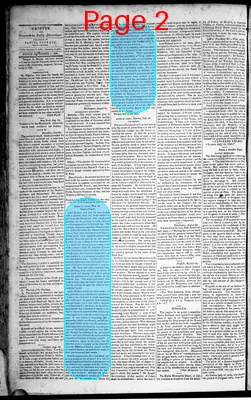
Alexandria Gazette & Daily Advertiser
Alexandria, Virginia
What is this article about?
In the British House of Lords on May 26, news vendors petitioned against compulsory Sunday newspaper sales, citing moral and religious concerns. Lords debated the issue, with some supporting a ban and others opposing, suspecting political motives. The petition was laid on the table.
Clipping
OCR Quality
Full Text
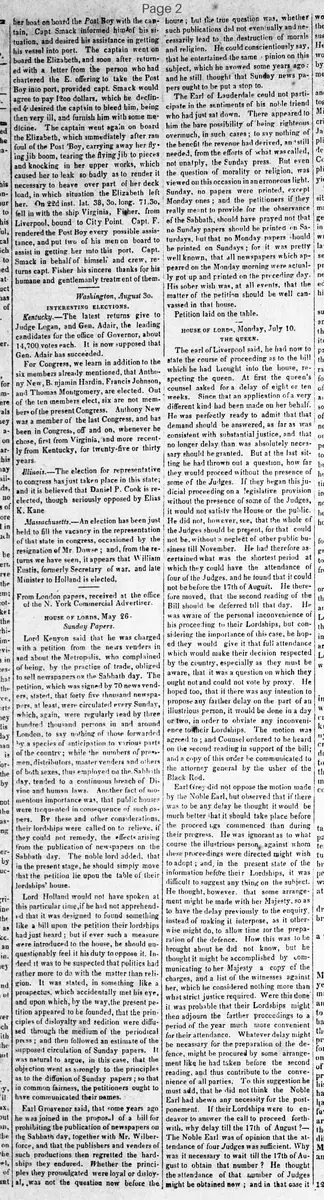
HOUSE OF LORDS, May 26.
Sunday Papers.
Lord Kenyon said that he was charged with a petition from the news venders in and about the Metropolis, who complained of being, by the practice of trade, obliged to sell newspapers on the Sabbath day. The petition, which was signed by 70 news venders, stated, that forty five thousand newspapers, at least, were circulated every Sunday, which, again, were regularly read by three hundred thousand persons in and around London, to say nothing of those forwarded by a species of anticipation to various parts of the country: while he numbers of press-men, distributors, master venders and others of both sexes, thus employed on the Sabbath day, tended to a continuous breach of Divine and human laws. Another fact of momentous importance was, that public houses were frequented in consequence of such papers. By these and other considerations, their lordships were called on to relieve, if they could not remedy, the effects arising from the publication of newspapers on the Sabbath day. The noble lord added. that in the present stage, he should simply move that the petition lie upon the table of their lordships' house.
Lord Holland would not have spoken at this particular time,if he had not apprehended that it was designed to found something like a bill upon the petition their lordships had just heard; but if ever such a measure were introduced to the house, he should unquestionably feel it his duty to oppose it. Indeed it was to be suspected that politics had rather more to do with the matter than religion. It was stated, in something like a prospectus, which accidentally met his eye, and upon which, by the way,the present petition appeared to be founded, that the principles of disloyalty and sedition were diffused through the medium of the periodical press; and then followed an estimate of the supposed circulation of Sunday papers. It was natural to argue, in this case, that the objection went as strongly to the principles as to the diffusion of Sunday papers ; so that in common fairness, the petitioners ought to have communicated their names.
Earl Grosvenor said, that some years ago he was joined in the proposal of a bill for prohibiting the publication of newspapers on the Sabbath day, together with Mr. Wilberforce, and that the publishers and venders of such productions then regretted the hardships they endured. Whether the principles they promulgated were loyal or disloyal, was not the question now before the house; but the true question was, whether such publications did not eventually and necessarily lead to the destruction of morals and religion. He could conscientiously say, that he entertained the same opinion on this subject, which he avowed some years ago : and he still thought that Sunday news papers ought to be put a stop to.
The Earl of Lauderdale could not participate in the sentiments of his noble friend who had just sat down. There appeared to him the bare possibility of'being righteous overmuch, in such cases; to say nothing of the benefit the revenue had derived, and still needed, from the efforts of what was called, not unaptly, the Sunday press. But even the question of morality or religion, was viewed on this occasion in an erroneous light. Sunday, no papers were printed, except Monday ones; and the petitioners if they really meant to provide for the observance of the Sabbath, should have prayed not that no Sunday papers should be printed on Saturdays. but that no Monday papers should be printed on Sundays: for it was pretty well known, that all newspapers which appeared on the Monday morning were actually got up and printed on the preceding day. His sober wish was, at all events, that the matter of the petition should be well canvassed in that house.
Petition laid on the table.
What sub-type of article is it?
What keywords are associated?
What entities or persons were involved?
Where did it happen?
Foreign News Details
Primary Location
London
Event Date
May 26
Key Persons
Outcome
petition laid on the table.
Event Details
Lord Kenyon presented a petition from 70 news vendors complaining about being forced to sell newspapers on Sundays, estimating 45,000 papers circulated to 300,000 readers, leading to Sabbath breaches and public house visits. Lords debated: Holland opposed potential bills suspecting political motives; Grosvenor supported prohibition for moral reasons; Lauderdale argued against over-righteousness and noted printing practices.