Thank you for visiting SNEWPapers!
Sign up free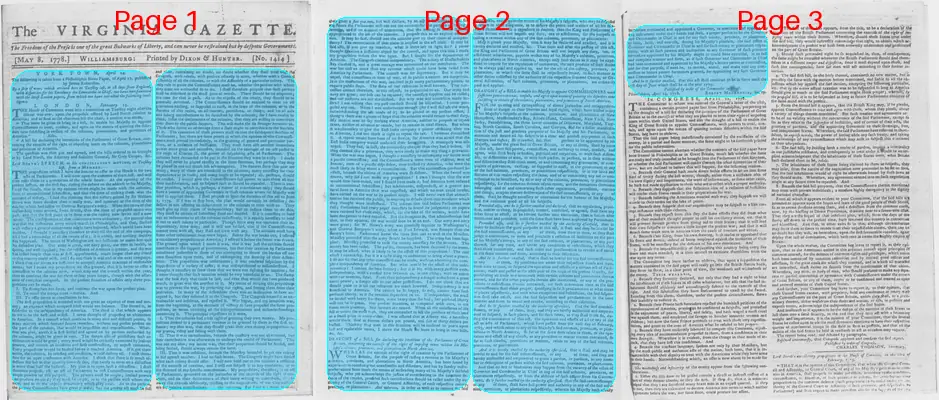
The Virginia Gazette
Richmond, Williamsburg, Richmond County, Virginia
What is this article about?
British Parliament, via Lord North's motion on Feb. 19, 1778, advances conciliatory bills to negotiate peace with American colonies, suspending taxation for revenue and empowering commissioners to address grievances and hostilities amid ongoing war.
Merged-components note: Continuation of Lord North's speech and parliamentary bills on American colonies across pages 1-3; original label of second component was 'story', changed to 'foreign_news' as it fits international reports.
Clippings
1 of 3
OCR Quality
Full Text
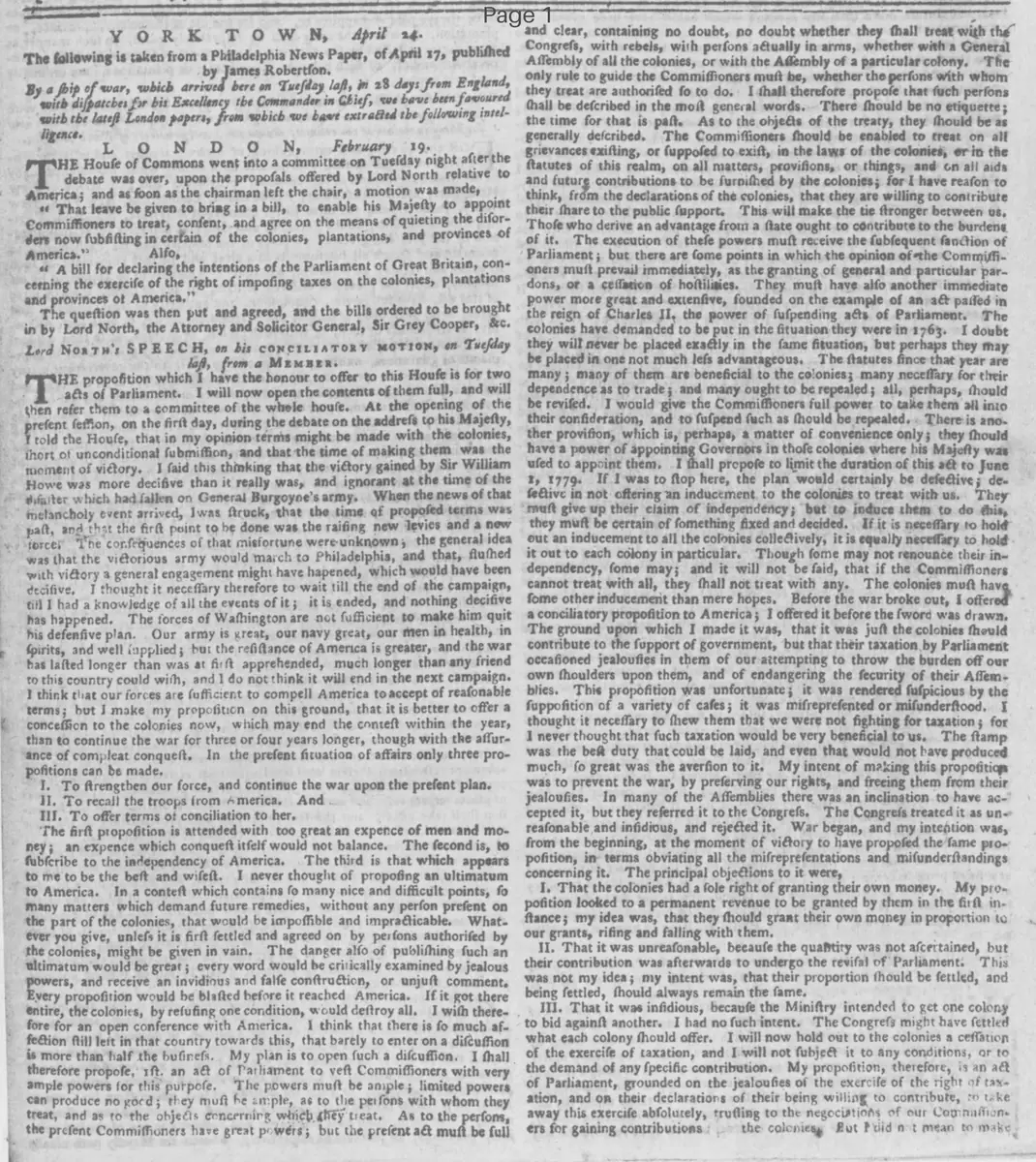
The following is taken from a Philadelphia News Paper, of April 17, published by James Robertson.
By a ship of war, which arrived here on Tuesday last, in 28 days from England, with dispatches for his Excellency the Commander in Chief, we have been favoured with the latest London papers, from which we have extracted the following intelligence.
LONDON, February 19.
THE House of Commons went into a committee on Tuesday night after the debate was over, upon the proposals offered by Lord North relative to America; and as soon as the chairman left the chair, a motion was made,
"That leave be given to bring in a bill, to enable his Majesty to appoint Commissioners to treat, consent, and agree on the means of quieting the disorders now subsisting in certain of the colonies, plantations, and provinces of America."
Also,
"A bill for declaring the intentions of the Parliament of Great Britain, concerning the exercise of the right of imposing taxes on the colonies, plantations and provinces of America."
The question was then put and agreed, and the bills ordered to be brought in by Lord North, the Attorney and Solicitor General, Sir Grey Cooper, &c.
Lord NORTH's SPEECH, on his conciliatory MOTION, on Tuesday last, from a MEMBER.
THE proposition which I have the honour to offer to this House is for two acts of Parliament. I will now open the contents of them fully, and will then refer them to a committee of the whole house. At the opening of the present session, on the first day, during the debate on the address to his Majesty, I told the House, that in my opinion terms might be made with the colonies, short of unconditional submission, and that the time of making them was the moment of victory. I said this thinking that the victory gained by Sir William Howe was more decisive than it really was, and ignorant at the time of the disaster which had fallen on General Burgoyne's army. When the news of that melancholy event arrived, I was struck, that the time of proposed terms was past, and that the first point to be done was the raising new levies and a new force. The consequences of that misfortune were unknown; the general idea was that the victorious army would march to Philadelphia, and that, flushed with victory a general engagement might have happened, which would have been decisive. I thought it necessary therefore to wait till the end of the campaign, till I had a knowledge of all the events of it; it is ended, and nothing decisive has happened. The forces of Washington are not sufficient to make him quit his defensive plan. Our army is great, our navy great, our men in health, in spirits, and well supplied; but the resistance of America is greater, and the war has lasted longer than was at first apprehended, much longer than any friend to this country could wish, and I do not think it will end in the next campaign. I think that our forces are sufficient to compel America to accept of reasonable terms; but I make my proposition on this ground, that it is better to offer a concession to the colonies now, which may end the contest within the year, than to continue the war for three or four years longer, though with the assurance of complete conquest. In the present situation of affairs only three propositions can be made.
I. To strengthen our force, and continue the war upon the present plan.
II. To recall the troops from America. And
III. To offer terms of conciliation to her.
The first proposition is attended with too great an expense of men and money; an expense which conquest itself would not balance. The second is, to subscribe to the independency of America. The third is that which appears to me to be the best and wisest. I never thought of proposing an ultimatum to America. In a contest which contains so many nice and difficult points, so many matters which demand future remedies, without any person present on the part of the colonies, that would be impossible and impracticable. Whatever you give, unless it is first settled and agreed on by persons authorised by the colonies, might be given in vain. The danger also of publishing such an ultimatum would be great; every word would be critically examined by jealous powers, and receive an invidious and false construction, or unjust comment. Every proposition would be blasted before it reached America. If it got there entire, the colonies, by refusing one condition, would destroy all. I wish therefore for an open conference with America. I think that there is so much affection still left in that country towards this, that barely to enter on a discussion is more than half the business. My plan is to open such a discussion. I shall therefore propose, 1st. an act of Parliament to vest Commissioners with very ample powers for this purpose. The powers must be ample; limited powers can produce no good; they must be ample, as to the persons with whom they treat, and as to the objects concerning which they treat. As to the persons, the present Commissioners have great powers; but the present act must be full and clear, containing no doubt, no doubt whether they shall treat with the Congress, with rebels, with persons actually in arms, whether with a General Assembly of all the colonies, or with the Assembly of a particular colony. The only rule to guide the Commissioners must be, whether the persons with whom they treat are authorised so to do. I shall therefore propose that such persons shall be described in the most general words. There should be no etiquette; the time for that is past. As to the objects of the treaty, they should be as generally described. The Commissioners should be enabled to treat on all grievances existing, or supposed to exist, in the laws of the colonies, or in the statutes of this realm, on all matters, provisions, or things, and on all aids and future contributions to be furnished by the colonies; for I have reason to think, from the declarations of the colonies, that they are willing to contribute their share to the public support. This will make the tie stronger between us. Those who derive an advantage from a state ought to contribute to the burdens of it. The execution of these powers must receive the subsequent sanction of Parliament; but there are some points in which the opinion of the Commissioners must prevail immediately, as the granting of general and particular pardons, or a cessation of hostilities. They must have also another immediate power more great and extensive, founded on the example of an act passed in the reign of Charles II. the power of suspending Acts of Parliament. The colonies have demanded to be put in the situation they were in 1763. I doubt they will never be placed exactly in the same situation, but perhaps they may be placed in one not much less advantageous. The statutes since that year are many; many of them are beneficial to the colonies; many necessary for their dependence as to trade; and many ought to be repealed; all, perhaps, should be revised. I would give the Commissioners full power to take them all into their consideration, and to suspend such as should be repealed. There is another provision, which is, perhaps, a matter of convenience only; they should have a power of appointing Governors in those colonies where his Majesty was used to appoint them. I shall propose to limit the duration of this act to June 1, 1779. If I was to stop here, the plan would certainly be defective; defective in not offering an inducement to the colonies to treat with us. They must give up their claim of independency; but to induce them to do this, they must be certain of something fixed and decided. If it is necessary to hold out an inducement to all the colonies collectively, it is equally necessary to hold it out to each colony in particular. Though some may not renounce their independency, some may; and it will not be said, that if the Commissioners cannot treat with all, they shall not treat with any. The colonies must have some other inducement than mere hopes. Before the war broke out, I offered a conciliatory proposition to America; I offered it before the sword was drawn. The ground upon which I made it was, that it was just the colonies should contribute to the support of government, but that their taxation by Parliament occasioned jealousies in them of our attempting to throw the burden off our own shoulders upon them, and of endangering the security of their Assemblies. This proposition was unfortunate; it was rendered suspicious by the supposition of a variety of cases; it was misrepresented or misunderstood. I thought it necessary to shew them that we were not fighting for taxation; for I never thought that such taxation would be very beneficial to us. The stamp was the best duty that could be laid, and even that would not have produced much, so great was the aversion to it. My intent of making this proposition was to prevent the war, by preserving our rights, and freeing them from their jealousies. In many of the Assemblies there was an inclination to have accepted it, but they referred it to the Congress. The Congress treated it as unreasonable and insidious, and rejected it. War began, and my intention was, from the beginning, at the moment of victory to have proposed the same proposition, in terms obviating all the misrepresentations and misunderstandings concerning it. The principal objections to it were,
I. That the colonies had a sole right of granting their own money. My proposition looked to a permanent revenue to be granted by them in the first instance; my idea was, that they should grant their own money in proportion to our grants, rising and falling with them.
II. That it was unreasonable, because the quantity was not ascertained, but their contribution was afterwards to undergo the revisal of Parliament. This was not my idea; my intent was, that their proportion should be settled, and being settled, should always remain the same.
III. That it was insidious, because the Ministry intended to get one colony to bid against another. I had no such intent. The Congress might have settled what each colony should offer. I will now hold out to the colonies a cessation of the exercise of taxation, and I will not subject it to any conditions, or to the demand of any specific contribution. My proposition, therefore, is an act of Parliament, grounded on the jealousies of the exercise of the right of taxation, and on their declarations of their being willing to contribute, to take away this exercise absolutely, trusting to the negotiations of our Commissioners for gaining contributions from the colonies. But I did not mean to make their grant a sine qua non, but will declare, by an act of Parliament, that for the future the Parliament will not tax the colonies for the purpose of raising a revenue, and if on account of commerce, that the money so raised shall be appropriated to the use of the colonies. I propose this as an explicit declaration. It may be said, should not the colonies give up their claim of independence? The renunciation of that claim is implied in the act itself. It may be said also, if you give up taxation, what is there left to fight for? I never thought taxation a sufficient object for the contest, and upon this idea I made my proposition before the war began. But I fought for the dependence of America. The Congress claimed independence. The colony of Massachusetts Bay claimed it, and a great outrage was committed on our merchants. The war has cost us more than any revenue which could have been raised from America by Parliament. The contest was for supremacy. But it may be urged, that concessions in time of war, of so public a nature are dangerous. It is the misfortune of this war, involved in so many parliamentary points, to require public steps. The state of our resources is well known. This concession cannot therefore, in this respect, be prejudicial to us. Our army and navy are great; our loss can be repaired; the necessary supplies can be raised; and our customs are not diminished. But why was not concession made before? I am willing that my past conduct should be inspected. I never proposed any tax. When I was unfortunate enough (for I will still use the word, notwithstanding the use we made of it) to be placed in my present office, I thought there was a gleam of hope that the colonies would return to their duty. My maxim was to say nothing about America, neither to propose or repeal taxes, neither to advance or recede, but to remain in total silence. But when it was necessary to give the East India company a power of selling their tea in America, I did not think it right to repeal the tax. I however diminished it. A repeal would have been of no service, for America was afraid that the East India company would undersell their smugglers. A monopoly was also urged. They had, in fact, the commodity cheaper than they had it before. If they deemed this a grievance, they were ready to make any thing a grievance. When the war was begun, I thought it necessary to accompany our forces with a pacific commission; and the Commissioners were men of abilities, men of honour, men of a pacific disposition, men trusted by America, who were the most likely to bring about a reconciliation. But this commission produced no effect, because the claims of America were so distant. When the Sword was drawn, why did I not make my proposition? I own I thought that the war would soon have ended, and I should have made it, had America been reduced to unconditional submission; but misfortunes, misconduct, or a greater natural force in America than was expected, and which no man could foresee, have carried on the war to its present length. I will never own that administration has deceived the public, in wanting to delude them into measures which they thought were ineffectual. The information laid before Parliament was full; Parliament had every paper necessary to found its judgment; no papers were retained but those only, which, for the sake of the writers, would have been dangerous to have exposed. But the deception is, that administration did that, in their opinion, the war would soon be at an end. Our army and navy were great; Sir W. Howe's army was generally superior to Washington's; and General Burgoyne's army, when at Fort Edward, was stronger than the enemy's force. Parliament knew the force sent out as well as the Minister. Ministry promised that the army should be supplied. The army has been supplied. Ministry promised to raise the money necessary for the services. The money has been raised. The public, therefore, has been deceived by the event. It may be asked, what is likely to be the effect of this proposition? The real effect I cannot say, but it is a right thing to endeavour to bring about a peace. I do not see that any other concession can be made, without admitting the complete independency of America. But what would be the effect of that independence? I cannot see into futurity; but it is big with many possible evils. Independency, with a cordial love between us, is one thing; with an union with our enemies, fatal. From their independency a danger arises from a great naval power, a danger also to our other possessions. I do not think that we should yield to it till our resources are much lowered. Independency is not beneficial to America. She cannot be so happy, so easy, cannot have such personal liberty, as if she remains dependent on us. If independent, she must be loaded with heavy burdens, more heavy than she had; her personal liberty will not be so great. Her present situation, as compared with ours, is ten times more grievous. Her farmers are ruined. When all the necessaries of life sell at prices the most high, they are compelled to sell the produce of their land at a small price in comparison. I was assured that at Albany tea, a necessary article there, sold at sixteen dollars per pound, and salt at thirty dollars per bushel. Thinking that men in this situation will be inclined to peace upon just and reasonable terms, I move the House for leave to bring in two bills, &c. &c.
DRAUGHT of a BILL for declaring the intentions of the Parliament of Great Britain, concerning the exercise of the right of imposing taxes within his Majesty's colonies, provinces, and plantations in North America,
WHEREAS the exercise of the right of taxation by the Parliament of Great Britain, for the purpose of raising a revenue in his Majesty's colonies, provinces, and plantations in North America, has been found by experience to occasion great uneasinesses and disorders, and has by sundry misrepresentations been made the means of misleading many of his Majesty's faithful subjects, who yet acknowledge the justice of contributing to the common defence of the empire, provided such contributions should be raised under the authority of the General Court, or General Assembly, of each respective colony, province, or plantation: And whereas, in order as well as to remove the said uneasinesses, and to quiet the minds of his Majesty's subjects, who may be disposed to return to their allegiance, as to restore the peace and welfare of all his Majesty's dominions. It is expedient to declare, that the King and Parliament of Great Britain will not impose any duty, tax or assessment, for the purpose of raising a revenue within any of the said colonies, provinces, or plantations: May it please your Majesty, that it may be declared and enacted, and it is hereby declared and enacted, &c. That from and after the passing of this act, the King and Parliament of Great Britain will not impose any duty, tax, or assessment whatsoever, payable within any of his Majesty's colonies, provinces, and plantations in North America, except only such duties as it may be expedient to impose for the regulation of commerce, the nett produce of such duties to be always paid and applied to, and for the use of the colony, province, or plantation, in which the same shall be respectively levied, in such manner as other duties collected by the authority of the respective General Courts, or General Assemblies, of such colonies, provinces, or plantations, are ordinarily paid and applied.
DRAUGHT of a BILL to enable his Majesty to appoint COMMISSIONERS with sufficient powers to treat, consult, and agree upon means of quieting the disorders now subsisting in certain of the colonies, plantations, and provinces of North America.
FOR the quieting and extinguishing of diverse jealousies and misapprehensions of danger to their liberties and legal rights, which have misled many of his Majesty's subjects in the colonies, provinces, and plantations of New Hampshire, Massachusetts Bay, Rhode Island, Connecticut, New York, New Jersey, Pennsylvania, the three lower-counties of Delaware, Maryland, Virginia, North Carolina, South Carolina, and Georgia, and for a fuller manifestation of the just and gracious purposes of his Majesty and his Parliament, to maintain and secure all his subjects in a clear and perfect enjoyment of such liberties and rights; Be it enacted, &c. that persons to be appointed by his Majesty, under the great seal of Great Britain, or any of them, shall by force of this act, have full power, commission, and authority to treat, consult, and agree, with such body or bodies, political and corporate, or with such Assembly, or Assemblies of men, or with such person, or persons, as in their wisdom and discretion they shall think meet, of and concerning any grievances, or complaints of grievances, existing, or supposed to exist, in the government of any of the said colonies, provinces, or plantations respectively, or in the laws and statutes of this realm respecting the same, and of or concerning any aid or contribution to be furnished, by all or any of the colonies, provinces, or plantations respectively, for the common defence of this realm, and the dominions thereunto belonging and of and concerning such other regulations, provisions, matters and things, as upon mature deliberation of the said commissioners, or any of them, shall be thought necessary or convenient for the honour of his Majesty. and the common good of all his subjects.
Provided also, and be it further enacted and declared, that no regulation, provision, matter or thing, so proposed, treated, consulted, or agreed, shall have any other force or effect, or be carried further into execution, than is herein after mentioned and provided, until the same shall have been approved by Parliament.
Provided also, and be it further enacted by the authority aforesaid, that in order to facilitate the good purposes of this act, it shall and may be lawful for the said commissioners, or any of them, from time to time, as they shall judge it convenient, to order and proclaim a cessation of hostilities on the part of his Majesty's troops, in any of the said colonies, or plantations, or any part thereof, for any time, and under any conditions or restrictions, which they shall think convenient, and such order and proclamation to revoke and annul in the same manner and form, according to their discretion.
And be it further enacted, that it shall be lawful for the said commissioners, or any of them, by proclamation under their respective hands and seals, from time to time, to suspend the operation and effects of a certain act of Parliament, made and passed in the 16th year of the reign of his present Majesty, for prohibiting all trade and intercourse with certain colonies and plantations therein named, and for the other purposes therein also mentioned, or any of the provisions or restrictions therein contained, for such convenient time as the said commissioners shall think proper, specifying in such proclamation at what times or places respectively, and with what exceptions and restrictions, the said suspension shall take effect, and the said suspension and proclamation in the same manner and form to annul and revoke, according to their discretion.
And be it further enacted by the authority aforesaid, that the said commissioners, or any of them, may, and they are hereby authorised and empowered to suspend, in such places, and for such times, as they shall think fit, during the continuance of this act, the operation and effects of all or any of the act or acts of Parliament, which have passed since the 10th day of February, 1763, and which relate to any of his Majesty's said colonies, provinces, or plantations in North America, so far as the same does relate to them, or the operation and effect of any clause, or any provision or matter therein contained, so far as such clauses, provisions or matters, relate to any of the said colonies, provinces, or plantations.
And it is hereby enacted by the authority aforesaid, that it shall and may be lawful to and for the said commissioners, or any of them, and they are hereby authorised and empowered to grant a pardon, or pardons, to any number or description of persons within the said colonies, provinces, or plantations.
And that no lett or hindrances may happen from the vacancy of the office of Governor and Commander in Chief in any of the said colonies, provinces, or plantations respectively, or from the absence of such officer from his Government, Be it further enacted by the authority aforesaid, that the said commissioners, or any of them, shall have full power and authority in any of the said colonies, provinces, or plantations respectively, wherein his Majesty hath usually heretofore nominated and appointed a Governor, to nominate and appoint, by any instrument under their hands and seals, a proper person to be the Governor and Commander in Chief in and for any such colony, province, or plantation, to have, hold, and exercise, during his Majesty's pleasure, the said office of Governor and Commander in Chief in and over such colony or plantation respectively, with all such powers and authorities as any Governor of such province and complete manner and form, as if such Governor and Commander in Chief heretofore appointed by his Majesty might or could have exercised, in as full had been nominated and appointed by his Majesty's letters patent or commission, and for that purpose, if need be, to revoke, annul, and make void any commission or letters patent heretofore granted, for appointing any such Governor and Commander in Chief.
And be it further enacted, that this act shall continue to be in force until the first day of June which shall be in the year 1779.
Published by order of the Commander in Chief.
Philadelphia, April 14, 1778.
Robert MacKenzie, Sec'ry
What sub-type of article is it?
What keywords are associated?
What entities or persons were involved?
Where did it happen?
Foreign News Details
Primary Location
London
Event Date
February 19, 1778
Key Persons
Outcome
house of commons agreed to motions for two bills: one to appoint commissioners to treat with american colonies on quieting disorders, and another declaring parliament's intentions not to impose taxes for revenue in the colonies (except for commerce regulation, with proceeds for colonial use).
Event Details
In the House of Commons, Lord North proposed conciliatory measures including bills to empower commissioners to negotiate with authorized American representatives on grievances, taxation, contributions, pardons, cessation of hostilities, suspension of certain acts since 1763, and appointment of governors. He argued for offering terms short of unconditional submission to end the war, citing the prolonged conflict and high costs. The propositions addressed taxation jealousies by declaring no future revenue taxes by Parliament, relying on colonial contributions instead.