Thank you for visiting SNEWPapers!
Sign up free
Literary
August 10, 1803
The National Intelligencer And Washington Advertiser
Washington, District Of Columbia
What is this article about?
Excerpt from Weld's travels describing the Natural Bridge near Fluvanna River and Blue Ridge Mountains in America: a massive stone arch spanning a deep chasm formed by natural convulsion, with details on its dimensions, geology, and awe-inspiring views.
Clipping
OCR Quality
95%
Excellent
Full Text
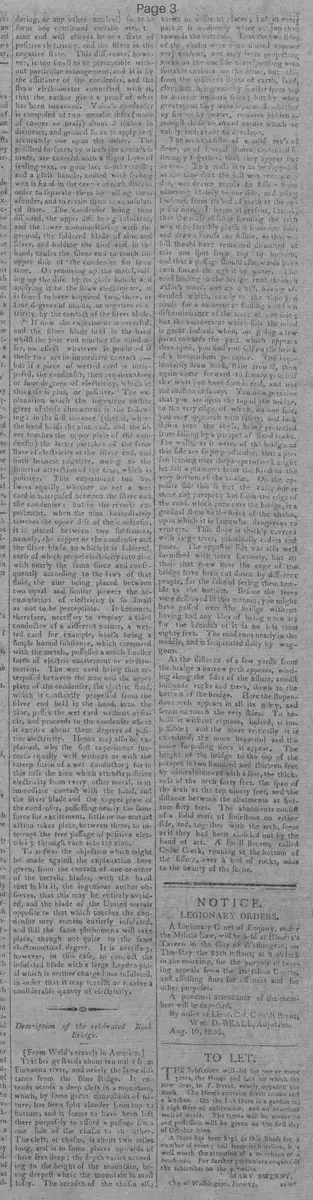
Description of the celebrated Rock
Bridge.
[From Weld's travels in America.]
This bridge stands about ten miles from
Fluvanna river, and nearly the same distance
from the Blue Ridge. It extends across
a deep cleft in a mountain,
which, by some great convulsion of nature,
has been split asunder from top to
bottom, and it seems to have been left
there purposely to afford a passage from
one side of the chasm to the other.
The cleft, or chasm, is about two miles
long, and is in some places upwards of
three hundred feet deep; the depth varies according
to the height of the mountain, being
deepest where the mountain is most
lofty. The breadth of the chasm also
varies in different places; but in every
part it is uniformly wider at top than
towards the bottom. That the two sides
of the chasm were once united appears
very evident, not only from projecting
rocks on the one side corresponding with
suitable cavities on the other, but also
from the different strata of earth, and
clay, &c. being exactly similar from top
to bottom on both sides; but by what
great agent they were separated, whether
by fire or by water, remains hidden amongst
those arcana of nature which we
vainly endeavor to develope.
The arch consists of a solid mass of
stone, or of several stones cemented strongly
together, that they appear but
as one. This mass it is to be supposed
at the time that the hill was rent asunder,
was drawn across the fissure from
adhering closely to one side, and being
opened from its bed of earth at the opposite
side. It remains at present, I think,
that the mass of stone forming the arch
was thus forcibly plucked from one side,
and drawn cross the fissure, as that vast
hill should have remained disunited at
this one spot from top to bottom,
and that a passage should afterwards have
been forced through it by water. The
road leading to the bridge runs through
a thick wood, and up a hill, having ascended
which, nearly to the top, you
pause for a moment at finding a sudden
discontinuance of the trees at one side:
but the amazement which fills the mind
is great indeed, when, on going a few
paces towards the part which appears
thus open, you find yourself on the brink
of a tremendous precipice. You involuntarily
draw back, stare around, then
again come forward to satisfy yourself
that what you have seen is real, and not
the illusion of fancy. You now perceive
that you are upon the top of the bridge
to the very edge of which, on one side,
you may approach with safety, and look
down into the abyss, being protected
from falling by a parapet of fixed rocks.
The walls, as it were, of the bridge at
this side are so perpendicular, that a person
leaning over the parapet of rock might
let fall a plummet from the hand to the
very bottom of the chasm. On the opposite
side this is not the case, nor is
there any parapet; but on the edge of
the road, which runs over the bridge, is a
gradual slope to the brink of the chasm,
upon which it is somewhat dangerous to
venture. This slope is thickly covered
with large trees, principally cedars and
pines. The opposite side was also well
furnished with trees formerly, but all
those that grew near the edge of the
bridge have been cut down by different
people, for the sake of seeing them tumble
to the bottom. Before the trees
were destroyed in this manner, you might
have passed over the bridge without
having had any idea of being upon it;
for the breadth of it is no less than
eighty feet. The road runs nearly in the
middle, and is frequented daily by wagons.
At the distance of a few yards from
the bridge a narrow path appears, winding
along the sides of the fissure, amidst
immense rocks and trees, down to the bottom
of the bridge. Here the stupendous arch
appears in all its glory, and
seems to touch the very skies. To behold
it without rapture, indeed, is impossible;
and the more critically it is
examined, the more beautiful and the
more surprising does it appear. The
height of the bridge to the top of the
parapet is two hundred and thirteen feet
by admeasurement with a line, the thickness
of the arch forty feet, the span of
the arch at the top ninety feet, and the
distance between the abutments at bottom
fifty feet. The abutments consist
of a solid mass of limestone on either
side, and, together with the arch, seem
as if they had been chiselled out by the
hand of art. A small stream, called
Cedar Creek, running at the bottom of
the fissure, over a bed of rocks, adds
to the beauty of the scene.
Bridge.
[From Weld's travels in America.]
This bridge stands about ten miles from
Fluvanna river, and nearly the same distance
from the Blue Ridge. It extends across
a deep cleft in a mountain,
which, by some great convulsion of nature,
has been split asunder from top to
bottom, and it seems to have been left
there purposely to afford a passage from
one side of the chasm to the other.
The cleft, or chasm, is about two miles
long, and is in some places upwards of
three hundred feet deep; the depth varies according
to the height of the mountain, being
deepest where the mountain is most
lofty. The breadth of the chasm also
varies in different places; but in every
part it is uniformly wider at top than
towards the bottom. That the two sides
of the chasm were once united appears
very evident, not only from projecting
rocks on the one side corresponding with
suitable cavities on the other, but also
from the different strata of earth, and
clay, &c. being exactly similar from top
to bottom on both sides; but by what
great agent they were separated, whether
by fire or by water, remains hidden amongst
those arcana of nature which we
vainly endeavor to develope.
The arch consists of a solid mass of
stone, or of several stones cemented strongly
together, that they appear but
as one. This mass it is to be supposed
at the time that the hill was rent asunder,
was drawn across the fissure from
adhering closely to one side, and being
opened from its bed of earth at the opposite
side. It remains at present, I think,
that the mass of stone forming the arch
was thus forcibly plucked from one side,
and drawn cross the fissure, as that vast
hill should have remained disunited at
this one spot from top to bottom,
and that a passage should afterwards have
been forced through it by water. The
road leading to the bridge runs through
a thick wood, and up a hill, having ascended
which, nearly to the top, you
pause for a moment at finding a sudden
discontinuance of the trees at one side:
but the amazement which fills the mind
is great indeed, when, on going a few
paces towards the part which appears
thus open, you find yourself on the brink
of a tremendous precipice. You involuntarily
draw back, stare around, then
again come forward to satisfy yourself
that what you have seen is real, and not
the illusion of fancy. You now perceive
that you are upon the top of the bridge
to the very edge of which, on one side,
you may approach with safety, and look
down into the abyss, being protected
from falling by a parapet of fixed rocks.
The walls, as it were, of the bridge at
this side are so perpendicular, that a person
leaning over the parapet of rock might
let fall a plummet from the hand to the
very bottom of the chasm. On the opposite
side this is not the case, nor is
there any parapet; but on the edge of
the road, which runs over the bridge, is a
gradual slope to the brink of the chasm,
upon which it is somewhat dangerous to
venture. This slope is thickly covered
with large trees, principally cedars and
pines. The opposite side was also well
furnished with trees formerly, but all
those that grew near the edge of the
bridge have been cut down by different
people, for the sake of seeing them tumble
to the bottom. Before the trees
were destroyed in this manner, you might
have passed over the bridge without
having had any idea of being upon it;
for the breadth of it is no less than
eighty feet. The road runs nearly in the
middle, and is frequented daily by wagons.
At the distance of a few yards from
the bridge a narrow path appears, winding
along the sides of the fissure, amidst
immense rocks and trees, down to the bottom
of the bridge. Here the stupendous arch
appears in all its glory, and
seems to touch the very skies. To behold
it without rapture, indeed, is impossible;
and the more critically it is
examined, the more beautiful and the
more surprising does it appear. The
height of the bridge to the top of the
parapet is two hundred and thirteen feet
by admeasurement with a line, the thickness
of the arch forty feet, the span of
the arch at the top ninety feet, and the
distance between the abutments at bottom
fifty feet. The abutments consist
of a solid mass of limestone on either
side, and, together with the arch, seem
as if they had been chiselled out by the
hand of art. A small stream, called
Cedar Creek, running at the bottom of
the fissure, over a bed of rocks, adds
to the beauty of the scene.
What sub-type of article is it?
Essay
What themes does it cover?
Nature
What keywords are associated?
Natural Bridge
Rock Arch
Chasm
Blue Ridge
Cedar Creek
Weld Travels
Virginia Landscape
What entities or persons were involved?
From Weld's Travels In America
Literary Details
Title
Description Of The Celebrated Rock Bridge.
Author
From Weld's Travels In America
Key Lines
This Bridge Stands About Ten Miles From Fluvanna River, And Nearly The Same Distance From The Blue Ridge.
The Cleft, Or Chasm, Is About Two Miles Long, And Is In Some Places Upwards Of Three Hundred Feet Deep;
The Height Of The Bridge To The Top Of The Parapet Is Two Hundred And Thirteen Feet By Admeasurement With A Line, The Thickness Of The Arch Forty Feet, The Span Of The Arch At The Top Ninety Feet, And The Distance Between The Abutments At Bottom Fifty Feet.
To Behold It Without Rapture, Indeed, Is Impossible; And The More Critically It Is Examined, The More Beautiful And The More Surprising Does It Appear.