Thank you for visiting SNEWPapers!
Sign up free
Portland Gazette, And Maine Advertiser
Portland, Cumberland County, Maine
What is this article about?
An opinion article in the Centinel criticizes the U.S. government's new Embargo as unprecedented, aimed at preventing self-harm through trade restriction, predicting widespread misery, starvation among the poor, and political unrest, unlike prior temporary embargoes.
Clipping
OCR Quality
Full Text
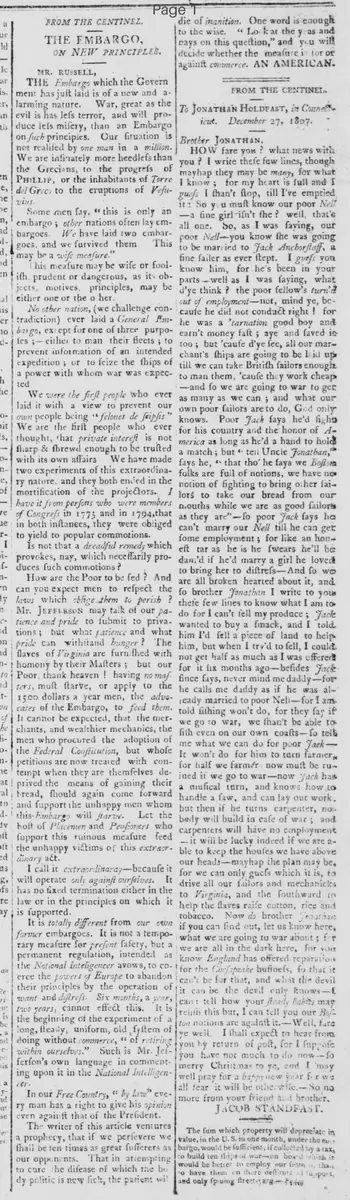
THE EMBARGO,
ON NEW PRINCIPLES.
MR. RUSSELL,
THE Embargo which the Government has just laid is of a new and alarming nature. War, great as the evil is has less terror, and will produce less misery, than an Embargo on such principles. Our situation is not realised by one man in a million. We are infinitely more heedless than the Grecians, to the progress of Philip. or the inhabitants of Torre del Grec, to the eruptions of Vesuvius.
Some men say. "this is only an embargo; other nations often lay embargoes. We have laid two embargoes, and we survived them. This may be a wise measure."
This measure may be wise or foolish. prudent or dangerous, as its objects, motives, principles, may be either one or the other.
No other nation, (we challenge contradiction) ever laid a General Embargo, except for one of three purposes ;—either to man their fleets ; to prevent information of an intended expedition ; or to seize the ships of a power with whom war was expected.
We were the first people who ever laid it with a view to prevent our own people being "felones de seipsis"
We are the first people who ever thought, that private interest is not sharp & shrewd enough to be trusted with its own affairs. We have made two experiments of this extraordinary nature, and they both ended in the mortification of the projectors. I have it from persons who were members of Congress in 1775 and in 1794,that in both instances, they were obliged to yield to popular commotions.
Is not that a dreadful remedy which provokes, nay, which necessarily produces such commotions?
How are the Poor to be fed ? And can you expect men to respect the laws which oblige them to perish ?
Mr. Jefferson may talk of our patience and pride to submit to privations; but what patience and what pride can withstand hunger? The slaves of Virginia are furnished with homony by their Masters; but our Poor, thank heaven ! having no masters, must starve, or apply to the 1500 dollars a year men, the advocates of the Embargo, to feed them.
It cannot be expected, that the merchants, and wealthier mechanics, the men who procured the adoption of the Federal Constitution, but whose petitions are now treated with contempt when they are themselves deprived the means of gaining their bread, should again come forward and support the unhappy men whom this Embargo will starve. Let the host of Placemen and Pensioners who support this ruinous measure feed the unhappy victims of this extraordinary act.
I call it extraordinary—because it will operate only against ourselves. It has no fixed termination either in the law or in the principles on which it is supported.
It is totally different from our former embargoes. It is not a temporary measure for present safety, but a permanent regulation, intended as the National Intelligencer avows, to coerce the powers of Europe to abandon their principles by the operation of want and distress. Six months, a year, two years, cannot effect this. It is the beginning of the experiment of a long, steady uniform, old system of doing without commerce, "of retiring within ourselves." Such is Mr. Jefferson's own language in commenting upon it in the National Intelligencer.
In our Free Country, "by law" every man has a right to give his opinion even against that of the President.
The writer of this article ventures a prophecy, that if we persevere we shall be ten times as great sufferers as our opponents. That in attempting to cure the disease of which the body politic is now sick, the patient will die of inanition. One word is enough to the wise. "Look at the yeas and nays on this question," and you will decide whether the measure is for or against commerce.
AN AMERICAN:
What sub-type of article is it?
What keywords are associated?
What entities or persons were involved?
Domestic News Details
Key Persons
Outcome
predicted starvation among the poor, popular commotions, economic distress, and death by inanition for the body politic.
Event Details
Criticism of the recent U.S. government Embargo as unprecedented, intended to prevent self-harm by restricting trade, differing from prior embargoes in 1775 and 1794 which ended due to commotions; warns of misery, hunger, and loss of support from merchants and mechanics.