Thank you for visiting SNEWPapers!
Sign up free
The National Intelligencer And Washington Advertiser
Washington, District Of Columbia
What is this article about?
In a December 8 House debate, Mr. Desha defends the embargo as vital against British and French aggressions, criticizing its opponents as unpatriotic and urging alternatives like non-intercourse to preserve U.S. independence and honor without rushing to war.
Clipping
OCR Quality
Full Text
DEBATE ON FOREIGN RELATIONS
[CONTINUED.]
December 8.
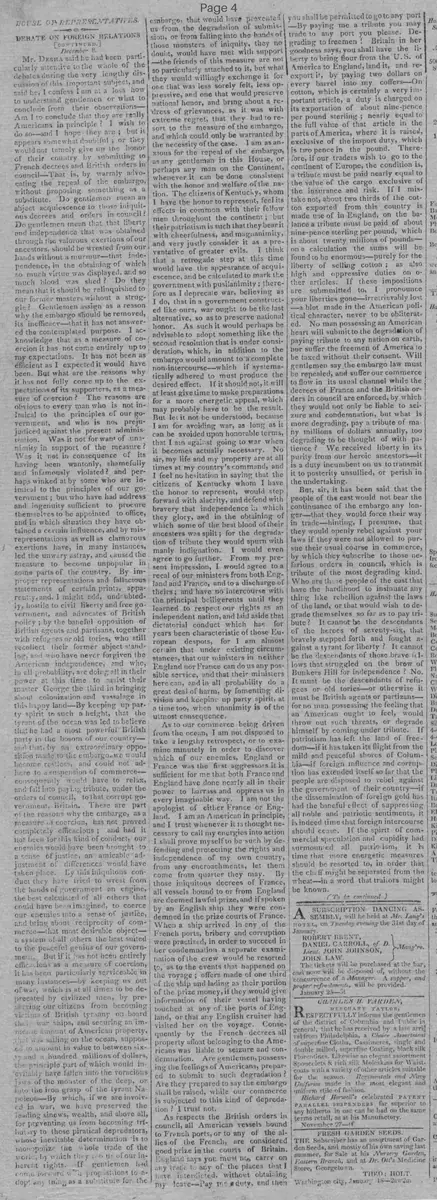
Mr. Desha said he had been particularly attentive to the whole of the debates during the very lengthy discussion of this important subject, and said he, I confess I am at a loss how to understand gentlemen or what to conclude from their observations-- Am I to conclude that they are really Americans in principle? I wish to do so--and I hope they are; but it appears somewhat doubtful; or they would not tamely give up the honor of their country by submitting to French decrees and British orders in council That is, by warmly advocating the repeal of the embargo, without proposing something as a substitute. Do gentlemen mean an abject acquiescence to those iniquitous decrees and orders in council? Do gentlemen mean that that liberty and independence that was obtained through the valorous exertions of our ancestors, should be wrested from our hands without a murmur-that independence, in the obtaining of which so much virtue was displayed, and so much blood was shed? Do they mean that it should be relinquished to our former masters without a struggle? Gentlemen assign as a reason why the embargo should be removed, its inefficacy-that it has not answered the contemplated purpose. I acknowledge that as a measure of coercion it has not come entirely up to my expectations. It has not been as efficient as I expected it would have been. But what are the reasons why it has not fully come up to the expectations of its supporters, as a measure of coercion? The reasons are obvious to every man who is not inimical to the principles of our government, and who is not prejudiced against the present administration. Was it not for want of unanimity in support of the measure? Was it not in consequence of its having been wantonly, shamefully and infamously violated? and perhaps winked at by some who are inimical to the principles of our government; but who have had address and ingenuity sufficient to procure themselves to be appointed to office, and in which situation they have obtained a certain influence, and by misrepresentations as well as clamorous exertions have, in many instances, led the unwary astray, and caused the measure to become unpopular in some parts of the country. By improper representations and fallacious statements of certain prints, apparently, and, I might add, undoubtedly, hostile to civil liberty and free government, and advocates of British policy; by the baneful opposition of British agents and partisans, together with refugees or old tories, who still recollect their former abject standing, and who have never forgiven the American independence, and who, in all probability, are doing all in their power at this time to assist their master George the third in bringing about colonization and vassalage in this happy land--By keeping up party spirit to such a height, that the tyrant of the ocean was led to believe that he had a most powerful British party in the bosom of our country— and that, by an extraordinary opposition made to the embargo. we would become restless, and could not adhere to a suspension of commerce-- consequently would have to relax, and all into paying tribute, under the orders of council, to that corrupt government, Britain. These are part of the reasons why the embargo, as a measure of coercion, has not proved completely efficacious; and had it not been for this kind of conduct, our enemies would have been brought to a sense of justice, an amicable adjustment of differences would have taken place. By this iniquitous conduct they have tried to wrest from the hands of government an engine, the best calculated of all others that could have been imagined, to coerce our enemies into a sense of justice, and bring about reciprocity of commerce-that most desirable object- a system of all others the best suited to the peaceful genius of our government. But if it has not been entirely efficacious as a measure of coercion, it has been particularly serviceable in many instances--by keeping us out of war, which is at all times to be deprecated by civilized men, by preserving our citizens from becoming victims of British tyranny on board their war ships, and securing an immense amount of American property, about sailing on the ocean, supposed to amount in value to between sixty and a hundred millions of dollars, the principal part of which would inevitably have fallen into the voracious jaws of the monster of the deep, or into the iron grasp of the tyrant Napoleon--By which, if we are involved in war, we have preserved the leading sinews, wealth, and above all, for preventing us from becoming tributary to those piratical depredators, whose inevitable determination is to monopolize the whole trade of the world, by which they rob us of our inherent rights. If gentlemen had come forward with propositions to adopt any thing as a substitute for the embargo, that would have prevented us from the degradation of submission, or from falling into the hands of those monsters of iniquity, they no doubt, would have met with support —the friends of this measure are not so particularly attached to it, but what they would willingly exchange it for one that was less sorely felt, less oppressive, and one that would preserve national honor, and bring about a redress of grievances, as it was with extreme regret, that they had to resort to the measure of the embargo, and which could only be warranted by the necessity of the case. I am as anxious for the repeal of the embargo as any gentleman in this House, or perhaps any man on the Continent, whenever it can be done consistent with the honor and welfare of the nation. The citizens of Kentucky, whom I have the honor to represent, feel its effects in common with their fellow men throughout the continent; but their patriotism is such that they bear it with cheerfulness, and magnanimity, and very justly consider it as a preventative of greater evils. I think that a retrograde step at this time would have the appearance of acquiescence, and be calculated to mark the government with pusillanimity; therefore as I deprecate war, believing as I do, that in a government constructed like ours, war ought to be the last alternative, so as to preserve national honor. As such it would perhaps be advisable to adopt something like the second resolution that is under consideration, which, in addition to the embargo would amount to a complete non-intercourse--which if systematically adhered to must produce the desired effect. If it should not, it will at least give time to make preparations for a more energetic appeal, which may probably have to be the result. But let it not be understood, because I am for avoiding war, as long as it can be avoided upon honorable terms, that I am against going to war when it becomes actually necessary. No sir, my life and my property are at all times at my country's command, and I feel no hesitation in saying that the citizens of Kentucky whom I have the honor to represent, would step forward with alacrity, and defend with bravery that independence in which they glory, and in the obtaining of which some of the best blood of their ancestors was spilt; for the degradation of tribute they would spurn with manly indignation. I would even agree to go further. From my present impression, I would agree to a recall of our ministers from both England and France, and to a discharge of theirs; and have no intercourse with the principal belligerents until they learned to respect our rights as an independent nation, and laid aside that dictatorial conduct which has for years been characteristic of those European despots, or I am almost certain that under existing circumstances, that our ministers in neither England nor France can do us any possible service, and that their ministers here can, and in all probability do a great deal of harm, by fomenting division and keeping up party spirit, at a time too, when unanimity is of the utmost consequence. As to our commerce being driven from the ocean, I am not disposed to take a lengthy retrospect, or to examine minutely in order to discover which of our enemies, England or France was the first aggressor it is sufficient for me that both France and England have done nearly all in their power to harass and oppress us in every imaginable way. I am not the apologist of either France or England. I am an American in principle, and I trust whenever it is thought necessary to call my energies into action I shall prove myself to be such by defending and protecting the rights and independence of my own country, from any encroachments, let them come from quarter they may. By those iniquitous decrees of France, all vessels bound to or from England are deemed lawful prize, and if spoken by an English ship they were condemned in the prize courts of France. When a ship arrived in any of the French ports, bribery and corruption were practised, in order to succeed in her condemnation a separate examination of the crew would be resorted to, as to the events that happened on the voyage; offers made of one third of the ship and lading as their portion of the prize money, if they would give information of their vessel having touched at any of the ports of England, or that any English cruiser had visited her on the voyage. Consequently by the French decrees all property afloat belonging to the Americans was liable to seizure and condemnation. Are gentlemen, possessing the feelings of Americans, prepared to submit to such degradation? Are they prepared to say the embargo shall be raised, while our commerce is subjected to this kind of depredation? I trust not. As respects the British orders in council, all American vessels bound to French ports, or to any of the allies of the French, are considered good prize in the courts of Britain. England says you must no carry on any trade to any of the places that I have interdicted, without obtaining my leave-Pay me a duty, and then you shall be permitted to go to any port —By paying me a tribute you may trade to any port you please. Degrading to freemen! Britain in her goodness says, you shall have the liberty to bring flour from the U.S. of America to England, land it, and re-export it, by paying two dollars on every barrel into my coffers-On cotton, which is certainly a very important article, a duty is charged on its exportation of about nine-pence per pound sterling; nearly equal to the full value of that article in the parts of America, where it is raised, exclusive of the import duty, which is two pence in the pound. Therefore, if our traders wish to go to the continent of Europe, the condition is, a tribute must be paid nearly equal to the value of the cargo exclusive of the insurance and risk. If I mistake not, about two thirds of the cotton exported from this country is made use of in England, on the balance a tribute must be paid of about nine-pence sterling per pound, which is about twenty millions of pounds— on a calculation the sums will be found to be enormous--purely for the liberty of selling cotton; as also high and oppressive duties on other articles. If these impositions are submitted to, I pronounce your liberties gone—irretrievably lost -a blot made in the American political character, never to be obliterated. No man possessing an American heart will submit to the degradation of paying tribute to any nation on earth, nor suffer the freemen of America to be taxed without their consent. Will gentlemen say the embargo law must be repealed, and suffer our commerce to flow in its usual channel while the decrees of France and the British orders in council are enforced, by which they would not only be liable to seizure and condemnation, but what is more degrading, pay a tribute of many millions of dollars annually, too degrading to be thought of with patience? We received liberty in its purity from our heroic ancestors—it is a duty incumbent on us to transmit it to posterity unsullied, or perish in the undertaking. But, sir, it has been said that the people of the east would not bear the continuance of the embargo any longer—that they would force their way in trade-hinting, I presume, that they would openly rebel against your laws if they were not allowed to pursue their usual course in commerce, by which they subscribe to those nefarious orders in council, which is tribute of the most degrading kind. Who are these people of the east that have the hardihood to insinuate any thing like rebellion against the laws of the land, or that would wish to degrade themselves so far as to pay tribute? It cannot be the descendants of the heroes of seventy-six, that bravely stepped forth and fought against a tyrant for liberty? It cannot be the descendants of those brave fellows that struggled on the brow of Bunkers Hill for independence? No. It must be the descendants of refugees or old tories-or otherwise it must be British agents or partisans— for no man possessing the feeling that an American ought to feel, would throw out such threats, or degrade himself by coming under tribute. If patriotism has left the land of freedom-if it has taken its flight from the mild and peaceful shores of Columbia-if foreign influence and corruption has extended itself so far that the people are disposed to rebel against the government of their country-if the dissemination of foreign gold has had the baneful effect of suppressing all noble and patriotic sentiments, it is indeed time that foreign intercourse should cease. If the spirit of commercial speculation and cupidity had surmounted all patriotism, it is time that more energetic measures should be resorted to, in order that the chaff might be separated from the wheat--in a word that traitors might be known.
(To be continued)
What sub-type of article is it?
What themes does it cover?
What keywords are associated?
What entities or persons were involved?
Where did it happen?
Story Details
Key Persons
Location
House Of Representatives
Event Date
December 8
Story Details
Mr. Desha defends the embargo in a debate on foreign relations, arguing against its repeal without a substitute to avoid submission to French decrees and British orders in council. He attributes the embargo's limited efficacy to opposition by British agents, tories, and internal divisions. He praises the embargo for preventing war, protecting property, and preserving independence, urging non-intercourse or minister recalls if needed, and affirms readiness for war to defend national honor.