Thank you for visiting SNEWPapers!
Sign up free
The Enquirer
Richmond, Henrico County, Virginia
What is this article about?
The House of Delegates debated and passed a bill enabling stays of execution on money judgments via bonds, addressing economic relief. Key objection to section 7 on constitutional grounds. Passed 109-54; proceeds to Senate. Act temporary until next assembly.
Clipping
OCR Quality
Full Text
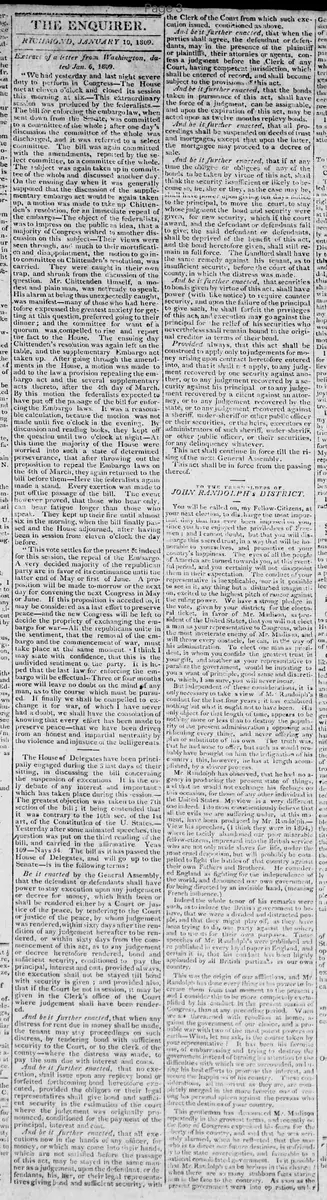
Be it enacted by the General Assembly, that the defendant or defendants shall have power to stay execution upon any judgement or decree for money, which hath been or shall be rendered either by a Court or justice of the peace, by tendering to the Court or justice of the peace, by whom judgement was rendered, within sixty days after the rendition of any judgement hereafter to be rendered, or within sixty days from the Commencement of this act, as to any judgement or decree heretofore rendered, bond and sufficient security, conditioned to pay the principal, interest and cost, provided always, the execution shall not be stayed till bond with security is given; and provided also, that if the Court be not in session, it may be given in the Clerk's office of the Court where judgement shall have been rendered.
And be it further enacted, that when any distress for rent due in money shall be made, the tenant may stay proceedings on such distress, by tendering bond with sufficient security to the Court, or to the clerk of the county—where the distress was made, to pay the sum due with interest and costs.
And be it further enacted, that no execution, shall issue upon any replevy bond or forfeited forthcoming bond heretofore executed, provided the obligors or their legal representatives shall give bond and sufficient security in the estimation of the court where the judgement was originally pronounced, conditioned for the payment of the principal, interest and cost.
And be it further enacted, that all executions now in the hands of any officer, for money, or which may come into their hands, which are not satisfied before the passage of this act, may be stayed in the same manner as a judgement, upon the defendant, or defendants, his, her, or their legal representatives giving bond and sufficient security, with the Clerk of the Court from which such execution issued, conditioned as above.
And be it further enacted, that when the parties shall agree, the defendant or defendants, may in the presence of the plaintiff or plaintiffs, their attornies or agents, confess a judgement before the Clerk of any Court, having competent jurisdiction, which shall be entered of record, and shall become subject to the provisions of this act.
And be it further enacted, that the bonds taken in pursuance of this act, shall have the force of a judgment, can be assignable, and upon the expiration of this act, may be acted upon as twelve months replevy bonds.
And be it further enacted, that all proceedings shall be suspended on deeds of trust and mortgages, except that upon the latter, the mortgagee may proceed to a decree of sale.
And be it further enacted, that if at any time the obligee or obligees of any of the bonds to be taken by virtue of this act, shall think the security insufficient or likely to become so, he, she or they, as the case may be, shall have power upon giving ten days notice to the principal, to move the court, whose judgement the bond and security were given, for new security, which if the court award, and the defendant or defendants fail to give; the said defendant or defendants, shall be deprived of the benefit of this act, and the bond heretofore given, shall still remain in full force. The Landlord shall have the same remedy against his tenant, as to insufficient security, before the court of that county, in which the distress was made.
And be it further enacted, that securities to bonds given by virtue of this act, shall have power (with like notice) to require counter security, and upon the failure of the principal to give such, he shall forfeit the privileges of this act, and execution may go against the principal for the relief of his securities who nevertheless shall remain bound to the original creditor in terms of their bond.
Provided always, that this act shall be construed to apply only to judgements for money arising upon contract heretofore entered into, and that it shall not apply, to any judgement recovered by one security against another, or to any judgement recovered by a security against his principal, or to any judgement recovered by a client against an attorney, or to any judgement recovered by the state, or to any judgement recovered against a sheriff, under-sheriff or other public officer or their securities, or the heirs, executors or administrators of such sheriff, under-sheriff or other public officer, or their securities, for any delinquency whatever.
This act shall continue in force till the rising of the next General Assembly.
This act shall be in force from the passing thereof.
What sub-type of article is it?
What keywords are associated?
Domestic News Details
Event Date
During The Last Days Of Their Sitting, Yesterday
Outcome
the bill passed the house of delegates with yeas 109—nays 54 and will go up to the senate.
Event Details
The House of Delegates discussed a bill concerning the suspension of executions, focusing on the 7th section's potential conflict with the U.S. Constitution. After animated speeches, the bill passed on its third reading. The bill allows defendants to stay executions on money judgments by tendering bond and security within specified timeframes, with provisions for rent distress, replevy bonds, ongoing executions, confessed judgments, bond forces, suspensions on deeds and mortgages, remedies for insufficient security, and securities' rights. It applies only to certain money judgments from contracts and lasts until the next General Assembly.