Thank you for visiting SNEWPapers!
Sign up free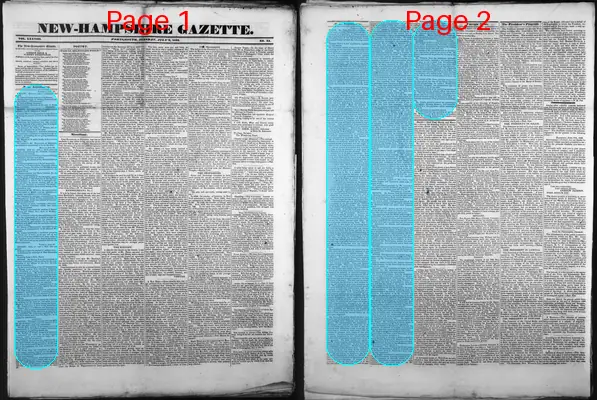
The New Hampshire Gazette
Portsmouth, Rockingham County, New Hampshire
What is this article about?
Proceedings of the New Hampshire Legislature from June 22-27, including passage of bills on highways, courts, incorporations, and appropriations for educating deaf, dumb, blind children ($2000); debates on public lands distribution (rejected), vote laws, bounties, and court moves; committee reports on banks and petitions.
Merged-components note: Continuation of N.H. Legislature proceedings across pages 1 and 2.
Clippings

1 of 2
OCR Quality
Full Text
Saturday, June 22.
SENATE.
Bills, &c, read a third time and passed.
To prevent encroachments on highways;
Altering the times of holding Probate Courts in the County of Hillsborough;
In favor of Elijah Carpenter;
Directing the collection of the note of Moses Foss and others.
Adjourned.
HOUSE. On report of the committee on the Judiciary, by Mr. Stevens of Mason.
Resolved, That it is inexpedient to alter the laws regulating the returns of votes to the Secretary's office.
Mr. Hutchinson, from the committee to report at what time the legislature may rise, reported that the business of the session may be completed by the 28th day of this month.
On motion of Mr. Colby, of Warner, the report was ordered to lie on the table.
Mr. Tufts introduced a resolution instructing the committee on Finance to inquire into the expediency of repealing the act giving bounties on crows and foxes.
Mr. Sawyer of S. spoke briefly in favor of the inquiry; but,
On motion of Mr. Wentworth, of Sandwich, the resolution was ordered to lie on the table.
Monday, June 24.
HOUSE. Bills &c. read a third time and passed.—Incorporating the Cheshire Provident Institution for savings.
Altering the time of holding Courts of Probate in Deerfield, Chester and Derry.
Amending the charter of the Brookfield Social Library.
Incorporating the Learned Relief association.
Granting to Hampton Falls, Newcastle, Centre Harbour, Temple, Brookline and Middleton, each the privilege of sending a representative to the General Court.
Classing Jackson and Harts Location for the choice of a representative.
On the third reading of the resolution appropriating $1500 to the education of the deaf and dumb children, it was on Mr. Livermore's motion, put upon its second reading, and on his motion was amended by inserting "the blind,"
so as to entitle blind children to the benefit of the appropriation, and
On motion of Mr. Waldron, the appropriation was increased to $2000—and the resolution, as amended was ordered to a third reading.
The Governor by message, communicated the annual report of James Willey, commissioner of the public lands, which was referred to the committee on public lands.
Mr. Harvey, on leave, introduced a bill incorporating Sutton Academy—which was twice read and committed.
Mr. Tibbetts presented the petition of Daniel Pickering and others, for a bank in Wolfeborough; referred.
Mr. Livermore called up the resolution providing for the appointment of an agent to make inquiries as to the hospitals for the insane,—the blank making an appropriation for the expense, was filled with $300—and the resolution ordered to a third reading.
Mr. Martin of Somersworth, was added to the committee of arrangements in the place of Mr. Kimball.
Mr. Angier introduced a resolution directing the Clerk not to make up the pay roll of any member, till he has certified how many miles he has travelled, and how many days he has attended.
But before taking any question thereon, the House adjourned.
Tuesday, June 25.
SENATE. Bills, &c. read a third time and passed.
Relating to fines for neglect of military duty;
Authorizing the exchange of New-Hampshire Reports;
Granting lands to Sally Hayes.
HOUSE. Mr. Harvey from the committee on Finance introduced a bill providing for the compensation of the officers of the civil list [the same as heretofore.
On the second reading of the bill incorporating the Mutual Loudon Fire Insurance Company.
Mr. Woodbury of Antrim moved to strike out the enacting clause. Mr. Porter doubted the expediency of incorporating town societies of this kind; but wished the House to decide the question. After some remarks by Messrs. Livermore and Porter, the motion prevailed, and the bill was refused a third reading, and rejected.
Mr. Oliver presented a remonstrance of the students of Dartmouth College against the petition of John Durkee and others.
Mr. Page from the committee on public lands reported a resolution that it is not expedient to legislate on the subject of a division of the proceeds of the sale of the public lands of the United States.
Mr. Livermore moved to amend the resolution by striking out the word not, and spoke at some length in favor of a division among the States.
Mr. Rogers spoke in favor of the amendment.
Messrs. Gove of Goffstown and Brownson opposed it.—The proposed amendment was rejected.
On the passage of the resolution as reported by the committee, Mr. Livermore required the Yeas and Nays which were Yeas 151, Nays 51; so the resolution was adopted.
HOUSE. The resolution appropriating $2000 for the education of the deaf and dumb or of the blind, was read a third time and passed.
On the third reading of the resolution for the appointment of an agent to inspect hospitals for the insane in neighboring States, &c.
Mr. Hadley, of Weare, moved it be indefinitely postponed, and called for the yeas and nays thereon, which were—yeas, 54—nays, 105—so the resolution did not prevail.
Mr. Aldrich moved that the resolution lie on the table—which did not prevail, 73 rising in favor of the motion and 92 against it; on the passing of the resolution, 101 rose in its favor and 99 against it.
Mr. Porter from the committee on bills on their second reading, reported the bill annexing a part of Warner to Bradford, with amendments, which were adopted.
Mr. Colby, of Warner, moved that the bill be indefinitely postponed; which, after a long debate in which Messrs. Colby, Sawyer, of Swan zey, Rogers, and Brownson were the speakers, was decided in the affirmative—yeas, 15—nays, 33.
HOUSE.
Tuesday, June 25.
Mr. Page, from the committee on public lands, to whom had been referred the resolutions of the Legislature of Massachusetts, in favor of a distribution of the proceeds of the sale of the public lands of the United States among the several States reported the following resolution.
Resolved, That it is not expedient to legislate upon that subject.
Mr. Livermore moved to amend the resolution by striking out the word not. He remarked that he had given as much of his attention to the subject as his other avocations would permit and he had come to a conclusion diametrically opposed to that of the committee. He had no doubt that they had investigated the subject, and expressed their honest opinion upon it, in the resolution under consideration. As the subject was of importance to the State and to the United States, it was desirable that those who thus differed in opinion should commune together and communicate to each other their feelings and their views. In moving to amend the resolution, he did not propose any act of special legislation but he did think it advisable that the Legislature should express their opinion upon a question which had for a long time engaged the attention of Congress and thus aid in effecting such a decision as would promote the interests of the State and the country.
The question is on the expediency of dividing among the States in some just proportion the proceeds of the sale of public lands. And to whom do these lands belong? None denied that they were the property of the United States. The jurisdiction and the territory was fairly and indispitably theirs—theirs by treaty and by purchase. The States are equally interested in these lands: and how shall they be disposed of for their greatest benefit? Shall the proceeds of their sale be cast into the Treasury, and be applied to the general purposes of the government; or shall they be divided among the several States in proportion to their representation in Congress.
He was and had for the last ten or twelve years been decidedly of opinion that they ought to be divided. Governor Dickerson of New-Jersey had taken the lead in Congress upon this question and had long uniformly and earnestly urged a division. Other members of Congress were in favor of applying the proceeds of sale to purposes of Internal Improvement. Should this application be made, the West might be benefitted by it at the expense of New-England. Without considering the constitutionality of appropriations for internal improvement he was opposed to such a disposition of the public lands.
Mr. L. said it had been suggested from high authority—an authority which he as sincerely respected as that of any man, that we ought no longer to look to these lands, as a source of revenue; and an opinion is intimated that at no distant time it may be advisable to cede them to the States in which they are situated. This did not seem to him to be just or expedient. New-Hampshire has as much interest in these lands as any other State and he had no wish that the time should come when her interests should be gratuitously surrendered to another. The conditions on which the territory was ceded to us have been complied with. We have done all that could reasonably be claimed or expected of us towards extinguishing the Indian titles. Gen. Jackson had labored for it with a praiseworthy earnestness, and it was to Mr. L. a matter of regret that for these his labors he had been so grossly abused. But as to the contemplated grant of the public lands to the States in which they lie, he could not agree with the President. And when an occasion called for his action on the question, or the expression of his opinion on the subject he should express that opinion with all freedom and act upon it with that independence which became a freeman and the representative of freemen.
It has been urged by some that if the proceeds of sale go into the national Treasury they will be expended for the benefit of all and each state will thus receive its proportion of the amount. He believed if it got into the Treasury, but a little of it would afterwards get into New-Hampshire. The expenses of our government are defrayed principally by our import duties. The revenue from this source will probably always be sufficient for this purpose. If not the Tariff may, after the expiration of ten years, be so modified as to meet the wants of the government. Whether the product of the sales be divided, or thrown into the Treasury, the Tariff will remain as it is.— Gentlemen who choose to dress in foreign cloths, must pay the duties imposed upon them. He had no objection to their paying them. But for us, said Mr. L. who aspire to be nothing better than husbandmen—and he did not perceive how we could be any thing better—who are clothed from our own fields and flocks, and fed on the products of our own soil, the tariff should give us but little trouble, as it makes upon us but trifling exactions. We may feel something of it, to be sure, when we sip our tea or our coffee, or the beverage that maketh glad the heart of man; but that beverage is growing less and less in demand and the sooner we dispense with our luxuries the sooner shall we rid ourselves of all these exactions.
He considered it of much importance that the public lands should speedily be disposed of, and the avails secured to the rightful owners. Unless this is done speedily, it will probably never be effected. The western States are increasing daily in population and power. They will ere long have a commanding and resistless influence in our national councils. They may become forgetful of right. They may become violent in their strength. And we have been forewarned that "the violent man taketh by force."
Let us act with deliberation, but with decision. A share of the property in question belongs to us rightfully and might be appropriated beneficially. We have at this session loud calls upon our sympathies and powerful appeals to the best affections of the heart. The deaf and the dumb, the insane and the blind are in their distress before us, and asking for protection, education and aid. We might grant their petitions and gratify our better feelings, and communicate light and happiness to these suffering classes of our citizens, if our own rights were recognized and our own property placed at our own disposal. He asked that our rights should not be forgotten and our interests disregarded; and he hoped that the legislature would do all in its power to secure to the State the powers and privileges and property which unquestionably belonged to it. He intended if the amendment which he had proposed should be adopted to introduce a further resolution, instructing our Senators and requesting their influence to procure the distribution of the sales of land, among the several States on the principles suggested.
Mr. Gove of G. said he should not enter very largely into the discussion of the question which the gentleman from Campton was disposed to agitate. He acknowledged the importance of the subject, not only to this state but to the United States, and he felt too that it was surrounded with difficulties which it was not perfectly easy to obviate or brush away.—We are owners, in common with others, of this great property. We have committed its management to agents recognized by the Constitution, and clothed with all necessary powers to act for us in the premises. We have chosen our agents—men in whose integrity, and patriotism, and prudence we may safely trust. It was their duty to investigate this subject. He had no doubt of their disposition and ability to do it. They have means, which we as a body do not possess, of forming an opinion and coming at a proper result. He was willing to leave it in the hands where the Constitution placed it. He did not feel competent to instruct our Senators and Representatives upon this point. If obliged to express his opinion he was not prepared to say that our public lands should be sold and the purchase money scattered abroad. As at present advised he would recommend that the proceeds of the sales should go into the treasury and. in the discharge of our common obligations and ordinary and necessary expenses. He was too dull of apprehension to perceive the benefit of claiming our proportion of this money that we might immediately return it in payment of taxes to the treasury from which it came. We might strut about for a day with the cash in our pockets—but having expended it or necessaries or luxuries, for tea, or coffee, or the juice of the grape—even that juice would fail to gladden our hearts when the collectors should call upon us to refund what we had received and perhaps improvidently expended. He did not see much difference between raising a revenue by direct taxation and by the tariff." In either case the money was paid by the people. The tariff was more unequal in its operation and less conformable to the spirit of the Constitution which declared that all taxes should be equal. He did not hold, as many appeared to hold, that they were the wisest statesmen who most artfully and effectually imposed upon and cheated the people. The people had no disposition to be cheated, and they are now looking at this subject too earnestly to be easily imposed upon. As to internal improvements the ruinous doctrines which have been fashionable with some men in power or aiming at power have received their death blow. Our excellent Chief Magistrate whom the gentleman from Campton so highly respects, has put a veto upon them which they cannot survive. During his administration at least there is no danger on that score. The time has been when we had reason to fear. We have now abundant reason to rejoice and be glad.
The gentleman has told us truly that those lands were ceded to the United States upon certain conditions. They are pledged and we have no right to dispose of them till the pledge is removed. The nett amount of sales is not so great as may have been supposed. After defraying the expense of surveys, of land agencies, the extinguishment of the Indian title, and the expenses of the Indian department the sum to be divided among the States, would not make the recipients so rich as had been imagined. But until we have fulfilled our part of the contract we have no right to the full enjoyment of its benefit. The debts of the nation are not fully paid; the expenses of the government, without recourse to the public lands are not fully provided for; the Indians are not removed beyond the Mississippi; and their title to these very lands is not yet extinguished. Until these objects are accomplished, we have no occasion to exercise our ingenuity in devising ways and means to get rid of our treasure. We have none to spare—no surplus to divide. Mr. G. was not at all desirous that Congress should follow the example of New-Hampshire in the distribution of the literary fund. In an evil hour we scattered that fund abroad and have lost the honor and the benefit which it might have secured us.
He believed the people regretted the measure but it is too late to revoke it. It should serve as a beacon and not as an example. He could not commend it to the imitation of Congress. Believing that the administration of our national government was in safe and proper hands, and reposing just confidence in their wisdom, he would not assume to instruct them in their duty: but would leave it to them to act upon the subject under consideration according to the dictates of their own judgment. He was therefore opposed to the amendment of the gentleman from Campton, and fully agreed with the committee on public lands, that it is not expedient to legislate on the subject.
Mr. Livermore replied to Mr. Gove, and Messrs. Rogers and Brownson made some remarks, when,
The amendment proposed by Mr. Livermore was rejected, and the resolution proposed by the committee was adopted—yeas 151, nays 51.
Wednesday, June 26.
SENATE. Mr. Drown, from the Committee on Banking Institutions, reported the bills incorporating the Rochester Bank, and the Mechanic's Bank at Concord, without amendment.
On motion of Mr. Farrington, the rule of the Senate was suspended and the bill to incorporate the Rochester Bank was read a third time and passed,
On motion of Mr. Barton, the bill to incorporate the Mechanic's Bank of Concord was read a third time (the rule suspended) and passed.
The resolution from the House authorizing the appointment of an agent to visit the Insane hospitals and collect information, and the resolution appropriating $2000 for educating the deaf dumb or blind, were read a second time and referred to the committee on schools and seminaries of learning:
The act changing the times of holding certain probate courts in the county of Rockingham, the act to establish the Sullivan manufacturing company at Claremont, the act to establish the Learned relief association at Hopkinton, the act to establish a corporation by the name of the Peterborough company, the act in addition to an act to establish the Rockingham mutual fire insurance company, were severally read a third time and passed.
The bills incorporating the Union Manufacturing company, and incorporating the Portsmouth marine rail-way company were read a third time and passed.
HOUSE. Bills introduced and passed stages—
Incorporating the Franklin savings bank in Hopkinton; by Mr. Waldron from the committee on banks.
Making towns liable for the funeral expenses of their paupers; by Mr. Gove from the committee on the judiciary.
On report of the committee on banks by Mr. Waldron, the bill incorporating the Jackson bank was postponed to the next session.
Mr. Gove of Grantham, from the delegation of the County of Sullivan, reported on the petitions and remonstrances of that county, relating to the removal of the courts from Newport to Claremont. that they be postponed to next session, and that the sense of the people be taken on the subject at the annual meeting.
Mr French moved that the resolution be indefinitely postponed. And after making some remarks relating to the history of their location, in which he was replied to by Mr. Clement the question was decided by yeas and nays on the call of Mr. French, in the negative, Yeas 49, Nays 106.
Mr. Currier of Chester, from the delegation of the County of Rockingham, to which had been referred the bill to remove the Courts from Exeter to Chester, reported a resolution that it is not expedient to legislate upon the subject.
Mr. Currier said that in introducing this resolution, he had performed the duty which he owed to the committee, and, in discharge of the duty which he owed to his constituents and the public, he would now move to amend the resolution by striking out the word "not." He supported the motion at some length, and was replied to, by Mr. Rogers. Mr. Woodbury of Salem, spoke in favor of the motion and Mr. Dow against it.
Mr. Batchelder of Hampstead, moved that the resolution be referred to a select committee of five, and that they report by bill or otherwise.
Mr. Rogers moved the indefinite postponement of the subject, but after a brief discussion of the effect of the motion, withdrew it.
On the motion to commit, a debate ensued in which Messrs, Sawyer of S. Currier of C. Harvey Woodbury of S. Porter and Colby participated and it was decided in the affirmative, 84 rising in favor, and 73 against it.
Afternoon. The bills from the Senate incorporating the Mechanic's bank in Concord, and the Rochester bank in Rochester—were twice read and committed.
Mr. Peaslee introduced a resolution appropriating $10,000 towards erecting a Hospital for the insane, whenever a like sum should be subscribed by individuals or corporations for the same purpose—which was twice read and on Mr. Peaslee's motion, laid upon the table.
Mr. Patterson on leave introduced a bill exempting potatoes necessary for family use, and two bushels of corn or meal from attachment and execution—which was twice read and committed.
Mr. Currier of C. called up the bill incorporating the Massabesic canal.
Mr. Atwood moved that it be postponed to the next session. Messrs. Carrier and Porter opposed the motion, and it was decided in the negative and the bill ordered to a third reading.
HOUSE.
Thursday June 27.
Mr. Sawyer of Dover, from the select committee on a new division of the State into Districts for the choice of Senators, reported a bill making such division which was read, and
On motion of Mr. Livermore laid on the table; and it was further ordered, on motion of Mr. McDaniel, that said bill be printed for the use of the House.
Mr. Tibbetts from the committee on roads, bridges and canals, reported a bill incorporating a company to cut a canal from Winnepisiogee Lake to Sanbornton Bay—which was twice read and referred to the committee on the Judiciary.
The same committee reported a bill relating to Hawkers and Pedlers, imposing a fee of $20, for a license, and requiring it to be recorded in every town wherein they should trade—which bill was on Mr. McDaniel's motion ordered to lie on the table.
On motion of Mr. Gove, previous notice having been given, the vote of the House rejecting the bill incorporating the Loudon Mutual Fire Insurance Company, was reconsidered and the bill ordered to lie on the table.
The consideration of the resolutions introduced by the committee on military affairs was resumed. The 4th resolution requires the payment of 2 per year from every person obtaining a surgeon's certificate unless the Selectmen shall excuse him on account of his pecuniary circumstances.
Mr. Angier moved to amend the resolution so as to subject Shakers, Quakers, and conditional exempts to a like payment—which was adopted 102 to 19.
The resolution as amended, passed.
The 5th resolution was amended on motion of Mr. McDaniel, so as to declare it inexpedient to alter the existing laws as to the number and times of company trainings.
What sub-type of article is it?
What keywords are associated?
What entities or persons were involved?
Where did it happen?
Domestic News Details
Primary Location
New Hampshire
Event Date
June 22 27
Key Persons
Event Details
The New Hampshire Legislature convened from June 22 to 27, passing various bills on highways, probate courts, incorporations, appropriations for education of deaf, dumb, blind, and insane; debating and rejecting resolutions on vote returns, bounties on crows and foxes, division of public lands proceeds, court relocations, and bank incorporations; reporting on committees; and handling petitions and messages.