Thank you for visiting SNEWPapers!
Sign up free
The New York Journal, And Daily Patriotic Register
New York, New York County, New York
What is this article about?
Continuation of a letter by Peter Landais to the public, disputing John Paul Jones' handling of prize money from Revolutionary War naval captures involving the USS Alliance, Bon Homme Richard, and Ranger. Landais claims the Bon Homme Richard was a privateer and demands his and his crew's shares, citing letters from Franklin and Jefferson and congressional actions.
Clipping
OCR Quality
Full Text
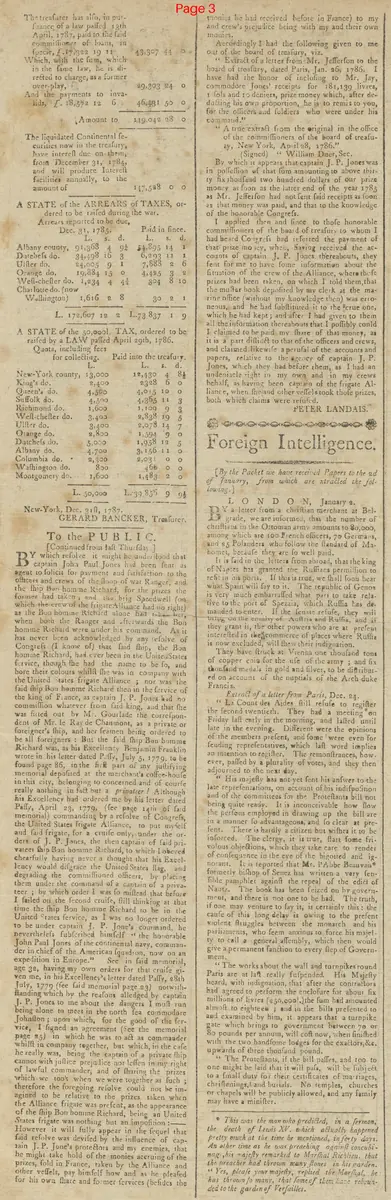
[Continued from last Thursday]
By which resolve it might be understood that captain John Paul Jones had been sent as agent to solicit for payment and satisfaction to the officers and crews of the sloop of war Ranger, and the ship Bon Homme Richard, for the prizes the former had taken, and the brig Speedwell (on which the crew of the frigate Alliance had no right) as the Bon Homme Richard alone had taken her, when both the Ranger and afterwards the Bon Homme Richard were under his command. As it has never been acknowledged by any resolve of Congress (I know of) that said ship, the Bon Homme Richard, had ever been in the United States service, though she had the name to be so, and bore their colours whilst she was in company with the United States frigate Alliance; nor was the said ship Bon Homme Richard then in the service of the king of France, as captain J. P. Jones had no commission whatever from said king, and that she was fitted out by Mr. Gourlade the correspondent of Mr. le Ray de Chaumont, as a private or foreigner's ship, and her seamen being ordered to be all foreigners: But the said ship Bon Homme Richard was, as his Excellency Benjamin Franklin wrote in his letter dated Paris, July 5, 1779, to be found page 86, in the first part of my justifying memorial deposited at the merchant's coffee-house in this city, belonging to concerned and of course really nothing in fact but a privateer! Although his Excellency had ordered me by his letter dated Paris, April 23, 1779, (see page 14th of said memorial) commanding by a resolve of Congress, the United States frigate Alliance, to put myself and said frigate, for a cruise only, under the orders of J. P. Jones, the then captain of said privateer Ship Bon Homme Richard, to which I obeyed cheerfully having never a thought that his Excellency would disgrace the United States flag, and degrading the commissioned officers, by placing them under the command of a captain of a privateer; by which order I was so misled that before I sailed on the second cruise, still thinking at that time the ship Bon Homme Richard to be in the United States service, as I was no longer ordered to be under captain J. P. Jones's command, he nevertheless subscribed himself the honorable John Paul Jones of the continental navy, commander in chief of the American squadron, now on an expedition in Europe. See in said memorial, page 39, having my own orders for that cruise given me, in his Excellency's letter dated Paris 28th July, 1779 (see said memorial page 23) notwithstanding which by the reasons alleged by captain J. P. Jones to me about the dangers I must run being alone to meet in the north sea commodore Johnstone; upon which, for the good of the service, I signed an agreement (See the memorial page 25) in which he was to act as commander whilst in company together, but which, in the case he really was, being the captain of a private ship cannot with justice prejudice nor lessen in my right of lawful commander, and of sharing the prizes which we took when we were together as such; therefore the foregoing resolve could not be imagined to be relative to the prizes taken when the Alliance frigate was present, as the appearance of the ship Bon Homme Richard, being an United States frigate was nothing but an imposition:-- However it will fully appear in the sequel that said resolve was devised by the influence of captain J. P. Jones's protectors and my enemies, that he might take hold of the monies accruing of the prizes, sold in France, taken by the Alliance and other vessels, pay himself how and as he pleased for his own share and former services (besides the cronies he had received before in France to my and crew's prejudice being with my and their own monies.)
Accordingly I had the following given to me out of the board of treasury, viz.
"Extract of a letter from Mr. Jefferson to the board of treasury, dated Paris, Jan. 26, 1786. I have had the honor of enclosing to Mr. Jay, commodore Jones' receipts for 181,139 livres, 10 sols and 10 deniers, prize money which, after deducting his own proportion, he is to remit to you, for the officers and soldiers who were under his command."
"A true extract from the original in the office of the commissioners of the board of treasury, New York, April 28, 1786."
(Signed) "William Duer, Sec.
By which it appears that captain J. P. Jones was in possession of that sum amounting to above thirty six thousand two hundred dollars of our prize money as soon as the latter end of the year 1785 as Mr. Jefferson had not sent said receipts as soon as that money was paid, and that to the knowledge of the honorable Congress
I applied then and since to those honorable commissioners of the board of treasury to whom I had heard Congress had referred the payment of that prize money, when, having received the accounts of captain J. P. Jones thereabouts. they sent for me to have some information about the situation of the crew of the Alliance, where those prizes had been taken, on which I told them,that the muster book deposited by my clerk at the marine office (without my knowledge then) was erroneous, and he had substituted it to the true one, which he had kept; and after I had given to them all the information thereabouts that I possibly could I claimed to be paid my share of that money, as it is a part distinct to that of the officers and crews, and claimed likewise a perusal of the accounts and papers, relative to the agency of captain J. P. Jones, which they had before them, as I had an undeniable right in my own and in my crews behalf, as having been captain of the frigate Alliance, when he and other vessels took those prizes, both which claims were refused.
PETER LANDAIS.
What sub-type of article is it?
What themes does it cover?
What keywords are associated?
What entities or persons were involved?
Letter to Editor Details
Author
Peter Landais
Recipient
To The Public
Main Argument
peter landais argues that the bon homme richard was a privateer, not a u.s. ship, and that john paul jones improperly handled prize money from captures involving the uss alliance, denying landais and his crew their rightful shares despite congressional resolves and orders from franklin and jefferson.
Notable Details