Thank you for visiting SNEWPapers!
Sign up free
The Hood River Glacier
Hood River, Hood River County, Oregon
What is this article about?
A report by J. C. Stubbs on the new rate law's implications for passenger transportation, prepared for western railroads, concludes that homeseekers' excursions are abolished, free passes restricted, and certain reduced rates unlawful, affecting various groups from missionaries to theatrical companies.
Clipping
OCR Quality
Full Text
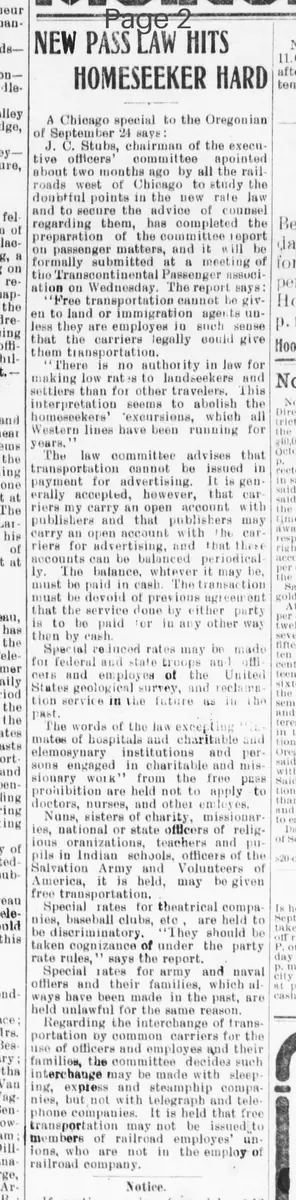
HOMESEEKER HARD
A Chicago special to the Oregonian of September 24 says:
J. C. Stubbs, chairman of the executive officers' committee appointed about two months ago by all the railroads west of Chicago to study the doubtful points in the new rate law and to secure the advice of counsel regarding them, has completed the preparation of the committee report on passenger matters, and it will be formally submitted at a meeting of the Transcontinental Passenger association on Wednesday. The report says:
"Free transportation cannot be given to land or immigration agents unless they are employees in such sense that the carriers legally could give them transportation."
"There is no authority in law for making low rates to landseekers and settlers than for other travelers. This interpretation seems to abolish the homeseekers' excursions, which all Western lines have been running for years."
The law committee advises that transportation cannot be issued in payment for advertising. It is generally accepted, however, that carriers may carry an open account with publishers and that publishers may carry an open account with the carriers for advertising, and that these accounts can be balanced periodically. The balance, whatever it may be, must be paid in cash. The transaction must be devoid of previous agreement that the service done by either party is to be paid for in any other way than by cash.
Special reduced rates may be made for federal and state troops and officers and employees of the United States geological survey, and reclamation service in the future as in the past.
The words of the law excepting inmates of hospitals and charitable and eleemosynary institutions and persons engaged in charitable and missionary work from the free pass prohibition are held not to apply to doctors, nurses, and other employees.
Nuns, sisters of charity, missionaries, national or state officers of religious organizations, teachers and pupils in Indian schools, officers of the Salvation Army and Volunteers of America, it is held, may be given free transportation.
Special rates for theatrical companies, baseball clubs, etc., are held to be discriminatory. "They should be taken cognizance of under the party rate rules," says the report.
Special rates for army and naval officers and their families, which always have been made in the past, are held unlawful for the same reason.
Regarding the interchange of transportation by common carriers for the use of officers and employees and their families, the committee decides such interchange may be made with sleeping, express and steamboat companies, but not with telegraph and telephone companies. It is held that free transportation may not be issued to members of railroad employees' unions, who are not in the employ of railroad company.
What sub-type of article is it?
What themes does it cover?
What keywords are associated?
What entities or persons were involved?
Where did it happen?
Story Details
Key Persons
Location
Chicago, Railroads West Of Chicago
Event Date
September 24
Story Details
The committee report interprets the new rate law as prohibiting free transportation to land agents unless employees, abolishing homeseekers' excursions, banning transportation for advertising, allowing special rates for troops and geological survey, restricting free passes to certain charitable figures but not their employees, deeming special rates for theatricals and military officers discriminatory, permitting interchange with some companies but not telegraph/telephone, and denying free transport to non-employee union members.