Thank you for visiting SNEWPapers!
Sign up free
Alexandria Gazette
Alexandria, Alexandria County, District Of Columbia
What is this article about?
Report of the 26th Congress, Second Session proceedings: Senate advances bill for Howard Institution and notices land cession; House debates and passes bill providing temporary care for lunatics in the District of Columbia, highlighting poor conditions in jail and need for medical attention, over objections on costs and responsibility.
Clipping
OCR Quality
Full Text
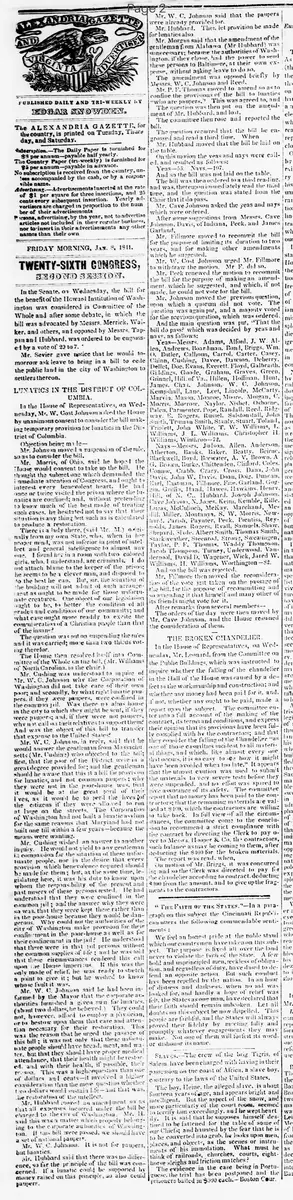
SECOND SESSION.
In the Senate, on Wednesday, the bill for
the benefit of the Howard Institution of Washington
was considered in Committee of the
Whole and after some debate, in which the
bill was advocated by Messrs. Merrick, Walker,
and others, and opposed by Messrs. Tappan
and Hubbard, was ordered to be engrossed
by a vote of 23 to 7.
Mr. Sevier gave notice that he would tomorrow ask leave to bring in a bill to cede
the public lands in the city of Washington to
settlers thereon.
LUNATICS IN THE DISTRICT OF COLUMBIA.
In the House of Representatives, on Wednesday, Mr. W. Cost Johnson asked the House
by unanimous consent to consider the bill making temporary provision for lunatics in the District
of Columbia.
Objection being made—
Mr. Johnson moved a suspension of the rule,
so as to consider the bill.
Mr. Morris, of Ohio, said he hoped the
House would consent to take up the bill. He
thought the subject one which demanded the
immediate attention of Congress, and ought to
interest every benevolent heart. He had
once or twice visited the prison where the lunatics are confined; and, without pretending
to know much of the best mode of treating
such cases, he hesitated not to say that their
situation is any thing but such as is calculated
to produce a restoration.
There is a lady there, (said Mr. M.) originally from my own State, who, when in her
proper mind, was not inferior in point of intellect and general intelligence to almost any
one. I found her in a room with two colored
girls, who, I understand, are criminals. I do
not attach blame to the keeper of the prison;
he seems to be a clever man, and disposed to
do the best he can. But, sir, the situation of
the building will not admit of such arrangement as ought to be made for those unfortunate creatures. One object of our legislation
ought to be to better the condition of all
grades and conditions of our community; and
what case ought more readily to excite the
commiseration of a Christian people than that
of the insane?
The question was put on suspending the rules
and it was carried; more than two thirds voting therefor.
The House then resolved itself into Committee of the Whole on the bill, (Mr. Williams
of North Carolina, in the chair.)
Mr. Cushing was understood to inquire of
Mr. W. C. Johnson why the Corporation of
Washington did not take care of their own
poor; and secondly, by what right lunatic paupers, if they were paupers, were confined in
the common jail. Was there an alms house
in the city to which they might be sent, if they
were paupers; and, if they were not paupers,
why not call on their relatives to support them:
And was the object of this bill to transfer
that expense to the United States?
Mr. W. C. Johnson, in reply, said that he
would answer the gentleman from Massachusetts (Mr. Cushing) who objected to the bill:
first, that the poor of the District were in a
great degree provided for; and the gentleman
should be aware that this is a bill for provision for lunatics, and not common paupers; why
they were not in the poor-house was, that
it would be at the great peril of their
lives, as it would be to peril the lives of
the citizens if they were allowed to run
at large on the streets. The Corporation
of Washington had not built a lunatic asylum
for the same reasons that Maryland had not
built one till within a few years—because the
means were wanting.
Mr. Cushing wished an answer to another
inquiry. He would not yield to any gentleman in compassion for the situation of these unfortunate people, nor in the desire that every
provision which benevolence required should
be made for them; but, at the same time, legislating here, it was his duty to know upon
whom the responsibility of the present and
past misery of these persons rested. He had
understood that they were confined in the
common jail; and the answer why they were
so was, that they were kept there rather than
in the poor-house because they would be dangerous. Why could not the authorities of the
city of Washington make provision for their
confinement in the poor-house as well as for
their confinement in the jail? He understood
that there were in that place persons without
the common supplies of life: and he was told
that these circumstances rendered this call
upon the House imperious. If this was the
only mode of relief, he was ready to stretch
a point to give it; but he wished to know
whose fault it was.
Mr. W. C. Johnson said he had been informed by the Mayor that the corporate authorities furnished a given sum for lunatics,
not, however, afford to employ a physician,
(about two dollars, he believed.) They could
or to bestow upon them that care and attention necessary for their restoration. This
was the reason that he urged the passage of
this bill; it was not only that these unfortunate people should have bread, meat, and water, but that they should have proper medical
attendance, that their health might be restored, and with their health, if possible, their
reason. This was a higher question than one
of dollars and cents—it involved a higher
consideration than the mere question whether
two dollars would sustain life—and that was,
the restoration of the intellect.
Mr. Hubbard moved an amendment so as
that all expenses incurred under the bill be
charged to the city of Washington. Mr. H.
said this was a matter which properly belonging to the corporate authorities of Washington. If this bill were passed, we should have
a set of national paupers.
Mr. W. C. Johnson. It is not for paupers,
but lunatics.
Mr. Hubbard said that there was no difference, so far the principle of the bill was concerned. If a lunatic could be supported by
money raised on this principle, so also could
paupers.
Mr. W. C. Johnson said that the paupers
were already provided for.
Mr. Hubbard. Then, let provision be made
for lunatics also.
Mr. Morgan said that the amendment of the
gentleman from Alabama (Mr. Hubbard) was
unnecessary; because the authorities of Washington, if they chose, had the power to send
these persons to Baltimore, at their own expense, without asking leave to do so.
The amendment was opposed briefly
by
Messrs. W. C. Johnson and Reed.
Mr. P. F. Thomas moved to amend so as to
confine the provisions of the bill to lunatics
"who are paupers." This was agreed to, and
The question was then put on the amendment of Mr. Hubbard, and lost.
The committee then rose and reported the
bill.
The question recurred that the bill be engrossed and read a third time. When
Mr. Hubbard moved that the bill be laid on
the table.
On this motion the yeas and nays were called, and resulted as follows:
Yeas—55. Nays—107.
And so the bill was not laid on the table.
The bill was then ordered to a third reading,
and was, thereupon immediately read the third
time, and the question was stated from the
Chair that it do pass.
Mr. Cave Johnson asked the yeas and nays,
which were ordered.
After some suggestions from Messrs. Cave
Johnson, Davis, of Indiana, Peck, and James
Garland,
Mr. Fillmore moved to recommit the bill
for the purpose of limiting its duration to two
years, and for making other amendments
which he suggested.
Mr. W. Cost Johnson urged Mr. Fillmore
to withdraw the motion. Mr F. did so.
Mr. Peck renewed the motion to recommit
the bill for the purpose of making an amendment, which he suggested, and which, if not
made, he could not vote for the bill.
Mr. Johnson moved the previous question,
upon which a quorum did not vote. The
question was again put, and a majority voted
for the previous question, which was ordered.
And the main question was put, "That the
bill do pass?" which was decided by yeas and
nays, as follows:
Yeas—Messrs. Adams, Alford, J. W. Allen, Andrews, Boardman, Bond, Briggs, Wm.
O. Butler, Calhoun, Carroll, Carter, Casey,
Chinn, Cushing, Davee, Dawson, Deberry,
Dellet, Doe, Evans, Everett, Floyd, Galbraith,
Giddings, Goode, Graham, Graves, Green,
Grinnell, Hill, of Va., Hillen, Hoffman, Hunt,
James, Chas. Johnson, W. C. Johnson,
Kempshall, Lane, Leet, Lincoln, McCarty,
Marvin, Mason, Monroe, Moore, Morgan, C.
Morris, Morrow, Naylor, Nisbet, Osborne,
Phelps, Parmenter, Pope, Randall, Reed, Ridgeway, E. Rogers, Russell, Saltonstall, John
Smith, Truman Smith, Stanley, Stuart, Toland,
Triplett, John White, T. W. Williams, L.
Williams, J. L. Williams, Christopher H.
Williams, Winthrop—72.
Nays—Messrs. Judson, Allen, Anderson,
Atherton, Banks, Baker, Beatty, Beirne,
Blackwell, Boyd, Brewster, A. V. Brown, A.
G. Brown, Burke, Chittenden, Clifford, Coles,
Connor, Crabb, Crary, Cross, Dana, John
Davis, John W. Davis, Doan, Doig, Duncan,
Earl, Eastman, Fillmore, Fine, Garland, Goggin, Grinn, Hand, Hawes, Hawkins, Henry,
Hill, of N. C., Hubbard, Joseph Johnson,
Cave Johnson, N. Jones, Keim, Kemble, Kill, Leas, McCulloch, McKay, Marchand, Medill, Miller, Montanya, S. W. Morris, New-
hard, Parish, Paynter, Peck, Prentiss, Rey-
nolds, James Rogers, Ryall, Samuels, Shaw,
Shepard, Slade, Albert Smith, Thomas Smith,
Starkweather, Steenrod, Strong, Swearingen,
Taylor, P. F. Thomas, Waddy Thompson,
Jacob Thompson, Turney, Underwood, Van-
derpool, David D. Wagener, Wick, Jared W.
Williams, H. Williams, Worthington—82.
And so the bill passed.
Mr. Fillmore then moved the reconsideration of the vote just taken on the passage of
the bill, for the purpose of recommitting and
so amending it that himself and many other of
its friends might vote for it.
After remarks from several members—
The orders of the day were then moved by
Mr. Cave Johnson, and the House resumed
the consideration of them.
What sub-type of article is it?
What themes does it cover?
What keywords are associated?
What entities or persons were involved?
Where did it happen?
Story Details
Key Persons
Location
Washington, District Of Columbia
Event Date
Wednesday, 26th Congress, Second Session
Story Details
Senate debates and advances bill for Howard Institution (23-7) and notices land cession bill. House suspends rules to debate bill for temporary provision for lunatics in DC, highlighting jail conditions and need for medical care; amendments proposed and defeated; bill passes 72-82 after yeas and nays.