Thank you for visiting SNEWPapers!
Sign up free
Virginia Argus
Richmond, Virginia
What is this article about?
Commentary on post-Fox death cabinet arrangements in Britain, portraying Foxites as submitting to Grenvilles' dominance, with details on ministerial shifts and political humiliations.
Clipping
OCR Quality
Full Text
September 26.
THE LATE ARRANGEMENTS:
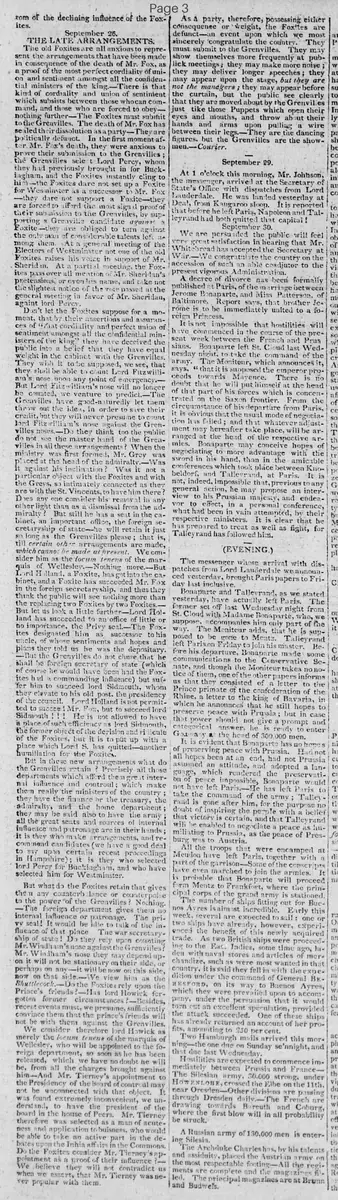
The old Foxites are all anxious to represent the arrangements that have been made in consequence of the death of Mr. Fox, as a proof of the most perfect cordiality of union and sentiment amongst all the confidential ministers of the king. There is that kind of cordiality and union of sentiment which subsists between those who can command, and those who are forced to obey--nothing further. The Foxites must submit to the Grenvilles. The death of Mr. Fox has sealed their dissolution as a party. They are politically defunct. In the first moment after Mr. Fox's death, they were anxious to prove their submission to the Grenvilles; the Grenvilles select Lord Percy, whom they had previously brought in for Buckingham, and the Foxites instantly cling to him. The Foxites dare not set up a Foxite for Westminster as a successor to Mr. Fox--they dare not support a Foxite--they are forced to afford the most signal proof of their submission to the Grenvilles, by supporting a Grenville candidate against a Foxite--they are obliged to turn against the only man of considerable talents left among them. At a general meeting of the Electors of Westminster not one of the old Foxites raises his voice in support of Mr. Sheridan. At a partial meeting, the Foxites pass over all mention of Mr. Sheridan's pretensions, or even his name, and take not the slightest notice of the vote passed at the general meeting in favor of Mr. Sheridan, against Lord Percy.
Don't let the Foxites suppose for a moment, that by their assertions and assurances of that cordiality and perfect union of sentiment amongst all the confidential ministers of the king they have deceived the public into a belief that they have equal weight in the cabinet with the Grenvilles. They wish it to be supposed, we see, that they shall be able to count Lord Fitzwilliam's nose upon any point of emergency. But Lord Fitzwilliam's nose will no longer be counted, we venture to predict. The Grenvilles have good-naturedly let them throw out the idea, in order to save their credit, but they will never presume to count Lord Fitzwilliam's nose against the Grenvilles noses. Do they think too the public do not see the master hand of the Grenvilles in all these arrangements? When the ministry was first formed, Mr. Grey was placed at the head of the admiralty. Was it against his inclination? Was it not a particular object with the Foxites and with the Greys, so intimately connected as they are with the St. Vincents, to have him there? Does any one consider his removal in any other light than as a dismissal from the admiralty? But still he has a seat in the cabinet, an important office, the foreign secretaryship of state--he will retain it just so long as the Grenvilles please; that is, till certain other arrangements are made, which cannot be made at present. We consider him as the locum tenens of the Marquis of Wellesley. Nothing more. But Lord Holland, a Foxite, has got into the cabinet, and a Foxite has succeeded Mr. Fox in the foreign secretaryship, and thus they think the public will see nothing more than the replacing two Foxites by two Foxites. But let us look a little further. Lord Holland has succeeded to an office of little or no importance, the Privy seal. The Foxites designated him as successor to his uncle, of whose sentiments and hopes and plans they told us he was the depositary. But the Grenvilles do not choose that he shall be foreign secretary of state (which of course he would have been had the Foxites had a commanding influence) but suffer him to succeed Lord Sidmouth, whom they elevate to his old post, the presidency of the council. Lord Holland is not permitted to succeed Mr. Fox, but to succeed Lord Sidmouth!!! He is not allowed to have a place of such efficiency as Lord Sidmouth, the former object of the derision and ridicule of the Foxites, but it is to put up with a place which Lord S. has quitted--another humiliation for the Foxites.
But in these new arrangements what do the Grenvilles retain? Precisely all those departments which afford them great internal influence and control; which make them really the ministers of the country; they have the finance by the treasury, the admiralty, and the home department; they may be said also to have the army; all the great seats and sources of internal influence and patronage are in their hands; it is they who make arrangements, and command candidates (we have a good deal to say upon certain recent proceedings in Hampshire); it is they who selected Lord Percy for Buckingham, and who have selected him for Westminster.
But what do the Foxites retain that gives them any counterbalance or counterpoise to the power of the Grenvilles? Nothing. The foreign department gives them no internal influence or patronage. The privy seal! It would be idle to talk of the influence of that place. The war secretaryship of state! Do they rely upon counting Mr. Windham's nose against the Grenvilles? Mr. Windham's nose they may depend upon it will not be stationary on their side, or perhaps on any--it will be now on this side, now on that side. We view him as the Shuttlecock. Do the Foxites rely upon the Prince's friends? Has Lord Howick forgotten former circumstances? Besides, recent events must, we presume, sufficiently convince them that the prince's friends will not be with them against the Grenvilles. We consider therefore Lord Howick as merely the locum tenens of the Marquis of Wellesley, who will be appointed to the foreign department, so soon as he has been released, which we have no doubt he will be, from all the charges brought against him. And Mr. Tierney's appointment to the Presidency of the board of control may not be unconnected with that object. It was found extremely inconvenient, we understand, to have the president of the board in the house of Peers. Mr. Tierney therefore was selected as a man of acuteness and application to business, who would be able to take an active part in the debates upon the India affairs in the Commons. Do the Foxites consider Mr. Tierney's appointment as a proof of their influence? We believe they will not contradict us when we assert, that Mr. Tierney was never popular with them.
As a party, therefore, possessing either consequence or weight, the Foxites are defunct--an event upon which we most sincerely congratulate the country. They must submit to the Grenvilles. They may show themselves more frequently at public meetings; they may make more noise; they may deliver longer speeches; they may appear upon the stage, but they are not the managers; they may appear before the curtain, but the public see clearly that they are moved about by the Grenvilles just like those Puppets which open their eyes and mouths, and throw about their hands and arms upon pulling a wire between their legs. They are the dancing figures, but the Grenvilles are the showmen.--Courier.
What sub-type of article is it?
What keywords are associated?
What entities or persons were involved?
Where did it happen?
Foreign News Details
Primary Location
Westminster
Event Date
September 26
Key Persons
Outcome
foxites politically defunct and submitting to grenvilles' dominance in cabinet and internal influence.
Event Details
Following Mr. Fox's death, cabinet arrangements show Foxites yielding to Grenvilles, with shifts like Mr. Grey's removal from Admiralty to Foreign Secretary as temporary, Lord Holland to Privy Seal instead of Foreign Secretary, and Grenvilles retaining key departments; Foxites fail to support Mr. Sheridan for Westminster against Lord Percy.