Thank you for visiting SNEWPapers!
Sign up free
The Enquirer
Richmond, Henrico County, Virginia
What is this article about?
In Paris on August 6, the second meeting of the Assembly of French Jewish Deputies opened on their Sabbath. Commissioners from Emperor Napoleon addressed the assembly, emphasizing integration into French society, and posed 11 questions on Jewish religious practices, marriage, citizenship, rabbis' roles, and usury.
Clipping
OCR Quality
Full Text
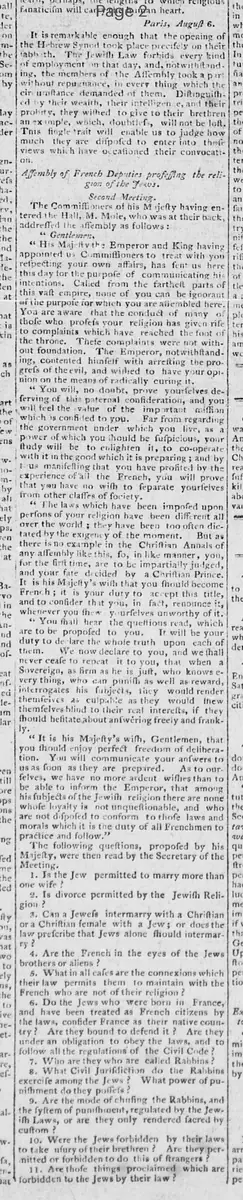
It is remarkable enough that the opening of the Hebrew Synod took place precisely on their Sabbath. The Jewish Law forbids every kind of employment on that day, and, notwithstanding, the members of the Assembly took a part without repugnance, in every thing which the circumstance demanded of them. Distinguished by their wealth, their intelligence, and their probity, they wished to give to their brethren an example, which, doubtless, will not be lost. This single trait will enable us to judge how much they are disposed to enter into those views which have occasioned their convocation.
Assembly of French Deputies professing the religion of the Jews.
Second Meeting.
The Commissioners of his Majesty having entered the Hall, M. Mole, who was at their back, addressed the assembly as follows:
"Gentlemen,
His Majesty the Emperor and King having appointed us Commissioners to treat with you respecting your own affairs, has sent us here this day for the purpose of communicating his intentions. Called from the farthest parts of this vast empire, none of you can be ignorant of the purpose for which you are all assembled here. You are aware that the conduct of many of those who profess your religion has given rise to complaints which have reached the foot of the throne. These complaints were not without foundation. The Emperor, notwithstanding, contented himself with arresting the progress of the evil, and wished to have your opinion on the means of radically curing it.
You will, no doubt, prove yourselves deserving of this paternal consideration, and you will feel the value of the important mission which is confided to you. Far from regarding the government under which you live, as a power of which you should be suspicious, your study will be to enlighten it, to co-operate with it in the good which it is preparing; and by thus manifesting that you have profited by the experience of all the French, you will prove that you have no wish to separate yourselves from other classes of society.
The laws which have been imposed upon persons of your religion have been different all over the world: they have been too often dictated by the exigency of the moment. But as there is no example in the Christian Annals of any assembly like this, so, in like manner, you, for the first time, are to be impartially judged, and your fate decided by a Christian Prince. It is his Majesty's wish that you should become French; it is your duty to accept this title, and to consider that you, in fact, renounce it, whenever you show yourselves unworthy of it.
You shall hear the questions read, which are to be proposed to you. It will be your duty to declare the whole truth upon each of them. We now declare to you, and we shall never cease to repeat it to you, that when a Sovereign, as firm as he is just, who knows everything, who can punish as well as reward, interrogates his subjects, they would render themselves as culpable as they would show themselves blind to their real interests, if they should hesitate about answering freely and frankly.
It is his Majesty's wish, Gentlemen, that you should enjoy perfect freedom of deliberation. You will communicate your answers to us as soon as they are prepared. As to ourselves, we have no more ardent wishes than to be able to inform the Emperor, that among his subjects of the Jewish religion there are none whose loyalty is not unquestionable, and who are not disposed to conform to those laws and morals which it is the duty of all Frenchmen to practice and follow."
The following questions, proposed by his Majesty, were then read by the Secretary of the Meeting.
1. Is the Jew permitted to marry more than one wife?
2. Is divorce permitted by the Jewish Religion?
3. Can a Jewess intermarry with a Christian or a Christian female with a Jew; or does the law prescribe that Jews alone should intermarry?
4. Are the French in the eyes of the Jews brothers or aliens?
5. What in all cases are the connexions which their law permits them to maintain with the French who are not of their religion?
6. Do the Jews who were born in France, and have been treated as French citizens by the laws, consider France as their native country? Are they bound to defend it? Are they under an obligation to obey the laws, and to follow all the regulations of the Civil Code?
7. Who are they who are called Rabbins?
8. What Civil Jurisdiction do the Rabbins exercise among the Jews? What power of punishment do they possess?
9. Are the mode of choosing the Rabbins, and the system of punishments, regulated by the Jewish Laws, or are they only rendered sacred by custom?
10. Were the Jews forbidden by their laws to take usury of their brethren? Are they permitted or forbidden to do this of strangers?
11. Are those things proclaimed which are forbidden to the Jews by their law?
What sub-type of article is it?
What keywords are associated?
What entities or persons were involved?
Where did it happen?
Foreign News Details
Primary Location
Paris
Event Date
August 6
Key Persons
Outcome
commissioners addressed the assembly on integration and posed 11 questions regarding jewish religious practices, marriage, divorce, intermarriage, citizenship obligations, rabbis' roles, and usury.
Event Details
The second meeting of the Assembly of French Jewish Deputies convened in Paris on their Sabbath. Despite religious prohibitions, members participated. M. Mole, on behalf of the Emperor's commissioners, delivered a speech urging loyalty, cooperation with French society, and frank responses to questions aimed at reforming Jewish conduct and ensuring citizenship.