Thank you for visiting SNEWPapers!
Sign up free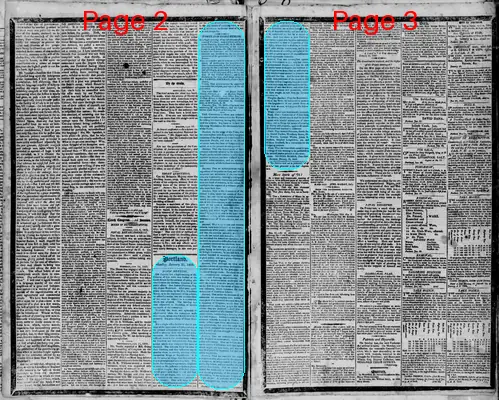
Portland Gazette, And Maine Advertiser
Portland, Cumberland County, Maine
What is this article about?
On January 17 and 19, 1809, Portland citizens convened a town meeting at the Court House to discuss distress from U.S. government policies, including the Embargo. They unanimously adopted resolutions condemning violations of rights, the Embargo's ruinous effects, and formed a Committee of Public Safety to protect liberties and petition the state legislature.
Merged-components note: Continuation of the Portland town meeting report and resolutions against the embargo; relabeled from notice to domestic_news as it reports political events.
Clippings
1 of 2
OCR Quality
Full Text
Monday, January 23, 1809.
TOWN MEETING.
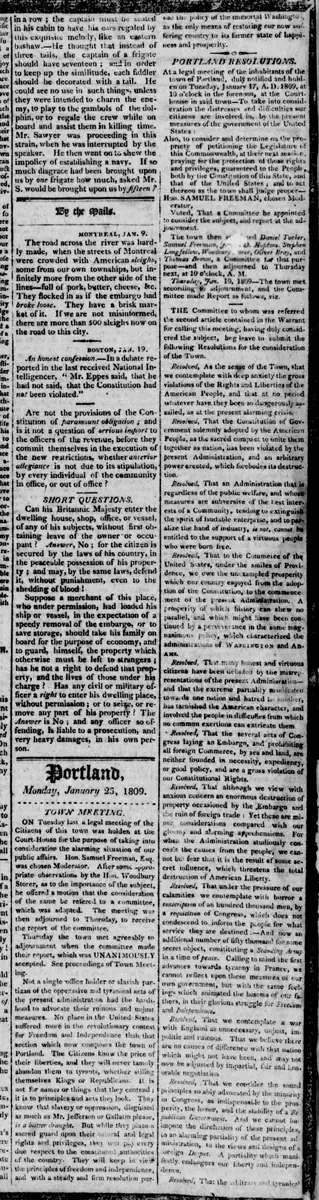
ON Tuesday last a legal meeting of the Citizens of this town was holden at the Court House for the purpose of taking into consideration the alarming situation of our public affairs. Hon. Samuel Freeman, Esq. was chosen Moderator. After some appropriate observations by the Hon. Woodbury Storer, as to the importance of the subject, he offered a motion that the consideration of the same be referred to a committee, which was adopted. The meeting was then adjourned to Thursday, to receive the report of the committee.
Thursday the town met agreeably to adjournment when the committee made their report, which was UNANIMOUSLY accepted. See proceedings of Town Meeting.
Not a single office holder or slavish partisan of the oppressive and tyrannical acts of the present administration had the hardihood to advocate their ruinous and unjust measures. No place in the United States suffered more in the revolutionary contest for Freedom and Independence than that section which now composes the town of Portland. The Citizens know the price of their liberties, and they will never tamely abandon them to tyrants, whether styling themselves Kings or Republicans. It is not for names or things that they contend; it is to principles and acts they look. They know that slavery or oppression, disguised as much as Mr. Jefferson or Gallatin please, is a bitter draught. But while they place a sacred guard upon their natural and legal rights and privileges, they will pay every due respect to the constituted authorities of the country. They will keep in view the principles of freedom and independence, and with a steady and firm resolution pursue the policy of the immortal Washington as the only means of restoring our now suffering country to its former state of happiness and prosperity.
PORTLAND RESOLUTIONS
At a legal meeting of the inhabitants of the town of Portland, duly notified and holden on Tuesday, January 17. A. D. 1809, at 10 o'clock in the forenoon, at the Court House in said town—To take into consideration the distresses and difficulties our citizens are involved in, by the present measures of the government of the United States:
Also, to consider and determine on the propriety of petitioning the Legislature of this Commonwealth, at their next session, praying for the protection of those rights and privileges, guaranteed to the People, both by the Constitution of this State, and that of the United States: and to act thereon as the town shall judge proper—
Hon. SAMUEL FREEMAN, chosen Moderator,
Voted, That a Committee be appointed to consider the subject, and report at the adjournment.
The town then appointed Daniel Tucker, Samuel Freeman, Jr. D. Hopkins, Stephen Longfellow, Woodbury Storer, Oliver Bray, and Thomas Brown, a Committee for that purpose—and then adjourned to Thursday next, at 10 o'clock, A.M.
Thursday, Jan. 19, 1809—The town met according to adjournment, and the Committee made Report as follows, viz.
THE Committee to whom was referred the second article contained in the Warrant for calling this meeting, having duly considered the subject, beg leave to submit the following Resolutions for the consideration of the Town.
Resolved, As the sense of the Town, that we contemplate with deep anxiety the gross violations of the Rights and Liberties of the American People, and that at no period whatever have they been so dangerously assailed, as at the present alarming crisis.
Resolved, That the Constitution of Government solemnly adopted by the American People, as the sacred compact to unite them together as nation, has been violated by the present Administration, and an arbitrary power erected, which forebodes its destruction.
Resolved, That an Administration that is regardless of the public welfare, and whose measures are subversive of the best interests of a Community, tending to extinguish the spirit of laudable enterprise, and to paralyze the hand of industry. is not, cannot be entitled to the support of a virtuous people who were born free.
Resolved, That to the Commerce of the United States, under the smiles of Providence, we owe the unexampled prosperity which our country enjoyed from the adoption of the Constitution, to the commencement of the present administration. A prosperity of which history can shew no parallel, and which might have been continued by a perseverance in the same magnanimous policy, which characterized the administrations of Washington and ADAMS.
Resolved, That many honest and virtuous citizens have been deluded by the misrepresentations of the present Administration— and that the extreme partiality manifested towards one nation and hatred to another, has tarnished the American character, and involved the people in difficulties from which no common exertions can extricate them.
—Resolved, That the several acts of Congress laying an Embargo, and prohibiting all foreign Commerce, by sea and land, are neither founded in necessity, expediency, or good policy, and are a gross violation of our Constitutional Rights.
Resolved, That although we view with anxious concern an enormous destruction of property occasioned by the Embargo and the ruin of foreign trade : Yet these are minor considerations compared with our gloomy and alarming apprehensions. For when the Administration studiously conceals the causes from the people, we cannot but fear that it is the result of some secret influence, which threatens the total destruction of American Liberty.
Resolved, That under the pressure of our calamities we contemplate with horror a conscription of an hundred thousand men, by a requisition of Congress, which does not condescend to inform the people for what service they are destined.—And now an additional number of fifty thousand for some secret object, constituting a Standing Army in a time of peace. Calling to mind the first advances towards tyranny in France, we cannot reflect upon these measures of our own government, but with the same feelings which animated the bosoms of our fathers, in their glorious struggle for Freedom and Independence.
Resolved, That we contemplate a war with England as unnecessary, unjust, impolitic and ruinous. That we believe there are no causes of difference with that nation which might not have been, and may not now be adjusted by impartial, fair and honorable negotiation.
Resolved, That we consider the sound principles so ably advocated by the minority in Congress, as indispensable to the prosperity, the honor, and the stability of a Republican Government. And we cannot but impute the dereliction of those principles, to an alarming partiality of the present administration, to the views and designs of a foreign Despot. A partiality which manifestly endangers our liberty and independence.
Resolved, That the arbitrary and tyrannical
Powers exercised in many instances by persons claiming authority under the Officers of the Customs, are unprecedented in the history of Republicanism, and such as cannot be submitted to, but by a nation of slaves. And that since a new Embargo Law has been passed to legalize oppression, it is expedient to raise a Committee of Public Safety, whose duty it shall be, to correspond with similar committees, and to devise the means of securing our rights of liberty and property against all unconstitutional and oppressive violations.
Resolved, That we contemplate opposition to Government as the very last resort of an oppressed People—and that we will not countenance or support the violation even of oppressive laws—but we will employ every constitutional method to preserve our rights and liberties. And because the respectful remonstrances of the people to the President and to Congress, have been treated with contempt, we will apply to the Legislature of our own State, and claim from them that security and protection, which we have sought in vain from the General Government.
Therefore Resolved, That the Representatives of the Town be instructed to present to the Legislature of our parent State at their next session, and support the following Petition
Which report was unanimously accepted.
Voted, That a Committee of Public Safety be chosen, whose duty it shall be to correspond with similar committees of other towns, and to devise the means of securing our liberty and property, against all unconstitutional and oppressive violations.
Voted, That Samuel Freeman, Enoch Ilsley, Daniel Tucker, Woodbury Storer, Isaac Warren, Lemuel Weeks, James D. Hopkins, Stephen Longfellow, jun. and William Goddard, be a committee for the foregoing purpose.
Voted, That the town clerk cause the proceedings of this meeting to be published in the several papers printed in this town.
Attest, SAMUEL HOMER, Town Clerk
Portland, January 19, 1809.
The Petition will not be published till after it has been presented to the State Legislature.
What sub-type of article is it?
What keywords are associated?
What entities or persons were involved?
Where did it happen?
Domestic News Details
Primary Location
Portland
Event Date
January 17 And 19, 1809
Key Persons
Outcome
unanimous acceptance of committee report and resolutions; formation of committee of public safety; instructions to representatives to present petition to state legislature.
Event Details
Citizens of Portland held a town meeting to address distress from U.S. government measures, including the Embargo prohibiting foreign commerce. A committee drafted resolutions condemning constitutional violations, administrative partiality, destruction of property and trade, conscription, potential war with England, and customs oppression. They resolved to petition the state legislature for protection of rights and formed a Committee of Public Safety to correspond with other towns.