Thank you for visiting SNEWPapers!
Sign up free
Story
March 15, 1945
The Skyland Post
West Jefferson, Ashe County, North Carolina
What is this article about?
J. T. McLAURIN's article warns of soil erosion's destructive impact on all land types via wind and water, detailing sheet and gully processes that silently strip topsoil, leading to barren fields, and urges farmers to tackle this practical problem.
Clipping
OCR Quality
98%
Excellent
Full Text
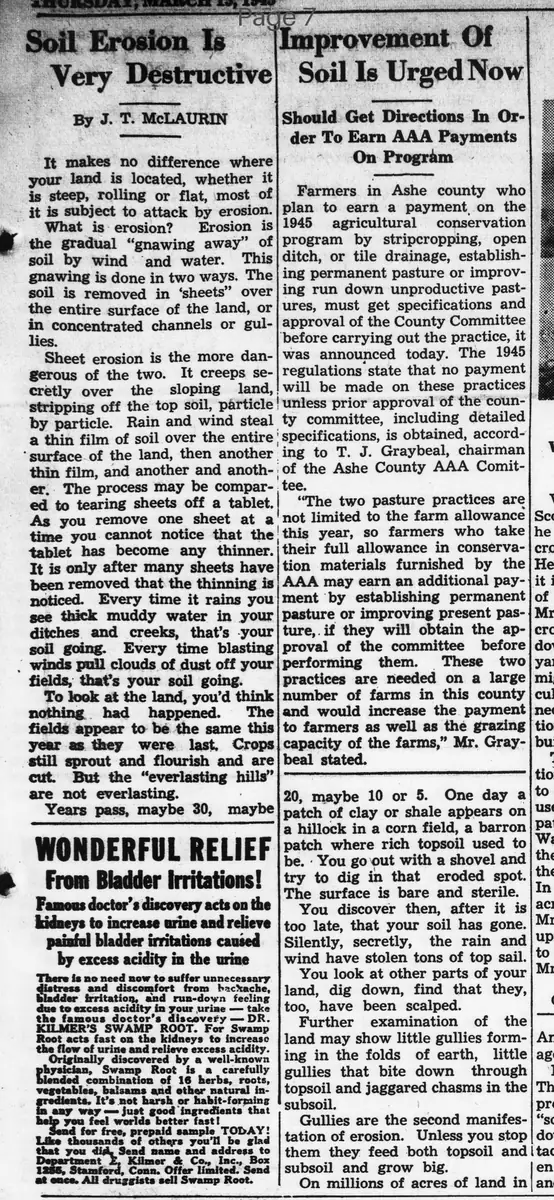
Soil Erosion Is Very Destructive
By J. T. McLAURIN
It makes no difference where your land is located, whether it is steep, rolling or flat, most of it is subject to attack by erosion.
What is erosion?
Erosion is the gradual "gnawing away" of soil by wind and water.
This gnawing is done in two ways. The soil is removed in "sheets" over the entire surface of the land, or in concentrated channels or gullies.
Sheet erosion is the more dangerous of the two. It creeps secretly over the sloping land, stripping off the top soil, particle by particle. Rain and wind steal a thin film of soil over the entire surface of the land, then another thin film, and another and another. The process may be compared to tearing sheets off a tablet. As you remove one sheet at a time you cannot notice that the tablet has become any thinner. It is only after many sheets have been removed that the thinning is noticed. Every time it rains you see thick muddy water in your ditches and creeks, that's your soil going. Every time blasting winds pull clouds of dust off your fields; that's your soil going.
To look at the land you'd think nothing had happened. The fields appear to be the same this year as they were last. Crops still sprout and flourish and are cut. But the "everlasting hills" are not everlasting.
Years pass, maybe 30, maybe 20, maybe 10 or 5. One day a patch of clay or shale appears on a hillock in a corn field, a barren patch where rich topsoil used to be. You go out with a shovel and try to dig in that eroded spot. The surface is bare and sterile. You discover then, after it is too late, that your soil has gone. Silently, secretly, the rain and wind have stolen tons of top soil. You look at other parts of your land, dig down, find that they, too, have been scalped.
Further examination of the land may show little gullies forming in the folds of earth, little gullies that bite down through topsoil and jagged chasms in the subsoil.
Gullies are the second manifestation of erosion. Unless you stop them they eat both topsoil and subsoil and grow big.
In America we now behold the ravages of sheet and gully erosion. Is this happening on your farm? This isn't a highly complicated problem to be handled only by "soil scientists." It is a practical down-to-earth problem to be tackled and licked by men, women and children who live on, tend, and love this American soil.
By J. T. McLAURIN
It makes no difference where your land is located, whether it is steep, rolling or flat, most of it is subject to attack by erosion.
What is erosion?
Erosion is the gradual "gnawing away" of soil by wind and water.
This gnawing is done in two ways. The soil is removed in "sheets" over the entire surface of the land, or in concentrated channels or gullies.
Sheet erosion is the more dangerous of the two. It creeps secretly over the sloping land, stripping off the top soil, particle by particle. Rain and wind steal a thin film of soil over the entire surface of the land, then another thin film, and another and another. The process may be compared to tearing sheets off a tablet. As you remove one sheet at a time you cannot notice that the tablet has become any thinner. It is only after many sheets have been removed that the thinning is noticed. Every time it rains you see thick muddy water in your ditches and creeks, that's your soil going. Every time blasting winds pull clouds of dust off your fields; that's your soil going.
To look at the land you'd think nothing had happened. The fields appear to be the same this year as they were last. Crops still sprout and flourish and are cut. But the "everlasting hills" are not everlasting.
Years pass, maybe 30, maybe 20, maybe 10 or 5. One day a patch of clay or shale appears on a hillock in a corn field, a barren patch where rich topsoil used to be. You go out with a shovel and try to dig in that eroded spot. The surface is bare and sterile. You discover then, after it is too late, that your soil has gone. Silently, secretly, the rain and wind have stolen tons of top soil. You look at other parts of your land, dig down, find that they, too, have been scalped.
Further examination of the land may show little gullies forming in the folds of earth, little gullies that bite down through topsoil and jagged chasms in the subsoil.
Gullies are the second manifestation of erosion. Unless you stop them they eat both topsoil and subsoil and grow big.
In America we now behold the ravages of sheet and gully erosion. Is this happening on your farm? This isn't a highly complicated problem to be handled only by "soil scientists." It is a practical down-to-earth problem to be tackled and licked by men, women and children who live on, tend, and love this American soil.
What sub-type of article is it?
Curiosity
What themes does it cover?
Nature
Misfortune
Catastrophe
What keywords are associated?
Soil Erosion
Sheet Erosion
Gully Erosion
Wind Erosion
Water Erosion
Topsoil Loss
Farming Disaster
Where did it happen?
American Farms
Story Details
Location
American Farms
Story Details
Explanation of soil erosion as the gradual removal of topsoil by wind and water through sheet erosion and gullies, its insidious effects on farmland, and a call for practical action by farmers to combat it.