Thank you for visiting SNEWPapers!
Sign up free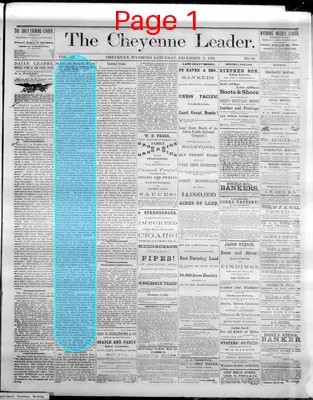
The Cheyenne Leader
Cheyenne, Laramie County, Wyoming
What is this article about?
Article promotes the untapped potential of central and northern Wyoming's Big Horn Country and Black Hills, citing reports of gold deposits from Indians, trappers, and soldiers. Encourages organized prospecting expeditions of at least 100 men from Cheyenne to safely explore despite dangers from Red Cloud's territory.
Clipping

OCR Quality
Full Text
Central and Northern Wyoming—Big Horn Country, and the Black Hills.
To the majority of our citizens that portion of Wyoming Territory watered by the Big Horn, Tongue, Powder and Cheyenne rivers is as yet, comparatively speaking, a terra incognita. Little is known of its climate, soil, mineral resources, etc., compared to other portions of the Territory, except from the reports of Jesuits, a few Indian trappers of the "Jim Bridger" style, and the observations of an occasional army officer who has threaded a pathway in his report to the government, which is chiefly interesting as showing a wonderful adaptation to follow the most crooked and serpentine courses imaginable. The reports of these military wanderers are made up of atmospheric prognostics, daily distances rambled over, and "wood, water and grass" accompaniments.
Notwithstanding the meager information contained in a majority of these "reports" in relation to the mineral wealth, the pastoral advantages, fertility of soil and salubrity of climate of central and northern Wyoming, enough is known to warrant us in asserting that in all these qualities it is unsurpassed by any portion of America.
The existence of the precious metals, both in placer and quartz mines, is positively known in the famous Black Hills, encircled by the forks of the Cheyenne river. Old residents of Fort Laramie well remember the time when the Indians who inhabit that section, were in the habit of bringing in specimens of gold, and trafficking the same away to traders. The half-breeds and trappers on the Upper Missouri are also conversant with the exhibition and sale of gold by these same Indians to the fur traders, from time to time, until within the past ten or twelve years. They are also familiar with the traditions among the Indians relative to the existence of rich gold mines in that portion of our young Territory, the exact locality being often surmised by those greedy for gain, but carefully concealed by the gentle savage. The past few years have witnessed efforts at Yankton and other points on the river looking to the organization and equipment of a body of men to penetrate the country to the Black Hills for the purpose of prospecting in that locality. Although none of these have proved a success, yet the belief is firm and apparently well founded, that valuable deposits of gold can there be found.
In the Big Horn mountains, about the centre of the territory, very good prospects of placer mines are said to have been discovered. The existence of auriferous quartz veins is beyond dispute, but their value is as yet only problematical. Soldiers stationed at Phil Kearney and Reno report seeing evidences of gold quartz mines in various places, through that region of country.
Of the value of these mines we are unable to make any definite statement. This must be determined by the usual mode of prospecting, which is accomplished at great expense, much hard labor, and dangerous undertakings. Practical miners understand these things, and to them the risk and danger are often the fascinating features of a prospecting trip.
To those hardy, indomitable pioneers of the mountains, this region of country north of here must open its wealth. There is danger attending the enterprise, but there is also a rich prospective reward. The chief danger will be to make an incursion into Red Cloud's country, in small, unorganized bands. Parties should be not less than 100 each—well equipped, thoroughly organized, under reliable leaders, and amply provided with provisions, tools, arms and ammunition.
There is no better point to start from than Cheyenne. The mining country can be approached by the way of Forts Laramie and Fetterman, and the Bozeman road. If compelled to fall back, they will know the country through which they will have to retreat, and be within reach of military assistance.
What sub-type of article is it?
What themes does it cover?
What keywords are associated?
What entities or persons were involved?
Where did it happen?
Story Details
Key Persons
Location
Central And Northern Wyoming—Big Horn Country, And The Black Hills
Story Details
Reports from Jesuits, trappers like Jim Bridger, and army officers indicate rich mineral resources, especially gold in Black Hills and Big Horn mountains, traded by Indians until recently. Failed prospecting attempts persist, but organized parties of at least 100 from Cheyenne are advised to explore safely despite dangers in Red Cloud's territory.