Thank you for visiting SNEWPapers!
Sign up free
The Massachusetts Spy, Or, Thomas's Boston Journal
Boston, Suffolk County, Massachusetts
What is this article about?
In 1769, reader A.Z. submits to the Public Advertiser a correspondence between J.W. and Benjamin Franklin on resolving Anglo-American disputes over taxation. J.W. poses questions on repealing duties; Franklin advocates restoring pre-Stamp Act status to satisfy colonists, preserve British supremacy, and avoid further conflict.
Merged-components note: Components form a single letter-to-editor piece containing correspondence between J.W. and Dr. Franklin on American taxation disputes, continued across pages; relabeling the story portion to letter_to_editor.
Clippings
1 of 2
OCR Quality
Full Text
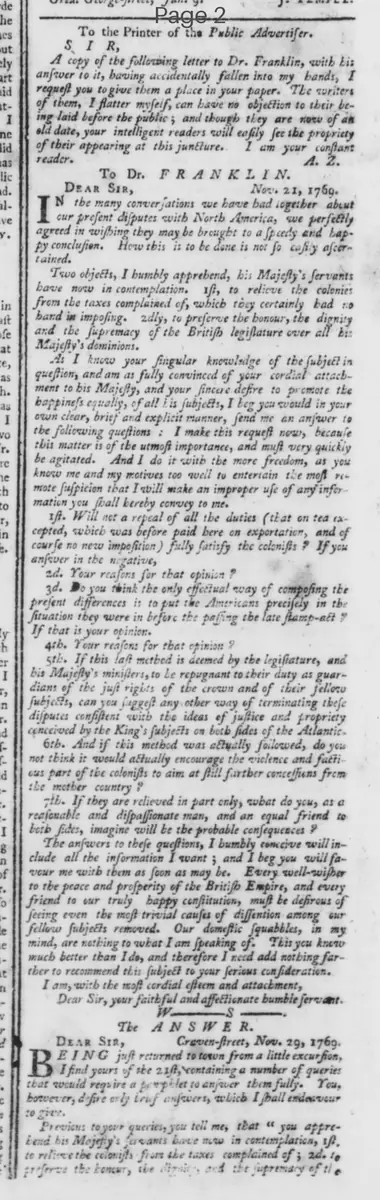
SIR,
A copy of the following letter to Dr. Franklin, with his answer to it, having accidentally fallen into my hands, I request you to give them a place in your paper. The writers of them, I flatter myself, can have no objection to their being laid before the public; and though they are now of an old date, your intelligent readers will easily see the propriety of their appearing at this juncture. I am your constant reader.
A. Z.
To Dr. FRANKLIN.
Dear SIR,
Nov. 21, 1769.
In the many conversations we have had together about our present disputes with North America, we perfectly agreed in wishing they may be brought to a speedy and happy conclusion. How this is to be done is not so easily ascertained.
Two objects, I humbly apprehend, his Majesty's servants have now in contemplation. 1, to relieve the colonies from the taxes complained of, which they certainly had no hand in imposing. 2dly, to preserve the honour, the dignity and the supremacy of the British legislature over all his Majesty's dominions.
As I know your singular knowledge of the subject in question, and am as fully convinced of your cordial attachment to his Majesty, and your sincere desire to promote the happiness equally, of all his subjects, I beg you would in your own clear, brief and explicit manner, send me an answer to the following questions: I make this request now, because this matter is of the utmost importance, and must very quickly be agitated. And I do it with the more freedom, as you know me and my motives too well to entertain the most remote suspicion that I will make an improper use of any information you shall hereby convey to me.
1st. Will not a repeal of all the duties (that on tea excepted, which was before paid here on exportation, and of course no new imposition) fully satisfy the colonists? If you answer in the negative,
2d. Your reasons for that opinion?
3d. Do you think the only effectual way of composing the present differences is to put the Americans precisely in the situation they were in before the passing the late stamp-act?
If that is your opinion.
4th. Your reasons for that opinion?
5th. If this last method is deemed by the legislature, and his Majesty's ministers, to be repugnant to their duty as guardians of the just rights of the crown and of their fellow subjects, can you suggest any other way of terminating these disputes consistent with the ideas of justice and propriety conceived by the King's subjects on both sides of the Atlantic?
6th. And if this method was actually followed, do you not think it would actually encourage the violence and factious part of the colonies to aim at still further concessions from the mother country?
7th. If they are relieved in part only, what do you, as a reasonable and dispassionate man, and an equal friend to both sides, imagine will be the probable consequences?
The answers to these questions, I humbly conceive will include all the information I want; and I beg you will favour me with them as soon as may be. Every well-wisher to the peace and prosperity of the British Empire, and every friend to our truly happy constitution, must be desirous of seeing even the most trivial causes of dissension among our fellow subjects removed. Our domestic squabbles, in my mind, are nothing to what I am speaking of. This you know much better than I do, and therefore I need add nothing further to recommend this subject to your serious consideration.
I am, with the most cordial esteem and attachment,
Dear Sir, your faithful and affectionate humble servant,
J. W.
The ANSWER.
Dear SIR,
Craven-street, Nov. 29, 1769
Being just returned to town from a little excursion, I find yours of the 21st, containing a number of queries that would require a pamphlet to answer them fully. You, however, desire only brief answers, which I shall endeavour to give.
Previous to your queries, you tell me, that "you apprehend his Majesty's servants have now in contemplation, 1. to relieve the colonists from the taxes complained of; 2d. to preserve the honour, the dignity, and the supremacy of the British legislature."
I think they are not mistaken in those two points; and if means can be found to answer both those ends, the sooner the better for all.
1. I do not think the Repeal of all the Duties (Tea excepted) would fully satisfy. The Colonies would probably consider the Tea Duty as an Experiment still to be repeated on occasion, and as a Bait to draw them into the Claim of Right to tax them with a Parliament. And it would be said, that the proper Time for total Repeal was, when the Constitution was reconsider'd and settled; for if the Parliament is to have one essential Right of Sovereignty over us, why not all? And if they may tax us, they will claim the Right of regulating our Trade, and extending their Monopoly, &c. and finally of establishing the whole System they please; so that the Colonies must become only Farms to the Mother Country, &c.
2. My reasons for this Opinion are, that the Claim of Right to tax us in a Parliament, is what they think fundamental in the British Constitution. While this remains unsettled, they will naturally be jealous of every Appearance of a new Exercise of that supposed Right. And as to the Tea, they would not be satisfied with our paying the Duty here, unless we would consent that it should be paid in the Ports of America. For they are not ignorant, that the Duty here on Tea, exported to America, is paid by the Consumer there, as the first Purchaser from the Smuggler pays it, and the Smuggler his, to the Under-officer that wink'd at his Importation; so that the British Parliament taxes the American in Effect, tho' the Money is not brought from America. And if this Fact be known, as it well may be, to the Colonies, they will never be satisfied with the Repeal of the American Duties, while the Duty on Exportation is continued here. For by the Act granting a Drawback, the Tea is to be understood as intended for America; and why may not Parliament say, it is therefore an American Duty?
3. I do think that putting the Colonies in the Situation they were in, before the Stamp Act, would be the only effectual Means of composing the present Differences.
4. My reasons for this Opinion are, that the Colonies were then confin'd in their Trade, and some others of their Liberties, by Acts of Parliament, and they had no Share in the Government, nor any negative Voice in the Laws that bound them, which was the Case of every Part of the Nation, except the Members of Parliament and their Friends. But they had this Comfort, that as no Part of the Nation was taxed by Parliament but the Members of it and their Friends, so they had an equal Share with the rest of the Nation in sending Members to Parliament, and therefore were not, in that Respect, treated as Strangers and Aliens. But if to this be added a Taxation of the Colonies by Parliament, without their Consent, they are then made Strangers to the Constitution, their Interest and their Privileges are invaded, and they are not treated as Brethren and free-born Subjects, but as conquered Foreigners and Slaves.
5. I cannot suggest any other Way of terminating the Disputes, so consistent with Justice and Propriety, as that of putting the Colonies back into the Situation they stood in before the Stamp Act; unless we suppose that Parliament could resolve to give up the Claim of Right to tax them, and to govern them without their Consent; which I think no wise or honest Men would, on due Consideration, be willing to do; or unless the Colonies should consent to send Members to Parliament, which, considering the vast and almost endless Extent of Country they contain, and the great and increasing Number of their Inhabitants, would be impracticable and absurd.
6. I do not think it would encourage Violence or Faction in the Colonies, to restore them to their former Situation. On the contrary, I think it would quiet them, and make them good Subjects for the future; for when the Constitution is restored to them, they will be sensible it is their Interest to preserve it; and the Faction will be only between those who wish to preserve it, and those who would wish to subvert it, in order to obtain some undue Advantage to themselves or their Families.
7. If they are only partially relieved, I think Resentment will be kept up, and the present Unanimity in Opposition to the Claim of Parliament will continue; the Colonies will probably proceed in forming themselves into a more united Interest, by which they will be better able to annoy Great Britain in Commerce, and perhaps in War, if forced to take Arms in their own Defence; and the Expence of Collecting the Duties, and the Hazard of Seizures, will probably make the partial Relief more expensive to the Crown than a total one.
I am, Sir, Your most obedient humble servant,
B. FRANKLIN.
British legislature over all his Majesty's dominions. I hope our information is good; and that what you suppose to be in contemplation, will be carried into execution, by repealing all the laws that have been made for raising a revenue in America by authority of parliament without the consent of the people there. The honour and dignity of the British legislature will not be hurt by such an act of justice and wisdom. The wisest councils are liable to be mistaken, especially in matters remote from their inspection. It is the persisting in an error, not the correcting it, that lessens the honour of any man or body of men. The supremacy of that legislature, I believe will be best preserved by making a very sparing use of it; never but for the evident good of the Colonies themselves, or of the whole British empire; never for the partial advantage of Britain to their prejudice. By such prudent conduct, I imagine that supremacy may be gradually strengthened, and in time fully established; but otherwise, I apprehend it will be disputed, and lost in the dispute. At present the colonies consent and submit to it, for the regulations of general commerce; but a submission to acts of parliament was no part of their original constitution. Our former Kings governed their colonies as they had governed their dominions in France, without the participation of British parliaments. The parliament of England never presumed to interfere in that prerogative till the time of the great rebellion, when they usurped the government of all the King's other dominions, Ireland, Scotland, &c. the colonies that held for the King, they conquered by force of arms, and governed afterwards as conquered countries: But New-England having not opposed the parliament, was considered and treated as a sister kingdom in amity with England, as appears by the Journals, March 10, 1692. Your first question is, "Will not a repeal of all the duties, that on tea excepted, which was before paid here on exportation, and of course no new opposition fully satisfy the colonists?" Answer. I think not. 2d. "Your reasons for that opinion" A. Because it is not the sum paid in that duty on tea that is complained of as a burden, but the principle of the act expressed in the preamble, viz. that those duties were laid for the better support of government, and the administration of justice in the colonies. This the colonists think unnecessary, unjust and dangerous to their most important rights. Unnecessary, because in all the colonies, two or three new ones excepted, government and the administration of justice were, and always had been, well supported without any charge to Britain: Unjust, as it made such colonies liable to pay such charge for others in which they had no concern or interest: Dangerous, as such mode of raising money for those purposes tended to render their assemblies useless; for if a revenue could be raised in the colonies for all the purposes of government by act of parliament, without grants from the people there, Governors, who do not generally love assemblies, would never call them; they would be laid aside; and when nothing should depend on the people's good-will to government, their rights would be trampled on; they would be treated with contempt. Another reason why I think they would not be satisfied with such a partial repeal, is, that their agreements not to import till the repeal takes place, include the whole, which shows that they object to the whole; and those agreements will continue binding on them, if the whole is not repealed. 3d. "Do you think the only effectual way of composing the present differences, is to put the Americans precisely in the situation they were in before the passing of the late stamp act?" A. I think so. 4th. "Your reasons for that opinion" A. Other methods have been tried. They have been rebuked in angry letters. Their petitions have been refused or rejected by parliament. They have been threatened with the punishment of treason by resolves of both houses. Their assemblies have been dissolved, and troops have been sent among them: But all these ways have only exasperated their minds and widened the breach. Their agreements to use no more British manufactures have been strengthened; and these measures instead of composing differences, and promoting a good correspondence, have almost annihilated your commerce with those countries, and greatly endangered the national peace and general welfare. 5th. "If this last method is deemed by the legislature and his Majesty's ministers to be repugnant to their duty as guardians of the full rights of the crown and of their fellow subjects, can you suggest any other way of terminating these disputes, consistent with the ideas of justice and propriety conceived by the King's subjects on both sides the Atlantic?" A. I do not see how that method can be deemed repugnant to the rights of the crown. If the Americans are put into their former situation, it must be by an act of parliament, in the passing of which by the King, the rights of the crown are exercised, not infringed. It is indifferent to the crown, whether the aids received from America are granted by parliament here, or by the assemblies there, provided the quantum be the same; and it is my opinion that more will be generally granted there voluntarily, than can ever be exacted or collected from thence by authority of parliament. As to the rights of fellow subjects, I suppose you mean the people of Britain, cannot conceive how those will be infringed by that method. They will still enjoy the right of granting their own money, and may still, if it pleases them, keep up their claim, to the right of granting ours; a right they can never exercise properly, for want of a sufficient knowledge of us, our circumstances and abilities, to say nothing of the little likelihood there is that we should ever submit to it, therefore a right that can be of no good use to them; and we shall continue to enjoy in fact the right of granting our money, with the opinion now universally prevailing among us, that we are free subjects of the King, and that fellow subjects of one part of his Dominions, are not sovereigns over fellow subjects in any other part. If the subjects on the different sides of the Atlantic have different and opposite ideas of "justice and propriety," no such "method" can possibly be consistent with both. The best will be to let each enjoy their own opinions, without disturbing themselves when they do not interfere with the common good. 6th. "And if this method were actually followed, do you not think it would encourage the violent and factious part of the colonists to aim at still further concessions from the mother country" A. I do not think it would. There may be a few among them that deserve the name of factious and violent, as there are in all countries; but these would have little influence, if the great majority of sober reasonable people were satisfied. If any colony should happen to think that some of your regulations of trade are inconvenient to the general interest of the Empire, or prejudicial to them without being beneficial to you, they will state these matters to parliament in petitions as heretofore; but will, I believe, take no violent steps to obtain what they may hope for in time from the wisdom of government here. I know of nothing else they can have in view; the notion that prevails here of their being desirous to set up a kingdom or commonwealth of their own, is to my certain knowledge entirely groundless. I therefore think, that on a total repeal of all duties, laid expressly for the purpose of raising a revenue on the people of America, without their consent, the present uneasiness would subside, the agreements not to import would be dissolved, and the commerce flourish as heretofore: And I am confirmed in this sentiment by all the letters I have received from America, and by the opinions of all the sensible people who have lately come from thence, crown officers excepted. I know indeed that the people of Boston are grievously offended by the quartering of troops among them, as they think contrary to law; and very angry with the board of commissioners who have calumniated them to government: But as I suppose the withdrawing of those troops may be a consequence if conciliating measures taking place; and that the commission also will be either dissolved if found useless, or filled with more temperate and prudent men, if still deemed useful and necessary, I do not imagine these particulars would prevent a return if the harmony so much to be wished. 7th. "If they are relieved in part only, what do you, as a reasonable and dispassionate man, and an equal friend to both sides, imagine will be the probable consequence?" A. I imagine, that repealing the offensive duties in part only, will still leave a fester no end to this country; no commerce could re-
What sub-type of article is it?
What themes does it cover?
What keywords are associated?
What entities or persons were involved?
Letter to Editor Details
Author
A. Z.
Recipient
The Printer Of The Public Advertiser
Main Argument
a.z. submits a 1769 letter from j.w. seeking franklin's views on resolving colonial tax disputes; franklin argues that only full repeal of revenue duties and restoration to pre-stamp act status will satisfy colonists, preserve british dignity, and prevent escalation.
Notable Details