Thank you for visiting SNEWPapers!
Sign up free
The Star Of The North
Bloomsburg, Columbia County, Pennsylvania
What is this article about?
On January 13, 1862, in the U.S. House of Representatives, Republican Congressman Henry L. Dawes from Massachusetts delivered a speech exposing widespread frauds in Civil War army contracts, including overpriced cattle, defective horses, and exorbitant arms deals, warning of treasury exhaustion.
Clipping
OCR Quality
Full Text
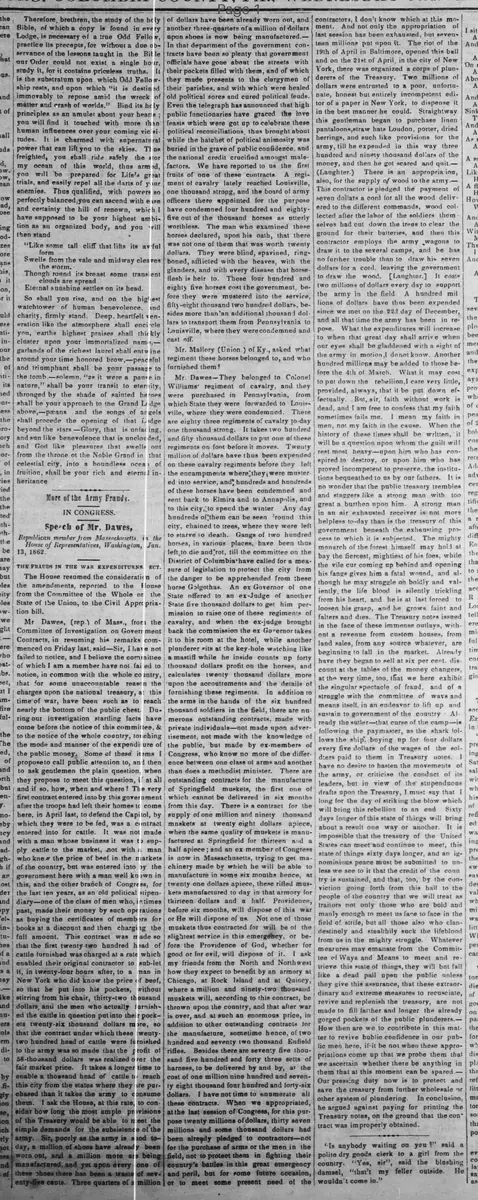
IN CONGRESS.
Speech of Mr. Dawes,
Republican member from Massachusetts, in the
House of Representatives, Washington, Jan.
13, 1862.
THE FRAUDS IN THE WAR EXPENDITURES, ETC.
The House resumed the consideration of
the amendments, reported to the House
from the Committee of the Whole on the
State of the Union, to the Civil Appropriation
bill.
Mr. Dawes, (rep.) of Mass., from the
Committee of Investigation on Government
Contracts, in resuming his remarks commenced
on Friday last, said--Sir, I have not
failed to notice, and I believe the committee
of which I am a member have not failed to
notice, in common with the whole country,
that for some unaccountable reason the
charges upon the national treasury, at this
time of war, have been such as to reach
nearly the bottom of the public chest.
During our investigation startling facts
have come before the notice of this committee, and
to the notice of the whole country, touching
the mode and manner of the expenditure of
the public money. Some of these items I
propose to call public attention to, and then
to ask gentlemen the plain question, when
they propose to meet this question, if at all
and if so, how, when and where? The very
first contract entered into by this government
after the troops had left their homes to come
here, in April last, to defend the Capitol, by
which they were to be fed, was a contract
entered into for cattle. It was not made
with a man whose business it was to supply
cattle to the market, not with a man
who knew the price of beef in the markets
of the country, but was entered into by the
government here with a man well known in
this and the other branch of Congress, for
the last ten years, as an old political stipendiary--one of the class of men who, in times
past, made their money by such operations
as buying the certificates of members for
books at a discount and then charging the
full amount. This contract was made so
that the first twenty-two hundred head of
cattle furnished was charged at a rate which
enabled their original contractor to
sub-let
it, in twenty-four hours after, to a man in
New York who did know the price of beef,
so that he put into his pockets, without
stirring from his chair, thirty-two thousand
dollars, and the men who actually furnished
the cattle in question put into their pockets
twenty-six thousand dollars more, so
that the contract under which these twenty-two
hundred head of cattle were furnished
to the army was so made that the profit of
fifty-eight thousand dollars was realized over the
fair market price. It takes a longer time to
enable a thousand head of cattle to reach
this city from the states where they are purchased
than it takes the army to consume
them. I ask the House, at this rate, to consider
how long the most ample provisions
of the Treasury would be able to meet the
simple demands for the subsistence of the
army. Sir, poorly as the army is armed today,
a million of shoes have already been
worn out, and a million more are being
manufactured, and yet upon every
one of
these shoes there has been a waste of seventy-five
cents. Three quarters of a
million
of dollars have been already worn out, and
another three-quarters of a million of dollars
upon shoes is now being manufactured.
In that department of the government contracts
have been so plenty that government
officials have gone about the streets with
their pockets filled with them, and of which
they made presents to the clergymen of
their parishes, and with which were healed
old political sores and cured political feuds.
Even the telegraph has announced that high
public functionaries have graced the love
feasts which were got up to celebrate these
political reconciliations thus brought about
while the hatchet of political animosity was
buried in the grave of public confidence, and
the national credit crucified amongst malefactors.
We have reported to us the first
fruits of one of these contracts. A regiment
of cavalry lately reached Louisville,
one thousand strong, and the board of army
officers there appointed for the purpose
have condemned four hundred and eighty-five
out of the thousand horses as utterly
worthless. The man who examined these
horses declared, upon his oath, that there
was not one of them that was worth twenty
dollars. They were blind, spavined, ring-boned,
afflicted with the heaves, with the
glanders, and with every disease that horse-flesh
is heir to. These four hundred and eighty-five
horses cost the government, before
they were mustered into the service,
fifty-eight thousand two hundred dollars, besides
more than an additional thousand dollars
to transport them from Pennsylvania to
Louisville, where they were condemned and
cast off.
Mr. Mallory (Union) of Ky., asked what
regiment these horses belonged to, and who
furnished them?
Mr. Dawes--They belonged to Colonel
Williams' regiment of cavalry, and they
were purchased in Pennsylvania, from
which State they were forwarded to Louisville,
where they were condemned. There
are eighty-three regiments of cavalry today
one thousand strong. It takes two hundred
and fifty thousand dollars to put one of these
regiments on foot before it moves. Twenty
million of dollars have thus been expended
on these cavalry regiments before they left
the encampments where they were mustered
into service, and hundreds and hundreds
of these horses have been condemned and
sent back to Elmira and to Annapolis, and
to this city, to spend the winter. Any day
hundreds of them can be seen round this
city, chained to trees, where they were left
to starve to death. Gangs of two hundred
horses, in various places, have been thus
left to die and rot, till the committee on the
District of Columbia have called for a measure
of legislation to protect the city from
the danger to be apprehended from these
horse Golgothas. An ex-Governor of one
State offered to an ex-Judge of another
State five thousand dollars to get him permission
to raise one of these regiments of
cavalry, and when the ex-judge brought
back the commission the ex-Governor takes
it to his room at the hotel, while another
plunderer puts at the key-hole watching like
a mastiff while he inside counts up forty
thousand dollars profit on the horses, and
calculates twenty thousand dollars more
upon the accoutrements and the details of
furnishing these regiments. In addition to
the arms in the hands of the six hundred
thousand soldiers in the field, there are numerous
outstanding contracts, made with
private individuals--not made upon advertisement,
not made with the knowledge of
the public, but made by ex-members of
Congress, who know no more of the difference
between one class of arms and another
than does a Methodist minister. There are
outstanding contracts for the manufacture
of Springfield muskets, the first one of
which cannot be delivered in six months
from this day. There is a contract for the
supply of one million and ninety thousand
muskets at twenty-eight dollars apiece,
when the same quality of muskets is manufactured
at Springfield for thirteen and a
half apiece; and an ex-member of Congress
is now in Massachusetts, trying to get machinery
made by which he will be able to
manufacture in some six months hence, at
twenty-one dollars apiece, these rifled muskets
manufactured today in that armory for
thirteen dollars and a half. Providence,
before six months, will dispose of this war
or He will dispose of us. Not one of those
muskets thus contracted for will be of the
slightest service in this emergency, or before
the Providence of God, whether for
good or for evil, will dispose of it. I ask
my friends from the North and Northwest
how they expect to benefit by an armory at
Chicago, at Rock Island and at Quincy,
where a million and ninety-two thousand
muskets will, according to this contract, be
thrown upon the country, and that after war
is over, and at such an enormous price, in
addition to other outstanding contracts for
the manufacture, sometime hence, of two
hundred and seventy-two thousand Enfield
rifles. Besides there are seventy-five thousand
five hundred and forty-three sets of
harness, to be delivered by and by, at the
cost of one million nine hundred and seventy-eight
thousand four hundred and forty-six
dollars. I have not time to enumerate all
these contracts. When we appropriated,
at the last session of Congress, for this purpose
twenty millions of dollars, thirty-seven
millions and some thousand dollars had
been already pledged to contractors--not
for the purchase of arms or the men in the
field, not to protect them in fighting their
country's battles in this great emergency
and peril, but for some future occasion,
or to meet some present need of the
contractors, I don't know which at this moment.
And not only the appropriation of
last session has been exhausted, but seventeen
millions put upon it. The riot of the
19th of April in Baltimore, opened this war,
and on the 21st of April, in the city of New
York, there was organized a corps of plunderers
of the Treasury. Two millions of
dollars were entrusted to a poor, unfortunate,
honest but entirely incompetent editor
of a paper in New York, to dispense it
in the best manner he could. Straightway
this gentleman began to purchase linen
pantaloons, straw hats, London porter, dried
herrings, and such like provisions for the
army, till he expended in this way three
hundred and ninety thousand dollars of the
money, and then he got scared and quit.
(Laughter.) There is an appropriation,
also, for the supply of wood to the army.
This contractor is pledged the payment of
seven dollars a cord for all the wood delivered
to the different commands, wood collected
after the labor of the soldiers themselves
had cut down the trees to clear the
ground for their batteries, and then this
contractor employs the army wagons to
draw it to the several camps, and he has
no further trouble than to draw his seven
dollars for a cord, leaving the government
to draw the wood. (Laughter.) It costs
two millions of dollars every day to support
the army in the field. A hundred millions
of dollars have thus been expended
since we met on the 22d day of December,
and all that time the army has been in repose.
What the expenditures will increase
to when that great day shall arrive when
our eyes shall be gladdened with a sight of
the army in motion, I do not know. Another
hundred millions may be added to those before
the 4th of March. What it may cost
to put down the rebellion, I care very little,
provided, always, that it be put down effectually.
But, sir, faith without work is
dead, and I am free to confess that my faith
sometimes fails me. I mean my faith in
men, not my faith in the cause. When the
history of these times shall be written, it
will be a question upon whom the guilt will
rest most heavy--upon him who has conspired
to destroy, or upon him who has
proved incompetent to preserve, the institutions
bequeathed to us by our fathers. It is
no wonder that the public treasury trembles
and staggers like a strong man with too
great a burden upon him. A strong man
in an air exhausted receiver is not more
helpless today than is the treasury of this
government beneath the exhausting process
to which it is subjected. The mighty
monarch of the forest himself may hold at
bay the fiercest, mightiest of his foes, while
the vile cur coming up behind and opening
his fangs gives him a fatal wound, and although
he may struggle on boldly and valiantly,
the life blood is silently trickling
from his heart, and he is at last forced to
loosen his grasp, and he grows faint and
falters and dies. The Treasury notes issued
in the face of these immense outlays, without
a revenue from custom houses, from
land sales, from any source whatever, are
beginning to fall in the market. Already
have they began to sell at six per cent. discount
at the tables of the money changers,
at the very time, too, that we here exhibit
the singular spectacle of fraud, and of a
struggle with the committee of ways and
means itself, in an endeavor to lift up and
sustain the government of the country. Already
the sutler--that curse of the camp--is
following the paymaster, as the shark follows
the ship, buying up for four dollars
every five dollars of the wages of the soldiers
paid to them in Treasury notes. I
have no desire to hasten the movements of
the army, or criticise the conduct of its
leaders, but in view of the stupendous
drafts upon the Treasury, I must say that I
long for the day of striking the blow which
will bring this rebellion to an end. Sixty
days longer of this state of things will bring
about a result one way or another. It is
impossible that the treasury of the United
States can meet and continue to meet, this
state of things sixty days longer, and an ignominious
peace must be submitted to unless
we see to it that the credit of the country
is sustained, and that, too, by the conviction
going forth from this hall to the
people of the country that we will treat as
traitors not only those who are bold and
manly enough to meet us face to face in the
field of strife, but all those also who clandestinely
and stealthily suck the lifeblood
from us in the mighty struggle. Whatever
measures may emanate from the Committee
of Ways and Means to meet and retrieve
this state of things, they will but fall
like a dead pall upon the public unless
they give this assurance, that these extraordinary
and extreme measures to resuscitate,
revive and replenish the treasury, are not
made to fill farther and longer the already
gorged pockets of the public plunderers.
How then are we to contribute in this matter
to revive public confidence in our public
men here, if it be not when these appropriations
come up that we probe them that
we ascertain whether there be anything in
them that at this moment can be spared.
Our pressing duty now is to protect and
save the treasury from further wholesale or
other system of plundering. In conclusion,
he argued against paying for printing the
Treasury notes, on the ground that the contract
was improperly obtained.
What sub-type of article is it?
What keywords are associated?
What entities or persons were involved?
Where did it happen?
Domestic News Details
Primary Location
Washington
Event Date
Jan. 13, 1862
Key Persons
Outcome
numerous frauds exposed including over $58,000 profit on cattle contract, 485 worthless horses costing $58,200 plus transport, overpriced shoes wasting $1.5 million, delayed and overpriced arms contracts, treasury notes discounted 6%, potential treasury collapse in 60 days.
Event Details
Congressman Dawes resumes speech on government contract investigations, detailing frauds in cattle supply, shoes, horses for cavalry regiments, arms manufacturing, harness, wood supply, and other war expenditures, criticizing political favoritism and incompetence leading to massive waste and threats to national credit during the Civil War.