Thank you for visiting SNEWPapers!
Sign up free
Letter to Editor
September 4, 1872
The Fairfield Herald
Winnsboro, Fairfield County, South Carolina
What is this article about?
A traveler describes recent improvements and prosperity in South Carolina's Pee Dee region, especially Marion County, highlighting thriving agriculture, rebuilt towns, and a post-war church, urging locals not to migrate west. Signed E. J. M. from Monticello, Aug. 1872.
Clipping
OCR Quality
95%
Excellent
Full Text
[COMMUNICATED.]
Mr. Editor:
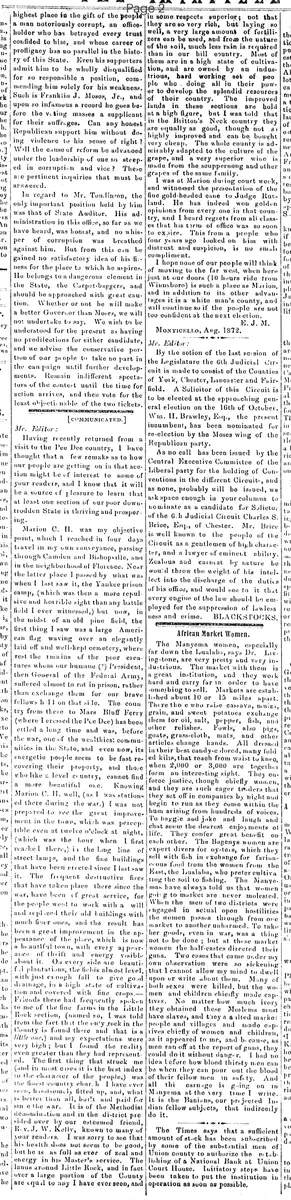
Having recently returned from a visit to the Pee Dee country, I have thought that a few remarks as to how our people are getting on in that section might be of interest to some of your readers, and I know that it will be a source of pleasure to learn that at least one section of our poor down-trodden State is thriving and prospering.
Marion C. H. was my objective point, which I reached in four days travel in my own conveyance, passing through Camden and Bishopville, and in the neighborhood of Florence. Near the latter place I passed by what was when I last saw it, the Yankee prison camp, (which was then a more repulsive and horrible sight than any battle field I ever witnessed,) but now, in the midst of an old pine field, the first thing I saw was a large American flag waving over an elegantly laid off and well-kept cemetery, where rest the remains of the poor creatures whom our humane (?) President, then General of the Federal Army, suffered almost to rot in prison, rather than exchange them for our brave fellows he had on that side. The country from there to Mars Bluff Ferry (where I crossed the Pee Dee) has been settled a long time and was, before the war, one of the wealthiest communities in the State, and even now, its energetic people seem to be fast recovering their property, and those who like a level country, cannot find a more beautiful one. Knowing Marion C. H. well, (as I was stationed there during the war.) I was not prepared to see the great improvement in the town, which was perceptible even at twelve o'clock at night, (which was the hour when I first reached there,) in the long line of street lamps, and the fine buildings that have been erected since I last saw it. The frequent destructive fires that have taken place there since the war, have been of great service, for the people went to work with a will and replaced their old buildings with much finer ones, and the result has been a great improvement in the appearance of the place, which is now a beautiful town, with every appearance of thrift and energy visible about it. On every side are beautiful plantations, the fields almost level, with just enough fall to give good drainage, in a high state of cultivation and covered with fine crops.
Friends there had frequently spoken to me of the fine farms in the Little Rock section, (named so, I was told from the fact that the only rock in the County is found there and that is a little one,) and my expectations were very high: but I found the reality even greater than they had represented. The first thing that struck me (and in most cases it is the best index to the character of the people,) was the finest country church I have ever seen, handsomely fitted up, and, what is better than all, built and paid for since the war. It is of the Methodist denomination and in the district presided over by our esteemed friend, Rev. J. W. Kelly, known to many of your readers. I was sorry to see that his health does not seem to be good, but he is as full as ever of zeal and energy in his Master's service. The farms around Little Rock, and in fact over a large portion of the County are equal to any I have ever seen, and in some respects superior; not that they are so very rich, but laying so well, a very large amount of fertilizers can be used, and from the nature of the soil, much less rain is required than in our hill country. Most of them are in a high state of cultivation, and are owned by an industrious, hard working set of people who are doing all in their power to develop the splendid resources of their country. The improved lands in these sections are held at a high figure, but I was told that in the Britton's Neck country they are equally as good, though not so highly improved and can be bought very cheap. The whole county is admirably adapted to the culture of the grape, and a very superior wine is made from the scuppernong and other grapes of the same family.
I was at Marion during court week, and witnessed the presentation of the fine gold-headed cane to Judge Rutland. He has indeed won golden opinions from every one in that country, and I heard regrets from all classes that his term of office was so soon to expire. This from a people who four years ago looked on him with distrust and suspicion, is no small compliment.
I hope none of our people will think of moving to the far west, when here just at our doors (10 hours ride from Winnsboro) is such a place as Marion, and in addition to its other advantages it is a white man's county, and will continue so if the people are not too confident at the next election.
E. J. M.
MONTICELLO, Aug. 1872.
Mr. Editor:
Having recently returned from a visit to the Pee Dee country, I have thought that a few remarks as to how our people are getting on in that section might be of interest to some of your readers, and I know that it will be a source of pleasure to learn that at least one section of our poor down-trodden State is thriving and prospering.
Marion C. H. was my objective point, which I reached in four days travel in my own conveyance, passing through Camden and Bishopville, and in the neighborhood of Florence. Near the latter place I passed by what was when I last saw it, the Yankee prison camp, (which was then a more repulsive and horrible sight than any battle field I ever witnessed,) but now, in the midst of an old pine field, the first thing I saw was a large American flag waving over an elegantly laid off and well-kept cemetery, where rest the remains of the poor creatures whom our humane (?) President, then General of the Federal Army, suffered almost to rot in prison, rather than exchange them for our brave fellows he had on that side. The country from there to Mars Bluff Ferry (where I crossed the Pee Dee) has been settled a long time and was, before the war, one of the wealthiest communities in the State, and even now, its energetic people seem to be fast recovering their property, and those who like a level country, cannot find a more beautiful one. Knowing Marion C. H. well, (as I was stationed there during the war.) I was not prepared to see the great improvement in the town, which was perceptible even at twelve o'clock at night, (which was the hour when I first reached there,) in the long line of street lamps, and the fine buildings that have been erected since I last saw it. The frequent destructive fires that have taken place there since the war, have been of great service, for the people went to work with a will and replaced their old buildings with much finer ones, and the result has been a great improvement in the appearance of the place, which is now a beautiful town, with every appearance of thrift and energy visible about it. On every side are beautiful plantations, the fields almost level, with just enough fall to give good drainage, in a high state of cultivation and covered with fine crops.
Friends there had frequently spoken to me of the fine farms in the Little Rock section, (named so, I was told from the fact that the only rock in the County is found there and that is a little one,) and my expectations were very high: but I found the reality even greater than they had represented. The first thing that struck me (and in most cases it is the best index to the character of the people,) was the finest country church I have ever seen, handsomely fitted up, and, what is better than all, built and paid for since the war. It is of the Methodist denomination and in the district presided over by our esteemed friend, Rev. J. W. Kelly, known to many of your readers. I was sorry to see that his health does not seem to be good, but he is as full as ever of zeal and energy in his Master's service. The farms around Little Rock, and in fact over a large portion of the County are equal to any I have ever seen, and in some respects superior; not that they are so very rich, but laying so well, a very large amount of fertilizers can be used, and from the nature of the soil, much less rain is required than in our hill country. Most of them are in a high state of cultivation, and are owned by an industrious, hard working set of people who are doing all in their power to develop the splendid resources of their country. The improved lands in these sections are held at a high figure, but I was told that in the Britton's Neck country they are equally as good, though not so highly improved and can be bought very cheap. The whole county is admirably adapted to the culture of the grape, and a very superior wine is made from the scuppernong and other grapes of the same family.
I was at Marion during court week, and witnessed the presentation of the fine gold-headed cane to Judge Rutland. He has indeed won golden opinions from every one in that country, and I heard regrets from all classes that his term of office was so soon to expire. This from a people who four years ago looked on him with distrust and suspicion, is no small compliment.
I hope none of our people will think of moving to the far west, when here just at our doors (10 hours ride from Winnsboro) is such a place as Marion, and in addition to its other advantages it is a white man's county, and will continue so if the people are not too confident at the next election.
E. J. M.
MONTICELLO, Aug. 1872.
What sub-type of article is it?
Informative
Reflective
Persuasive
What themes does it cover?
Agriculture
Social Issues
Politics
What keywords are associated?
Pee Dee
Marion
Post War Recovery
Farms
South Carolina
What entities or persons were involved?
E. J. M.
Mr. Editor
Letter to Editor Details
Author
E. J. M.
Recipient
Mr. Editor
Main Argument
the pee dee country, particularly marion, is thriving post-war with improved towns, farms, and communities, offering better opportunities locally than moving west.
Notable Details
Yankee Prison Camp Now Cemetery With American Flag
Post War Church Built And Paid For
Presentation Of Gold Headed Cane To Judge Rutland
White Man's County