Thank you for visiting SNEWPapers!
Sign up free
The Waco Daily Examiner
Waco, Mclennan County, Texas
What is this article about?
The Congregational Council of New England approves Rev. Dr. Newman Smyth's orthodoxy, rejecting Calvinistic eternal punishment and a physical hell, with his views on probation, atonement, and divine judgment supported by modern Congregationalists, indicating religious progress in New England.
Clipping
OCR Quality
Full Text
What sub-type of article is it?
What keywords are associated?
What entities or persons were involved?
Where did it happen?
Domestic News Details
Primary Location
New England
Key Persons
Outcome
approval of rev. dr. newman smyth's orthodoxy by the congregational council of new england, defeating supporters of calvinistic eternal punishment.
Event Details
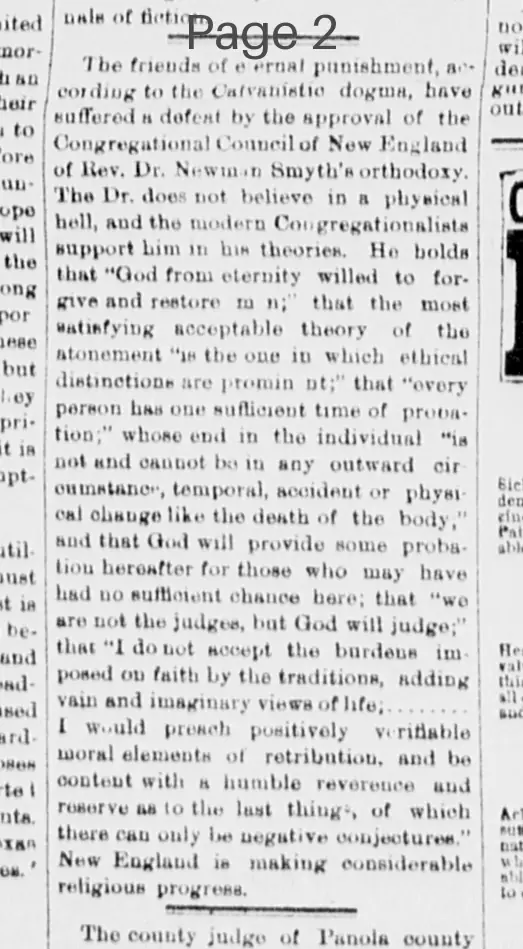
The friends of eternal punishment, according to the Calvinistic dogma, have suffered a defeat by the approval of the Congregational Council of New England of Rev. Dr. Newman Smyth's orthodoxy. The Dr. does not believe in a physical hell, and the modern Congregationalists support him in his theories. He holds that 'God from eternity willed to forgive and restore man;' that the most satisfying acceptable theory of the atonement 'is the one in which ethical distinctions are prominent;' that 'every person has one sufficient time of probation,' whose end in the individual 'is not and cannot be in any outward circumstance, temporal, accident or physical change like the death of the body,' and that God will provide some probation hereafter for those who may have had no sufficient chance here, that 'we are not the judges, but God will judge;' that 'I do not accept the burdens imposed on faith by the traditions, adding vain and imaginary views of life,' 'I would preach positively veritable moral elements of retribution, and be content with a humble reverence and reserve as to the last thing, of which there can only be negative conjectures.' New England is making considerable religious progress.