Thank you for visiting SNEWPapers!
Sign up free
Editorial
June 26, 1878
The Indiana State Sentinel
Indianapolis, Marion County, Indiana
What is this article about?
The editorial criticizes the American obsession with erecting public monuments that often glorify mediocrity, misrepresent history, and prioritize notoriety over true virtue. It specifically argues that the Lincoln statue in Washington symbolizes emancipation inaccurately, as Lincoln freed slaves primarily to preserve the Union, not out of anti-slavery philanthropy.
Clipping
OCR Quality
100%
Excellent
Full Text
THE MONUMENTAL MANIA.
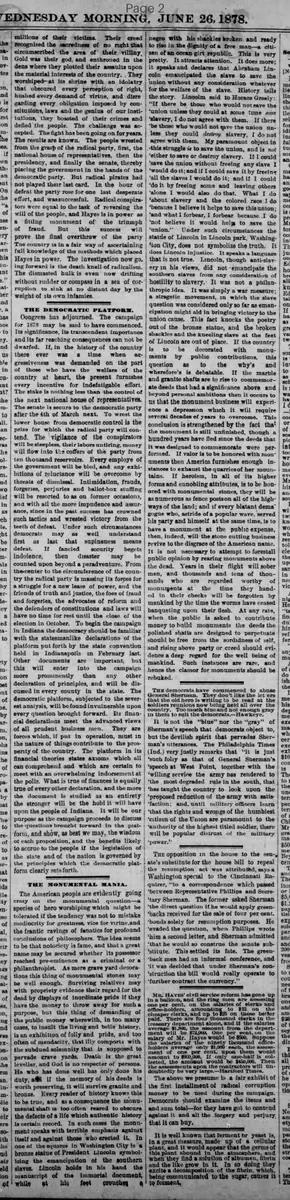
The American people are evidently going crazy on the monumental question—a species of hero worshiping which might be tolerated if the tendency was not to mistake mediocrity for greatness, vice for virtue, and the frantic ravings of fanatics for profound conclusions of philosophers. The idea seems to be that notoriety is fame, and that a great name may be secured whether its possessor reached pre-eminence as a criminal or a philanthropist. As mere grave yard decorations this thing of monumental stones may be well enough. Surviving relatives may with propriety evidence their regard for the dead by displays of inordinate pride if they have the money to throw away for such a purpose, but this thing of demanding of the public money wherewith, in too many cases, to insult the living and belie history, is an exhibition of folly and pride, and too often of mendacity, that illy comports with the subdued solemnity that is supposed to pervade grave yards. Death is the great leveller, and God is no respecter of persons. He who has done well has only done his duty, and if the memory of his deeds is worth preserving, it will survive granite and bronze. Every reader of history knows this to be true, and as a consequence the monumental shaft is too often reared to obscure the defects of a life which authentic history is certain to record. In such cases the monument speaks with terrible emphasis against itself and against those who erected it. In one of the squares in Washington City is a bronze statue of President Lincoln symbolizing the emancipation of the southern slaves. Lincoln holds in his hand the manuscript of the immortal document, while at his feet crouches a negro with his shackles broken and ready to rise in the dignity of a free man—a citizen of an ocean girt republic. This is very pretty. It attracts attention. It does more; it speaks and declares that Abraham Lincoln emancipated the slave to save the union without any consideration whatever for the welfare of the slave. History tells the story. Lincoln said to Horace Greeley: 'If there be those who would not save the union unless they could at some time save slavery, I do not agree with them. If there be those who would not save the union unless they could destroy slavery, I do not agree with them. My paramount object in this struggle is to save the union, and is not either to save or destroy slavery. If I could save the union without freeing any slave I would do it: and if I could save it by freeing all the slaves I would do it; and if I could do it by freeing some and leaving others alone I would also do that. What I do about slavery and the colored race I do because I believe it helps to save this union; and what I forbear, I forbear because I do not believe it would help to save the union.' Under such circumstances the statue of Lincoln in Lincoln park, Washington City, does not symbolize the truth. It does Lincoln injustice. It speaks a language that is not true. Lincoln, though anti-slavery in his views, did not emancipate the southern slaves from any consideration of hostility to slavery. It was not a philanthropic idea. It was simply a war measure: a strategic movement, in which the slave question was considered only so far as emancipation might aid in bringing victory to the union cause. This fact knocks the poetry out of the bronze statue, and the broken shackles and the kneeling slave at the feet of Lincoln are out of place. If the country is to be decorated with monuments by public contributions, this question as to the why's and wherefore's is debatable. If the marble and granite shafts are to rise to commemorate deeds that had a significance above and beyond personal ambitions then it occurs to us that the monument business will experience a depression which it will require several decades of years to overcome. This conclusion is strengthened by the fact that the monument is still unfinished, though a hundred years have fled since the deeds that it was designed to commemorate were performed. If valor is to be honored with monuments then America furnishes enough instances to exhaust the quarries of her mountains. If heroism, in all of its higher forms and ennobling attributes, is to be honored with monumental stones, they will be as numerous as fence posts on all of the highways of the land; and if every blatant demagogue who, astride of a popular wave, served his party and himself at the same time, is to have a monument at the public expense, then, indeed, will the stone cutting business revive to the disgrace of the American name. It is not necessary to attempt to forestall public opinion by rearing monuments above the dead. Years in their flight will sober men, and thousands and tens of thousands who are regarded worthy of monuments at the time they handed in their checks will be forgotten by mankind by the time the worms have ceased banqueting upon their flesh. At any rate, when the public is asked to contribute money to build monuments the deeds the polished shafts are designed to perpetuate should be free from the sordidness of self, and rising above party or creed should evidence a dear regard for the well being of mankind. Such instances are rare, and hence the clamor for monuments should be rebuked.
The American people are evidently going crazy on the monumental question—a species of hero worshiping which might be tolerated if the tendency was not to mistake mediocrity for greatness, vice for virtue, and the frantic ravings of fanatics for profound conclusions of philosophers. The idea seems to be that notoriety is fame, and that a great name may be secured whether its possessor reached pre-eminence as a criminal or a philanthropist. As mere grave yard decorations this thing of monumental stones may be well enough. Surviving relatives may with propriety evidence their regard for the dead by displays of inordinate pride if they have the money to throw away for such a purpose, but this thing of demanding of the public money wherewith, in too many cases, to insult the living and belie history, is an exhibition of folly and pride, and too often of mendacity, that illy comports with the subdued solemnity that is supposed to pervade grave yards. Death is the great leveller, and God is no respecter of persons. He who has done well has only done his duty, and if the memory of his deeds is worth preserving, it will survive granite and bronze. Every reader of history knows this to be true, and as a consequence the monumental shaft is too often reared to obscure the defects of a life which authentic history is certain to record. In such cases the monument speaks with terrible emphasis against itself and against those who erected it. In one of the squares in Washington City is a bronze statue of President Lincoln symbolizing the emancipation of the southern slaves. Lincoln holds in his hand the manuscript of the immortal document, while at his feet crouches a negro with his shackles broken and ready to rise in the dignity of a free man—a citizen of an ocean girt republic. This is very pretty. It attracts attention. It does more; it speaks and declares that Abraham Lincoln emancipated the slave to save the union without any consideration whatever for the welfare of the slave. History tells the story. Lincoln said to Horace Greeley: 'If there be those who would not save the union unless they could at some time save slavery, I do not agree with them. If there be those who would not save the union unless they could destroy slavery, I do not agree with them. My paramount object in this struggle is to save the union, and is not either to save or destroy slavery. If I could save the union without freeing any slave I would do it: and if I could save it by freeing all the slaves I would do it; and if I could do it by freeing some and leaving others alone I would also do that. What I do about slavery and the colored race I do because I believe it helps to save this union; and what I forbear, I forbear because I do not believe it would help to save the union.' Under such circumstances the statue of Lincoln in Lincoln park, Washington City, does not symbolize the truth. It does Lincoln injustice. It speaks a language that is not true. Lincoln, though anti-slavery in his views, did not emancipate the southern slaves from any consideration of hostility to slavery. It was not a philanthropic idea. It was simply a war measure: a strategic movement, in which the slave question was considered only so far as emancipation might aid in bringing victory to the union cause. This fact knocks the poetry out of the bronze statue, and the broken shackles and the kneeling slave at the feet of Lincoln are out of place. If the country is to be decorated with monuments by public contributions, this question as to the why's and wherefore's is debatable. If the marble and granite shafts are to rise to commemorate deeds that had a significance above and beyond personal ambitions then it occurs to us that the monument business will experience a depression which it will require several decades of years to overcome. This conclusion is strengthened by the fact that the monument is still unfinished, though a hundred years have fled since the deeds that it was designed to commemorate were performed. If valor is to be honored with monuments then America furnishes enough instances to exhaust the quarries of her mountains. If heroism, in all of its higher forms and ennobling attributes, is to be honored with monumental stones, they will be as numerous as fence posts on all of the highways of the land; and if every blatant demagogue who, astride of a popular wave, served his party and himself at the same time, is to have a monument at the public expense, then, indeed, will the stone cutting business revive to the disgrace of the American name. It is not necessary to attempt to forestall public opinion by rearing monuments above the dead. Years in their flight will sober men, and thousands and tens of thousands who are regarded worthy of monuments at the time they handed in their checks will be forgotten by mankind by the time the worms have ceased banqueting upon their flesh. At any rate, when the public is asked to contribute money to build monuments the deeds the polished shafts are designed to perpetuate should be free from the sordidness of self, and rising above party or creed should evidence a dear regard for the well being of mankind. Such instances are rare, and hence the clamor for monuments should be rebuked.
What sub-type of article is it?
Moral Or Religious
Slavery Abolition
Social Reform
What keywords are associated?
Monumental Mania
Hero Worship
Lincoln Statue
Emancipation History
Public Monuments
What entities or persons were involved?
Abraham Lincoln
Horace Greeley
Southern Slaves
Editorial Details
Primary Topic
Critique Of Public Monuments Misrepresenting Historical Figures And Events
Stance / Tone
Critical Of Monumental Mania And Emphasis On Historical Accuracy Over Flattery
Key Figures
Abraham Lincoln
Horace Greeley
Southern Slaves
Key Arguments
Monuments Often Mistake Mediocrity For Greatness And Vice For Virtue
Public Monuments Funded By Taxpayers Insult The Living And Belie History
Lincoln's Emancipation Was A War Measure To Save The Union, Not Philanthropy
True Greatness Survives Without Monuments
Monuments Should Commemorate Selfless Deeds For Mankind's Well Being