Thank you for visiting SNEWPapers!
Sign up free
Daily National Intelligencer
Washington, District Of Columbia
What is this article about?
On November 10, the U.S. Senate debated a bill to expand army enlistment by lowering age consent requirements and increasing land bounties, amid War of 1812 discussions. A militia enrollment bill for younger males was reported. In the House, petitions were referred, resolutions on army supplies passed, and various bills advanced or disagreed upon.
Merged-components note: These two sequential components in reading order 47 and 48 continue the same article reporting on congressional proceedings in the Senate and House on November 10, 1814, with the text directly flowing from one to the other without a break in topic.
Clipping
OCR Quality
Full Text
IN SENATE,
THURSDAY, NOVEMBER 10.
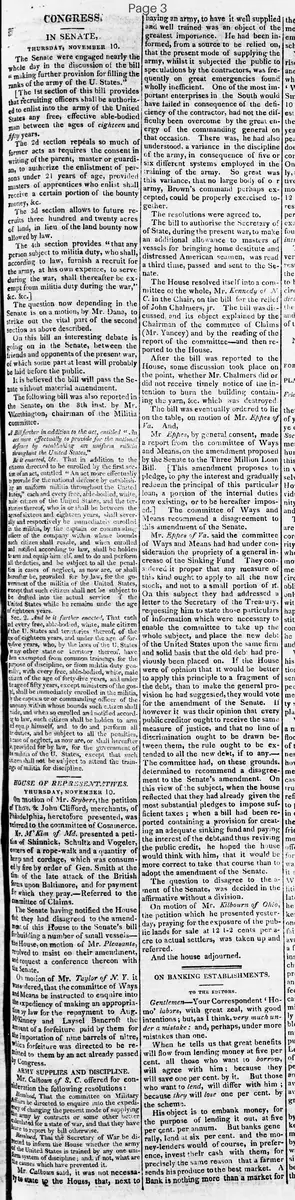
The Senate were engaged nearly the whole day in the discussion of the bill "making further provision for filling the ranks of the army of the U. States."
[The 1st section of this bill provides that recruiting officers shall be authorized to enlist into the army of the United States any free, effective, able-bodied man between the ages of eighteen and fifty years.
The 2d section repeals so much of former acts as requires the consent in writing of the parent, master or guardian, to authorize the enlistment of persons under 21 years of age, provided masters of apprentices who enlist shall receive a certain portion of the bounty money, &c.
The 3d section allows to future recruits three hundred and twenty acres of land, in lieu of the land bounty now allowed by law.
The 4th section provides "that any person subject to militia duty, who shall, according to law, furnish a recruit for the army, at his own expense, to serve during the war, shall thereafter be exempt from militia duty during the war," &c. &c.]
The question now depending in the Senate is on a motion, by Mr. Dana, to strike out the vital part of the second section as above described.
On this bill an interesting debate is going on in the Senate, between the friends and opponents of the present war, of which some part at least will probably be laid before the public.
It is believed the bill will pass the Senate without material amendment.
The following bill was also reported in the Senate, on the 8th inst. by Mr. Worthington, chairman of the Militia committee.
A Bill further in addition to the act, entitled "An act more effectually to provide for the national defence by establishing an uniform militia throughout the United States."
Be it enacted, &c. That in addition to the citizens directed to be enrolled by the first section of an act, entitled "An act more effectually to provide for the national defence by establishing an uniform militia throughout the United States," each and every free, able-bodied, white, male citizen of the United States, and the territories thereof, who is or shall be between the ages of sixteen and eighteen years, shall severally and respectively be immediately enrolled in the militia, by the captain or commanding officer of the company within whose bounds such citizen shall reside, and when enrolled and notified according to law, shall be holden to arm and equip himself, and to do and perform all the duties, and be subject to all the penalties in cases of neglect, as now are, or shall hereafter be, provided for by law, for the government of the militia of the United States, except that such citizen shall not be subject to be drafted into the actual service of the United States while he remains under the age of eighteen years.
Sec. 2. And be it further enacted, That each and every free, able-bodied, white, male citizen of the U. States and territories thereof, of the age of eighteen years, and under the age of forty-five years, who, by the laws of the U. States or any other state or territory thereof, have been exempted from common trainings for the purpose of discipline, or from militia duty generally, with every free, able-bodied, white, male citizen of the age of forty-five years, and under the age of fifty years, except ministers of the gospel, shall be immediately enrolled in the militia, by the captain or commanding officer of the company within whose bounds such citizen shall reside, and when so enrolled and notified according to law, such citizen shall be holden to arm and equip himself, and to do and perform all the duties, and be subject to all the penalties, in case of neglect, as now are, or shall hereafter be, provided for by law, for the government of the militia of the U. States, except that such citizen shall not be subject to attend the trainings of militia for discipline.
HOUSE OF REPRESENTATIVES.
THURSDAY, NOVEMBER 10.
On motion of Mr. Seybert, the petition of Thos. & John Clifford, merchants, of Philadelphia, heretofore presented, was referred to the committee of Commerce.
Mr. M'Kim of Md. presented a petition of Shinnick, Schultz and Vogeler, owners of a rope-walk and a quantity of hemp and cordage, which was consumed by fire by order of Gen. Smith at the time of the late attack of the British forces upon Baltimore, and for payment for which they pray.--Referred to the committee of Claims.
The Senate having notified the House that they had disagreed to the amendment of this House to the Senate's bill for building a number of small vessels--the House, on motion of Mr. Pleasants, resolved to insist on their amendment, and request a conference thereon with the Senate.
On motion of Mr. Taylor of N. Y. it was ordered, that the committee of Ways and Means be instructed to enquire into the expediency of making an appropriation by law for the repayment to Aug. M'Kinney and Laysel Bancroft the amount of a forfeiture paid by them for the importation of nine barrels of nitre, which forfeiture was directed to be remitted to them by an act already passed by Congress.
ARMY SUPPLIES AND DISCIPLINE.
Mr. Calhoun of S. C. offered for consideration the following resolutions:
Resolved, That the committee on Military Affairs be directed to enquire into the expediency of changing the present mode of supplying the army by contracts or some other better calculated for a state of war, and that they have leave to report by bill or otherwise.
Resolved, That the Secretary of War be directed to inform the House whether the army of the United States is trained by any one uniform system of discipline; and, if not, what are the causes which have prevented it.
Mr. Calhoun said, it was not necessary to state to the House, that, next to
having an army, to have it well supplied and well trained was an object of the greatest importance. He had been informed, from a source to be relied on, that the present mode of supplying the army, whilst it subjected the public to speculations by the contractors, was frequently on great emergencies found wholly inefficient. One of the most important enterprises in the South would have failed in consequence of the deficiency of the contractor, had not the difficulty been overcome by the great energy of the commanding general on that occasion. There was, he had also understood, a variance in the discipline of the army, in consequence of five or six different systems employed in the training of the army. So great was this variance, that no large body of our army, Brown's command perhaps excepted, could be properly exercised together.
The resolutions were agreed to.
The bill to authorise the Secretary of State, during the present war, to make an additional allowance to masters of vessels for bringing home destitute and distressed American seamen, was read a third time, passed and sent to the Senate.
The House resolved itself into a committee of the whole, Mr. Kennedy of N. C. in the Chair, on the bill for the relief of John Chalmers, jr. The bill was discussed, and its object explained by the Chairman of the committee of Claims (Mr. Yancey) and by the reading of the report of the committee--and then reported to the House.
After the bill was reported to the House, some discussion took place on the point, whether Mr. Chalmers did or did not receive timely notice of the intention to burn the building containing the yarn, &c. which was destroyed.
The bill was eventually ordered to lie on the table, on motion of Mr. Efnes of Va. And,
Mr. Efnes, by general consent, made a report from the committee of Ways and Means, on the amendment proposed by the Senate to the Three Million Loan Bill. [This amendment proposes to pledge, to pay the interest and gradually redeem the principal of this particular loan, a portion of the internal duties now existing, or to be hereafter imposed.]
The committee of Ways and Means recommend a disagreement to this amendment of the Senate.
Mr. Efnes of Va. said the committee of Ways and Means had had under consideration the propriety of a general increase of the Sinking Fund. They considered it proper that any measure of this kind ought to apply to all the new stock, and not to a small portion of it. On this subject they had addressed a letter to the Secretary of the Treasury, requesting him to state those particulars of information which were necessary to enable the committee to take up the whole subject, and place the new debt of the United States upon the same firm and solid basis that the old debt had previously been placed on. If the House were of opinion that it would be better to apply this principle to a fragment of the debt, than to make the general provision he had suggested, they would vote for the amendment of the Senate. If, however, it was their opinion that every public creditor ought to receive the same measure of justice, and that no line of discrimination ought to be drawn between them, the rule ought to be extended to all the new debt, if to any.--The committee had, on these grounds, determined to recommend a disagreement to the Senate's amendment. On this view of the subject, when the house reflected that they had already given the most substantial pledges to impose sufficient taxes; when a bill had been reported containing a provision for creating an adequate sinking fund and paying the interest of the debt, and thus reviving the public credit, he hoped the house would think with him, that it would be more correct to take that course than to adopt the amendment of the Senate.
The question to disagree to the amendment of the Senate, was decided in the affirmative without a division.
On motion of Mr. Kilbourn of Ohio, the petition which he presented yesterday, praying for the exposure of the public lands for sale at 1 1/2 cents per acre to actual settlers, was taken up and referred.
And the house adjourned.
What sub-type of article is it?
What keywords are associated?
What entities or persons were involved?
Domestic News Details
Event Date
November 10
Key Persons
Outcome
army enlistment bill debated in senate, expected to pass; militia enrollment bill reported; house referred petitions, passed resolutions on army supplies, disagreed to senate amendment on loan bill; various bills advanced or tabled.
Event Details
The Senate discussed a bill to authorize enlistment of men aged 18-50 without parental consent for under-21s, increase land bounties to 320 acres, and exempt militia providers from duty. Debate on striking consent repeal. A militia bill enrolled 16-18 year olds and exempted certain groups. In the House, petitions from Philadelphia merchants and Baltimore fire victims referred; insisted on amendment for vessel-building bill; inquired into nitre forfeiture repayment; resolutions to improve army supplies and uniform discipline passed; seamen relief bill passed; Chalmers relief bill tabled; disagreed to Senate's loan amendment; public lands petition referred.