Thank you for visiting SNEWPapers!
Sign up free
Editorial
July 15, 1829
Daily Richmond Whig
Richmond, Virginia
What is this article about?
Satirical Whig editorial mocks Virginia Governor Giles' new 'Retrospects' series in the Enquirer, highlighting inconsistencies in his constitutional interpretations of the Missouri Compromise versus protective tariffs, and defending Henry Clay's compromise role. Dated July 15, 1829.
Clipping
OCR Quality
95%
Excellent
Full Text
Richmond, Va.
WEDNESDAY MORNING, JULY 15, 1829.
For The Whig.
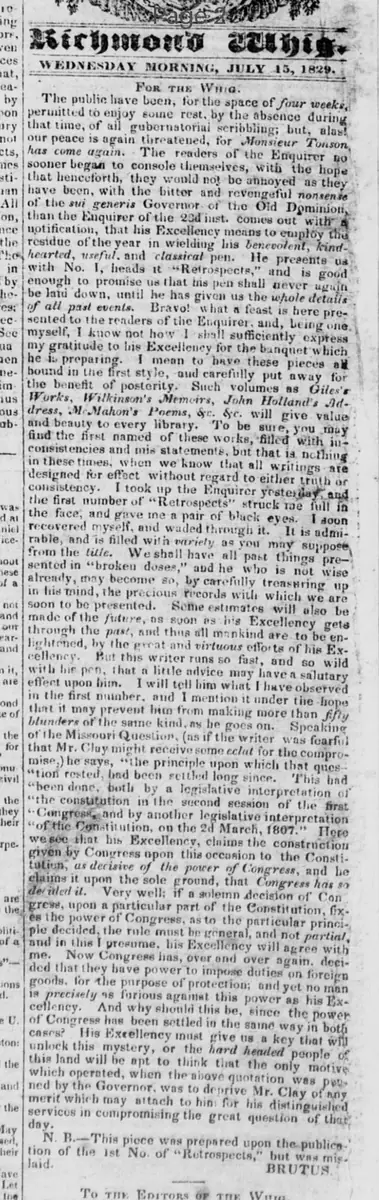
The public have been, for the space of four weeks, permitted to enjoy some rest, by the absence during that time, of all gubernatorial scribbling; but, alas! our peace is again threatened, for Monsieur Tonson, has come again. The readers of the Enquirer no sooner began to console themselves, with the hope that henceforth, they would not be annoyed as they have been, with the bitter and revengeful nonsense of the sui generis Governor of the Old Dominion, than the Enquirer of the 2d inst. comes out with notification, that his Excellency means to employ the residue of the year in wielding his benevolent, kind-hearted, useful, and classical pen. He presents us with No. I, heads it "Retrospects," and is good enough to promise us that his pen shall never again be laid down, until he has given us the whole details of all past events. Bravo! what a feast is here presented to the readers of the Enquirer, and, being one myself, I know not how I shall sufficiently express my gratitude to his Excellency for the banquet which he is preparing. I mean to have these pieces all bound in the first style, and carefully put away for the benefit of posterity. Such volumes as Giles's Works, Wilkinson's Memoirs, John Randolph's Address, Mc Mahon's Poems, &c. &c. will give value and beauty to every library. To be sure, you may find the first named of these works, filled with inconsistencies and misstatements, but that is nothing in these times, when we know that all writings are designed for effect without regard to either truth or consistency. I took up the Enquirer yesterday, and the first number of "Retrospects" struck me full in the face, and gave me a pair of black eyes. I soon recovered myself, and waded through it. It is admirable, and is filled with variety as you may suppose from the title. We shall have all past things presented in "broken doses," and he who is not wise already, may become so, by carefully treasuring up in his mind, the precious records with which we are soon to be presented. Some estimates will also be made of the future, as soon as his Excellency gets through the past, and thus all mankind are to be enlightened, by the great and virtuous efforts of his Excellency. But this writer runs so fast, and so wild with his pen, that a little advice may have a salutary effect upon him. I will tell him what I have observed in the first number, and I mention it under the hope that it may prevent him from making more than fifty blunders of the same kind, as he goes on. Speaking of the Missouri Question, (as if the writer was fearful that Mr. Clay might receive some eclat for the compromise,) he says, "the principle upon which that question rested, had been settled long since. This had been done, both by a legislative interpretation of the constitution in the second session of the first Congress, and by another legislative interpretation of the Constitution, on the 2d March, 1807." Here we see that his Excellency, claims the construction given by Congress upon this occasion to the Constitution, as decisive of the power of Congress, and he claims it upon the sole ground, that Congress has so decided it. 'Very well: if a solemn decision of Congress, upon a particular part of the Constitution, fixes the power of Congress, as to the particular principle decided, the rule must be general, and not partial, and in this I presume, his Excellency will agree with me. Now Congress has, over and over again, decided that they have power to impose duties on foreign goods, for the purpose of protection; and yet no man is precisely as furious against this power as his Excellency. And why should this be, since the power of Congress has been settled in the same way in both cases? His Excellency must give us a key that will unlock this mystery, or the hard headed people of this land will be apt to think that the only motive which operated, when the above quotation was penned by the Governor, was to deprive Mr. Clay of any merit which may attach to him for his distinguished services in compromising the great question of that day.
N. B.--This piece was prepared upon the publication of the 1st No. of "Retrospects," but was mislaid.
BRUTUS
WEDNESDAY MORNING, JULY 15, 1829.
For The Whig.
The public have been, for the space of four weeks, permitted to enjoy some rest, by the absence during that time, of all gubernatorial scribbling; but, alas! our peace is again threatened, for Monsieur Tonson, has come again. The readers of the Enquirer no sooner began to console themselves, with the hope that henceforth, they would not be annoyed as they have been, with the bitter and revengeful nonsense of the sui generis Governor of the Old Dominion, than the Enquirer of the 2d inst. comes out with notification, that his Excellency means to employ the residue of the year in wielding his benevolent, kind-hearted, useful, and classical pen. He presents us with No. I, heads it "Retrospects," and is good enough to promise us that his pen shall never again be laid down, until he has given us the whole details of all past events. Bravo! what a feast is here presented to the readers of the Enquirer, and, being one myself, I know not how I shall sufficiently express my gratitude to his Excellency for the banquet which he is preparing. I mean to have these pieces all bound in the first style, and carefully put away for the benefit of posterity. Such volumes as Giles's Works, Wilkinson's Memoirs, John Randolph's Address, Mc Mahon's Poems, &c. &c. will give value and beauty to every library. To be sure, you may find the first named of these works, filled with inconsistencies and misstatements, but that is nothing in these times, when we know that all writings are designed for effect without regard to either truth or consistency. I took up the Enquirer yesterday, and the first number of "Retrospects" struck me full in the face, and gave me a pair of black eyes. I soon recovered myself, and waded through it. It is admirable, and is filled with variety as you may suppose from the title. We shall have all past things presented in "broken doses," and he who is not wise already, may become so, by carefully treasuring up in his mind, the precious records with which we are soon to be presented. Some estimates will also be made of the future, as soon as his Excellency gets through the past, and thus all mankind are to be enlightened, by the great and virtuous efforts of his Excellency. But this writer runs so fast, and so wild with his pen, that a little advice may have a salutary effect upon him. I will tell him what I have observed in the first number, and I mention it under the hope that it may prevent him from making more than fifty blunders of the same kind, as he goes on. Speaking of the Missouri Question, (as if the writer was fearful that Mr. Clay might receive some eclat for the compromise,) he says, "the principle upon which that question rested, had been settled long since. This had been done, both by a legislative interpretation of the constitution in the second session of the first Congress, and by another legislative interpretation of the Constitution, on the 2d March, 1807." Here we see that his Excellency, claims the construction given by Congress upon this occasion to the Constitution, as decisive of the power of Congress, and he claims it upon the sole ground, that Congress has so decided it. 'Very well: if a solemn decision of Congress, upon a particular part of the Constitution, fixes the power of Congress, as to the particular principle decided, the rule must be general, and not partial, and in this I presume, his Excellency will agree with me. Now Congress has, over and over again, decided that they have power to impose duties on foreign goods, for the purpose of protection; and yet no man is precisely as furious against this power as his Excellency. And why should this be, since the power of Congress has been settled in the same way in both cases? His Excellency must give us a key that will unlock this mystery, or the hard headed people of this land will be apt to think that the only motive which operated, when the above quotation was penned by the Governor, was to deprive Mr. Clay of any merit which may attach to him for his distinguished services in compromising the great question of that day.
N. B.--This piece was prepared upon the publication of the 1st No. of "Retrospects," but was mislaid.
BRUTUS
What sub-type of article is it?
Partisan Politics
Constitutional
Economic Policy
What keywords are associated?
Governor Giles
Missouri Compromise
Henry Clay
Congressional Powers
Protective Tariffs
Retrospects
What entities or persons were involved?
Governor Giles
Mr. Clay
Congress
Editorial Details
Primary Topic
Critique Of Governor Giles' Retrospects On Missouri Compromise And Congressional Powers
Stance / Tone
Satirical Criticism
Key Figures
Governor Giles
Mr. Clay
Congress
Key Arguments
Governor's Retrospects Promise Detailed Past Events But Contain Inconsistencies
Congressional Interpretation Of Constitution On Missouri Question Should Apply Consistently To Other Powers Like Tariffs
Governor Opposes Protective Tariffs Despite Similar Congressional Basis
Aim To Deprive Mr. Clay Of Credit For Missouri Compromise