Thank you for visiting SNEWPapers!
Sign up free
The Gazette
Portland, Cumberland County, Maine
What is this article about?
Intercepted letters from Paris dated February 12, 1798, to Dr. Priestley in America describe French views on European events: preparations to invade England, fall of Venetian, Genoese, and Papal governments, formation of Roman and Helvetic Republics, unrest in Swabia and Spain, and diplomatic shifts at Rastadt Congress.
Merged-components note: This is a continuation of the same foreign news story about intercepted letters from Paris to Dr. Priestley, spanning across pages 1 and 2.
Clippings
1 of 2
OCR Quality
Full Text
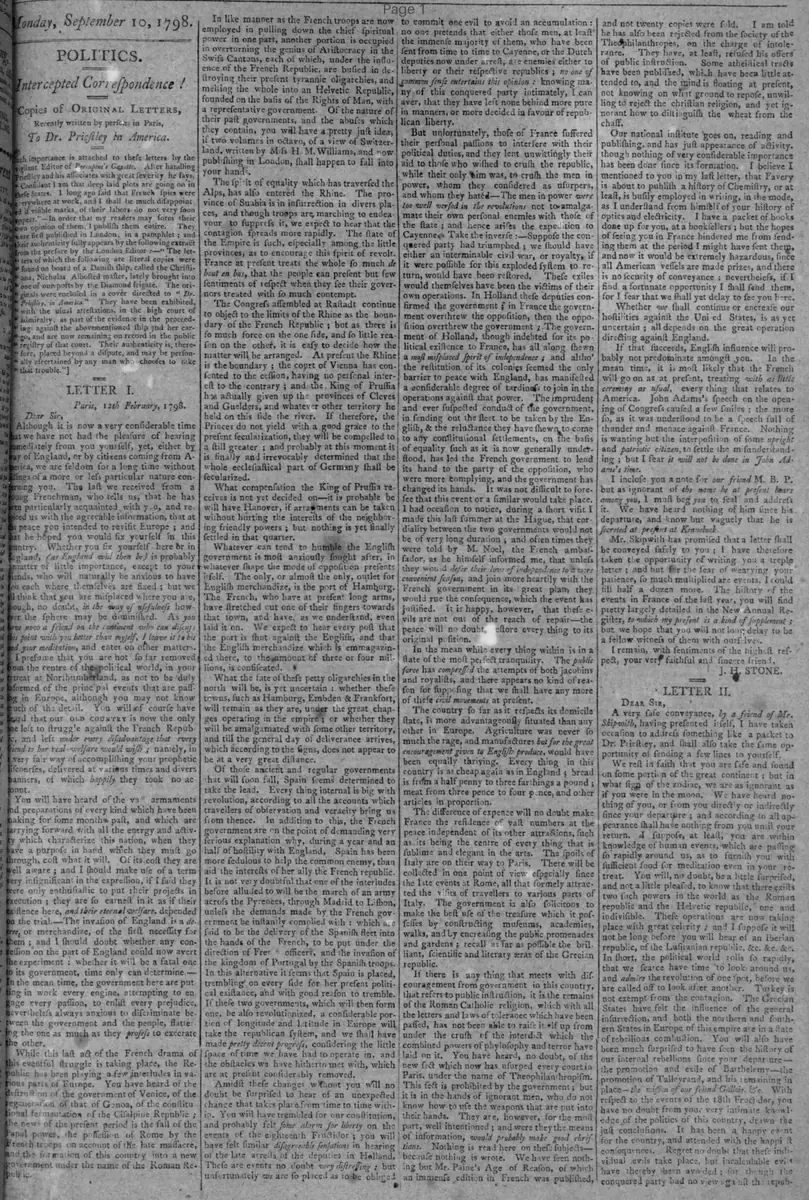
POLITICS.
Intercepted Correspondence!
Copies of Original Letters,
Recently written by persons in Paris,
To Dr. Priestley in America.
Such importance is attached to these letters by the
vigilant Editor of Porcupine's Gazette. After handling
Priestley and his associates with great severity he says,
"Confident I am that deep laid plots are going on in
these States. I long ago said that French spies were
everywhere at work, and I shall be much disappointed
if visible marks of their labors do not very soon
appear."—In order that my readers may form their
own opinion of them, I publish them entire. They
were first published in London, in a pamphlet; and
their authenticity fully appears by the following extract
from the preface by the London Editor :— "The let-
ters of which the following are literal copies were
found on board of a Danish ship, called the Chris-
tiana, Nicholas Alstede master, lately brought into
one of our ports by the Diamond frigate. The ori-
ginals were enclosed in a cover directed to "Dr.
Priestley, in America." They have been exhibited,
with the usual attestations, in the high court of
admiralty, as part of the evidence in the proceed-
ings against the abovementioned ship and her car-
go, and are now remaining on record in the public
registry of that court. Their authenticity is, there-
fore, placed beyond a dispute, and may be person-
ally ascertained by any man who chooses to take
that trouble."
LETTER I.
Paris, 12th February, 1798.
Dear Sir,
Although it is now a very considerable time
that we have not had the pleasure of hearing
immediately from yourself, yet, either by
way of England, or by citizens coming from A-
merica, we are seldom for a long time without
tidings of a more or less particular nature con-
cerning you. The last we received from a
young Frenchman, who tells us, that he has
been particularly acquainted with you, and re-
joiced us with the agreeable information, that at
the peace you intended to revisit Europe; and
that he hoped you would fix yourself in this
country. Whether you fix yourself here or in
England, (as England will then be) is probably
matter of little importance, except to your
friends, who will naturally be anxious to have
you near where themselves are fixed; but we
all think that you are misplaced where you are,
though, no doubt, in the way of usefulness how-
ever the sphere may be diminished. As you
have now a friend on the continent who can discuss
this point with you better than myself, I leave it to his
and your meditation, and enter on other matters.
I presume that you are not so far removed
from the centre of the political world, in your
retreat at Northumberland, as not to be duly
informed of the principal events that are pass-
ing in Europe, although you may not know
such of the detail. You will of course have
heard that our old country is now the only
one left to struggle against the French Repub-
lic, and left under every disadvantage that every
friend to her real welfare would wish; namely, in
very fair way of accomplishing your prophetic
discourses, delivered at various times and divers
manners, of which happily they took no ac-
count.
You will have heard of the vast armaments
and preparations of every kind which have been
making for some months past, and which are
carrying forward with all the energy and activ-
ity which characterize this nation, when they
have a purpose in hand which they must go
through, cost what it will. Of its cost they are
well aware; and I should make use of a term
very insignificant in the expression, if I said they
were only enthusiastic to put their projects in
execution; they are so earnest in it as if their
existence here, and their eternal welfare, depended
on the trial.—The invasion of England is a de-
cree, or merchandise, of the first necessity for
them; and I should doubt whether any con-
cession on the part of England could now avert
the experiment: whether it will be a fatal one
to its government, time only can determine.—
In the mean time, the government here are put-
ing in work every engine, attempting to en-
gage every passion, to enlist every prejudice,
nevertheless always anxious to discriminate be-
tween the government and the people, flatter-
ing the one as much as they profess to execrate
the other.
While this last act of the French drama of
this eventful struggle is taking place, the Re-
public has been playing a few interludes in va-
rious parts of Europe. You have heard of the
destruction of the government of Venice, of the
regeneration of that of Genoa, of the constitu-
tional fermentation of the Cisalpine Republic;
the news of the present period is the fall of the
Papal power, the possession of Rome by the
French troops on account of the late massacre,
and the formation of this country into a new
government under the name of the Roman Re-
public.
In like manner as the French troops are now
employed in pulling down the chief spiritual
power in one part, another portion is occupied
in overturning the genius of Aristocracy in the
Swiss Cantons, each of which, under the inlu-
ence of the French Republic, are busied in de-
troying their present tyrannic oligarchies, and
melting the whole into an Helvetic Republic,
founded on the basis of the Rights of Man, with
a representative government. Of the nature of
their past governments, and the abuses which
they contain, you will have a pretty just idea
if two volumes in octavo, of a view of Switzer-
land, written by Miss H. M. Williams, and now
publishing in London, shall happen to fall into
your hands.
The spirit of equality which has traversed the
Alps, has also entered the Rhine. The pro-
vince of Suabia is in insurrection in divers pla-
ces, and though troops are marching to endea-
vour to suppress it, we expect to hear that the
contagion spreads more rapidly. The state of
the Empire is such, especially among the little
provinces, as to encourage this spirit of revolt.
France at present treats the whole so much de
bout en bas, that the people can present but few
sentiments of respect when they see their gover-
nors treated with so much contempt.
The Congress assembled at Rastadt continue
to object to the limits of the Rhine as the boun-
dary of the French Republic; but as there is
so much force on the one side, and so little rea-
son on the other, it is easy to decide how the
matter will be arranged. At present the Rhine
is the boundary; the court of Vienna has con-
sented to the cession, having no personal inter-
est to the contrary; and the King of Prussia
has actually given up the provinces of Cleves
and Guelders, and whatever other territory he
held on this side the river. If therefore, the
Princes do not yield with a good grace to the
present secularization, they will be compelled to
a still greater: and probably at this moment it
is finally and irrevocably determined that the
whole ecclesiastical part of Germany shall be
secularized.
What compensation the King of Prussia re-
ceives is not yet decided on—it is probable he
will have Hanover, if arrangements can be taken
without hurting the interests of the neighbor-
ing friendly powers; but nothing is yet finally
settled in that quarter.
Whatever can tend to humble the English
government is most anxiously sought after, in
whatever shape the mode of opposition presents
itself. The only, or almost the only, outlet for
English merchandise, is the port of Hamburg.
The French, who have at present long arms,
have stretched out one of their fingers towards
that town, and have, as we understand, even
laid it on. We expect to hear every post that
the port is shut against the English, and that
the English merchandise which is emmagazin-
ed there, to the amount of three or four mil-
lions, is confiscated.
What the fate of these petty oligarchies in the
north will be, is yet uncertain: whether these
towns, such as Hamburg, Embden & Frankfort,
will remain as they are, under the great chap-
ges operating in the empire; or whether they
will be amalgamated with some other territory,
and till the general day of deliverance arrives,
which according to the signs, does not appear to
be at a very great distance.
Of those ancient and regular governments
that will soon fall, Spain seems determined to
take the lead. Every thing internal is big with
revolution, according to all the accounts which
travellers of observation and veracity bring us
from thence. In addition to this, the French
government are on the point of demanding very
serious explanation why, during a year and an
half of hostility with England, Spain has been
more sedulous to help the common enemy, than
aid the interests of her ally the French republic.
It is not very doubtful that one of the interludes
before alluded to will be the march of an army
across the Pyrenees, through Madrid to Lisbon,
unless the demands made by the French gov-
ernment be instantly complied with: which are
said to be the delivery of the Spanish fleet into
the hands of the French, to be put under the
direction of French officers, and the invasion of
the kingdom of Portugal by the Spanish troops.
In this alternative it seems that Spain is placed,
trembling on every side for her present politi-
cal existence, and with good reason to tremble.
If these two governments, which will then form
one, be also revolutionized, a considerable por-
tion of longitude and latitude in Europe will
take the republican system, and we shall have
made pretty decent progress, considering the little
space of time we have had to operate in, and
the obstacles we have hitherto met with, which
are at present considerably removed.
Amidst these changes without you will no
doubt be surprised to hear of an unexpected
change that takes place from time to time with-
in. You will have trembled for our constitution,
and probably felt some alarm for liberty on the
events of the eighteenth Fructidor; you will
have felt similar disagreeable sensations in hearing
of the late arrests of the deputies in Holland.
These are events no doubt very distressing; but
unfortunately we are so placed as to be obliged
to commit one evil to avoid an accumulation:
no one pretends that either those men, at least
the immense majority of them, who have been
sent from time to time to Cayenne, or the Dutch
deputies now under arrest, are enemies either to
liberty or their respective republics; no one of
common sense entertains this opinion: knowing ma-
ny of this conquered party intimately, I can
aver, that they have left none behind more pure
in manners, or more decided in favour of repub-
lican liberty.
But unfortunately, those of France suffered
their personal passions to interfere with their
political duties, and they lent unwittingly their
aid to those who wished to crush the republic,
while their only aim was, to crush the men in
power, whom they considered as usurpers,
and whom they hated—The men in power were
too well versed in the revolutions not to amalga-
mate their own personal enemies with those of
the state; and hence arises the expedition to
Cayenne. Take the inverse:—Suppose the con-
quered party had triumphed; we should have
either an interminable civil war, or royalty, if
it were possible for this exploded system to re-
turn, would have been restored. These exiles
would themselves have been the victims of their
own operations. In Holland these deputies con-
firmed the government; in France the govern-
ment overthrew the opposition, then the oppo-
sition overthrew the government; The govern-
ment of Holland, though indebted for its po-
litical existence to France, has all along shewn
a most misplaced spirit of independence: and altho'
the restitution of its colonies seemed the only
barrier to peace with England, has manifested
a considerable degree of tardiness to join in the
operations against that power. The imprudent
and ever suspected conduct of the government,
in sending out the fleet to be taken by the En-
glish, & the reluctance they have shewn to come
to any constitutional settlements, on the basis
of equality such as it is now generally under-
stood, has led the French government to lend
its hand to the party of the opposition, who
were more complying, and the government has
changed its hands. It was not difficult to fore-
see that this event or a similar would take place.
I had occasion to notice, during a short visit I
made this last summer at the Hague, that cor-
diality between the two governments would not
be of very long duration; and often times they
were told by M. Noel, the French amba-
ssador, as he himself informed me, that unless
they would defer their loves of independence to a more
convenient season, and join more heartily with the
French government in its great plans, they
would rue the consequence, which the event has
justified. It is happy, however, that these e-
vils are not out of the reach of repair—the
peace will no doubt, restore every thing to its
original position.
In the mean while every thing within is in a
state of the most perfect tranquility. The public
force has comprehended the attempts of both jacobins
and royalists, and there appears no kind of rea-
son for supposing that we shall have any more
of these civil movements at present.
The country so far as it repels its domicile
state, is more advantageously situated than any
other in Europe. Agriculture was never so
much the rage, and manufactures but for the great
encouragement given to English produce, would have
been equally thriving. Every thing in this
country is as cheap again as in England; bread
is from a half penny to three farthings a pound;
meat from three pence to four pence, and other
articles in proportion.
The difference of expense will no doubt make
France the residence of vast numbers at the
peace independent of its other attractions, such
as its being the centre of every thing that is
sublime and elegant in the arts. The spoils of
Italy are on their way to Paris. There will be
collected in one point of view especially since
the late events at Rome, all that formerly attrac-
ted the visits of travellers to various parts of
Italy. The government is also solicitous to
make the best use of the treasure which it pos-
sesses by constructing museums, academies,
walks, and by increasing the public promenades
and gardens; recall as far as possible the bril-
liant, scientific and literary eras of the Grecian
republic.
If there is any thing that meets with di-
couragement from government in this country,
that refers to public instruction, it is the remains
of the Roman Catholic religion, which with all
the letters and laws of tolerance which have been
passed, has not been able to raise itself up from
under the crush of the interdict which the
combined powers of philosophy and terror have
laid on it. You have heard, no doubt, of the
new sect which now has usurped every courtin
Paris, under the name of Theophilanthropism.
This sect is prohibited by the government; but
it is in the hands of ignorant men, who do not
know how to use the weapons that are put into
their hands. They are, however, for the mo-
part, well intentioned; and were they the means
of information, would probably make good chri-
tians. Nothing is read here on the subjects—
because nothing is wrote. We have seen noth-
ing but Mr. Paine's Age of Reason, of which
an immense edition in French was published,
and not twenty copies were sold. I am told
he has also been rejected from the society of the
Theo-philanthropes, on the charge of intole-
rance. They have, at least, refused his offers
of public instruction. Some atheistical tracts
have been published, which have been little at-
tended to, and the mind is floating at present,
not knowing on what ground to repose, unwil-
ling to reject the christian religion, and yet ig-
norant how to distinguish the wheat from the
chaff.
Our national institute goes on, reading and
publishing, and has just appearance of activity,
though nothing of very considerable importance
has been done since its formation. I believe I
mentioned to you in my last letter, that Fourcroy
is about to publish a history of Chemistry, or at
least, is busily employed in writing, in the mode,
as I understand from himself of your history of
optics and electricity. I have a packet of books
done up for you, at a booksellers; but the hopes
of seeing you in France hindered me from end-
ing them at the period I might have sent them,
and now it would be extremely hazardous, since
all American vessels are made prizes, and there
is no security of conveyance; nevertheless, if I
find a fortunate opportunity I shall send them,
for I fear that we shall yet delay to see you here.
Whether we shall continue or increase our
hostilities against the United States, is as yet
uncertain; all depends on the great operation
directing against England.
If that succeeds, English influence will pro-
bably not predominate amongst you. In the
mean time, it is most likely that the French
will go on as at present, treating with as little
ceremony as usual, every thing that relates to
America. John Adams's speech on the open-
ing of Congress caused a few smiles; the more
so, as it was understood to be a speech full of
thunder and menace against France. Nothing
is wanting but the interposition of some upright
and patriotic citizen, to settle the misunderstanding;
but I fear it will not be done in John Ad-
am's time.
I enclose you a note for our friend M. B. P.
but as ignorant of the name he at present bears
amongst you. I must beg you to seal and address
it. We have heard nothing of him since his
departure, and know but vaguely that he is
secreted at present at Kennebeck.
Mr. Skipwith has promised that a letter shall
be conveyed safely to you; I have therefore
taken the opportunity of writing you a triple
letter; and but for the fear of wearying your
patience, so much multiplied are events, I could
fill half a dozen more. The history of the
events in France of the last year, you will find
pretty largely detailed in the New Annual Re-
gister, to which my present is a kind of supplement;
but we hope that you will not long delay to be
a fellow witness of them with ourselves.
I remain, with sentiments of the highest re-
spect, your very faithful and sincere friend,
J. H. STONE.
LETTER II.
DEAR SIR,
A very safe conveyance, by a friend of Mr.
Skipwith, having presented itself, I have taken
occasion to address something like a packet to
Dr. Priestley, and shall also take the same op-
portunity of sending a few lines to yourself.
We rest in faith that you are safe and sound
on some portion of the great continent; but in
what sign of the zodiac, we are as ignorant as
if you were in the moon. We have heard no-
thing of you, or from you directly or indirectly
since your departure; and according to all ap-
pearance shall have nothing from you until your
return. I suppose, at least, you are within
knowledge of human events, which are passing
so rapidly around us, as to furnish you with
sufficient food for meditation even in your re-
treat. You will, no doubt, be a little surprised,
and not a little pleased, to know that there exist
two such powers in the world as the Roman
republic and the Helvetic republic, one and
indivisible. These operations are now taking
place with great celerity; and I suppose it will
not be long before you will hear of an Iberian
republic, of the Lusitanian republic, &c. &c. &c.
In short, the political world rolls so rapidly,
that we scarce have time to look around us,
and admire the revolution of one post, before we
are called off to look after another. Turkey is
not exempt from the contagion. The Grecian
States have felt the influence of the general
insurrection, and both the northern and south-
ern States in Europe of this empire are in a state
of rebellious combustion. You will also have
been much surprised to have seen the history of
our internal rebellions since your departure—
the promotion and exile of Barthelemy—the
promotion of Talleyrand, and his remaining in
place— the mission of our friend Gallais. &c. With
respect to the events of the 18th Fructidor, you
have no doubt from your very intimate knowl-
edge of the politics of this country, drawn the
just conclusions. It has been a happy event
for the country, and attended with the happi-
est consequences. Regret no doubt that these indi-
vidual evils take place, but incalculable evi-
ls have thereby been avoided: or though the
conquered party had no view to ga in th: iepub-
By the hosts of emigrants and royalists, armed and prepared for action, which at that time filled Paris, relied on this party for their support.
The government has since conducted itself with prudence and moderation, considering the circumstances in which it was placed. It has however taken a firm [a word here not legible] and is likely to meet with no more disturbances.
The minister who has the greatest influence, and who throws a lustre over all the rest, is citizen Talleyrand. He so conducts as not only to make his place respectable, but so as to ensure his continuance in it. We are also good friends; I see him now and then at his hotel, and once or twice he has done me the honor of a visit. On occasions which some day in the history of events, I may tell you, he continually enquires for you, and begs his best remembrances. The great actor is the Director Merlin. He was at our house the day before yesterday, and we renewed our acquaintance.
The person who goes out next month is Francois de Neuchateau, and his successor will be named in consequence of a new regulation by the present Legislature; so that the same spirit will continue to direct operations as before.
The police is very strong and active; many towns in the south army (among which Lyons) are put en etat de siege, and every measure has been taken to repress the spirit of fanaticism and royalty, which, without the 18th Fructidor, would have turned the republic, or plunged it into the horrors of civil war and confusion.
Your convert is very busy in collecting over the remains of his tottering faith; the good man has just written a letter to the Grand Inquisition of Spain, which, translated into Spanish, is to be distributed in that country. Spain is not very far from a revolution, and it is likely that these latter events will take place before the English expedition, of which immense preparations are making. Of the revolution of Switzerland you will see the accounts in the public papers. Our friend Le Grand is preparing a constitution for the new republic. Ochs has been very officious in this business, and has been here shewing himself off as the sole and great regenerator of his country; however, the thing is done; and the three coloured flag, with William Tell's hat, has displaced the [a word here not legible] on the council house of Berne.
You will probably see Miss W's two volumes of travels by the time this reaches you.
And now a few words on domestic affairs.
The manufactory of which you laid the corner stone, is now finished, and forms one of the finest establishments in France. But it has been subject to many mutations since you left us:
Mr. Parker for instance has met such a reverse of fortune that he has not been able to pay more than the third of one action; neither De Wit nor Van Stephent, or any of the original proprietors, are any thing in it. But we have among our friends got a very respectable company, who have paid in their shares, and the establishment is now entirely. I have paid in two shares, and am allowed till Prairial to make up the third, by the pot or pearl ash we expect from America. If they do not arrive, I forfeit the pledge I have put in. Whether that is to come if you would give us a single line to inform us you would much oblige us. You will not be displeased at this work of your hands when you come to see what a superb place, as well as convenient one. M. Talleyrand is a subscriber.
In the pleasing hope of seeing you once more among us, I subscribe for myself as well as Gallois, Talleyrand, Erione, and our family.
Your most faithful --.
12th February, 1798.
[The following is added by another person.]
Pray are you continuing your speculations on the great event? Are you in the press? Dr. G- has written to us that he has sent to your order the books you wrote. Is there any thing here that we can send you?
P. S. If pot or pearl ash could be sent, and a credit of nine or twelve months given, it would answer the same purpose as if it was sent from the works. I shall then be in full cash to answer it.
The first opportunity, the French translation of my Swiss travels--for I have no English copy in my possession. It is translated with great elegance by M. Ray, redacteur of the decade philosophique. I flatter myself you will approve the spirit with which it is written.
With the warmest wishes for your happiness, and all who are dear to you, believe me ever, my dear sir, your most affectionate-.
My mother and sister are well, and I have two charming little nephews; the eldest is already an excellent republican.
In another hand.
I snatch a little scrap of M's paper. to recall myself to your remembrance, and to remind you, my dear sir, that we count the seasons for the fulfilment of your promises to your friends in this part of the world. All here remember you with those sentiments of respect and affection, and regret your loss with that unaffected concern to which you have such claim. We hope the period is not far distant when those regrets will cease.
What sub-type of article is it?
What keywords are associated?
What entities or persons were involved?
Where did it happen?
Foreign News Details
Primary Location
Paris
Event Date
12th February, 1798
Key Persons
Outcome
fall of papal power and formation of roman republic; creation of helvetic republic from swiss cantons; cessions along the rhine boundary; potential revolutions in spain and portugal; internal changes in france and holland including arrests and government shifts; preparations for invasion of england.
Event Details
Intercepted letters from Paris discuss French preparations for invading England, destruction of governments in Venice, Genoa, and Papal Rome, formation of new republics in Italy and Switzerland, insurrections in Swabia, diplomatic negotiations at Rastadt Congress over Rhine boundaries and secularization in Germany, potential French demands on Spain leading to invasion of Portugal, internal political upheavals in France (18th Fructidor) and Holland, economic pressures on Hamburg, and cultural/religious developments in France.