Thank you for visiting SNEWPapers!
Sign up free
Literary
October 8, 1925
The Saratoga Sun
Saratoga, Carbon County, Wyoming
What is this article about?
In this humorous short story, college student Mack McAllister, who relies on his friend Jack Jamison to write his themes, competes with Jack for the affection of their witty rhetoric assistant, Marcia Merideth. When tested to write a story on the spot, Mack cleverly uses Jack's manuscript to pass the test, earning Marcia's forgiveness for doubting him and securing a date to the prom.
Clipping
OCR Quality
98%
Excellent
Full Text
Along the Concrete
By DONALD A. KAHN
(by Short Story Pub. Co.)
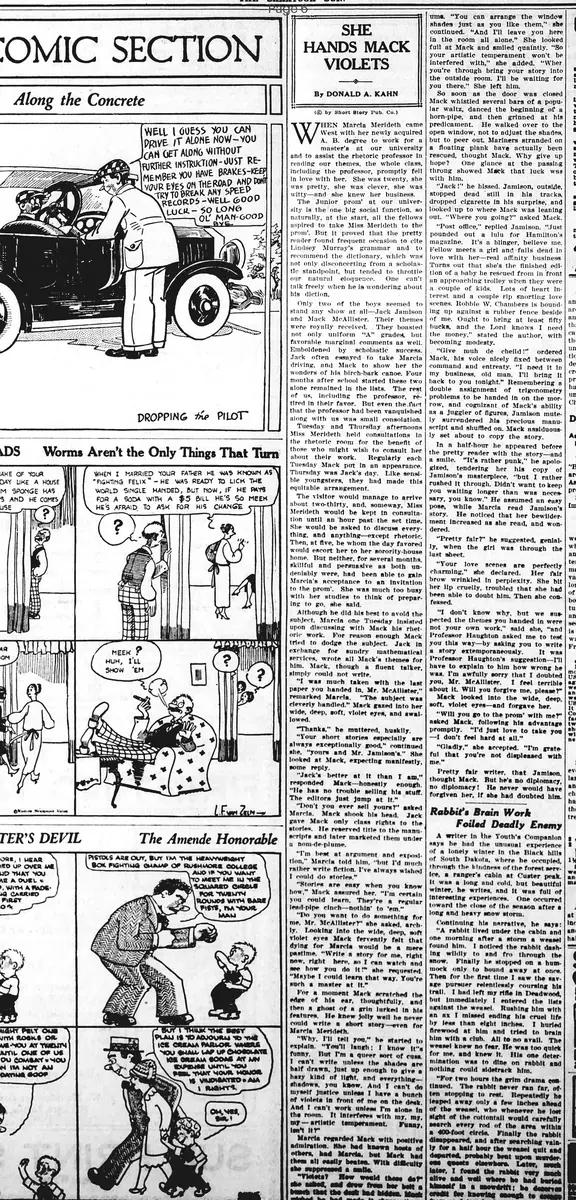
When Marcia Merideth came West with her newly acquired master's from our university and to assist the rhetoric professor in reading our themes, the whole class, including the professor, promptly fell in love with her. She was twenty, she was pretty, she was clever, she was witty—and she knew her business.
The Junior prom' at our university is the one big social function, so naturally, at the start, all the fellows aspired to take Miss Merideth to the prom'. But it proved that the pretty reader found frequent occasion to cite Lindsey Murray's grammar and to recommend the dictionary, which was not only disconcerting from a scholastic standpoint, but tended to throttle our natural eloquence. One can't talk freely when he is wondering about his diction.
Only two of the boys seemed to stand any show at all—Jack Jamison and Mack McAllister. Their themes were royally received. They boasted not only uniform "A" grades, but favorable marginal comments as well. Emboldened by scholastic success, Jack often essayed to take Marcia driving, and Mack to show her the wonders of his birch-bark canoe. Four months after school started these two alone remained in the lists. The rest of us, including the professor, retired in their favor. But even the fact that the professor had been vanquished along with us was small consolation.
Tuesday and Thursday afternoons Miss Merideth held consultations in the rhetoric room for the benefit of those who might wish to consult her about their work. Regularly each Tuesday Mack put in an appearance. Thursday was Jack's day. Like sensible youngsters, they had made this equitable arrangement.
The visitor would manage to arrive about two-thirty, and, someway, Miss Merideth would be kept in consultation until an hour past the set time. She would be asked to discuss everything, and anything—except rhetoric. Then, at five, he whom the day favored would escort her to her sorority-house home. But neither, for several months, skillful and persuasive as both undeniably were, had been able to gain Marcia's acceptance to an invitation to the prom'. She was much too busy with her studies to think of preparing to go, she said.
Although he did his best to avoid the subject, Marcia one Tuesday insisted upon discussing with Mack his rhetoric work. For reason enough Mack tried to dodge the subject. Jack, in exchange for sundry mathematical services, wrote all Mack's themes for him. Mack, though a fluent talker, simply could not write.
"I was much taken with the last paper you handed in, Mr. McAllister," remarked Marcia, "The subject was cleverly handled." Mack gazed into her wide, deep, soft, violet eyes, and swallowed.
"Thanks," he muttered, huskily.
"Your short stories especially are always exceptionally good," continued she, "yours and Mr. Jamison's." She looked at Mack, expecting manifestly some reply.
"Jack's better at it than I am," responded Mack—honestly enough.
"He has no trouble selling his stuff. The editors just jump at it."
"Don't you ever sell yours?" asked Marcia. Mack shook his head. Jack gave Mack only class rights to the stories. He reserved title to the manuscripts and later marketed them under a nom-de-plume.
"I'm best at argument and exposition," Marcia told him. "but I'd much rather write fiction. I've always wished I could do stories."
"Stories are easy when you know how," Mack assured her. "I'm certain you could learn. They're a regular lead-pipe cinch—nothin' to 'em."
"Do you want to do something for me, Mr. McAllister?" she asked, archly. Looking into the wide, deep, soft violet eyes Mack fervently felt that dying for Marcia would be a mere pastime.
"Write a story for me, right now, right here, so I can watch and see how you do it!" she requested. "Maybe I could learn that way. You're such a master at it."
For a moment Mack scratched the edge of his ear, thoughtfully, and then a ghost of a grin lurked in his features. He knew jolly well he never could write a short story—even for Marcia Merideth.
"Why, I'll tell you," he started to explain. "You'll laugh; I know it's funny. But I'm a queer sort of cuss. I can't write unless the shades are half drawn, just up enough to give a hazy kind of light, and everything—shadows, you know. And I can't do myself justice unless I have a bunch of violets in front of me on the desk. And I can't work unless I'm alone in the room. It interferes with my, my—artistic temperament. Funny, isn't it?"
Marcia regarded Mack with positive admiration. She had known lots of others, had Marcia, but Mack had them all easily beaten. With difficulty she suppressed
"Violets?"
ums. "You can arrange the window shades just as you like them," she continued. "And I'll leave you here in the room all alone." She looked full at Mack and smiled quaintly. "So your artistic temperament won't be interfered with," she added. "When you're through bring your story into the outside room. I'll be waiting for you there." She left him.
So soon as the door was closed Mack whistled several bars of a popular waltz, danced the beginning of a horn-pipe, and then grinned at his predicament. He walked over to the open window, not to adjust the shades but to peer out. Mariners stranded on a floating plank have actually been rescued, thought Mack. Why give up hope? One glance at the passing throng showed Mack that luck was with him.
"Jack!" he hissed. Jamison, outside, stopped dead still in his tracks, dropped cigarette in his surprise, and looked up to where Mack was leaning out. "Where you going?" asked Mack.
"Post office," replied Jamison. "Just pounded out a lulu for Hamilton's magazine. It's a blinger, believe me. Fellow meets a girl and falls dead in love with her—real affinity business. Turns out that she's the finished edition of a baby he rescued from in front an approaching trolley when they were a couple of kids. Lots of heart interest and a couple rip snorting love scenes. Robbie W. Chambers is bounding up against a rubber fence beside of me. Ought to bring at least fifty bucks, and the Lord knows I need the money," stated the author, with becoming modesty.
"Give me the child!" ordered Mack, his voice nicely fixed between command and entreaty. "I need it in my business, old man. I'll bring it back to you tonight." Remembering a double assignment of trigonometry problems to be handed in on the morrow, and cognizant of Mack's ability as a juggler of figures, Jamison mutely surrendered his precious manuscript and shuffled on. Mack assiduously set about to copy the story.
In a half-hour he appeared before the pretty reader with the story—and a smile. "It's rather punk," he apologized, tendering her his copy of Jamison's masterpiece. "but I rather rushed it through. Didn't want to keep you waiting longer than was necessary, you know." He assumed an easy pose, while Marcia read Jamison's story.
He noticed that her bewilderment increased as she read, and wondered.
"Pretty fair?" he suggested, genially, when the girl was through the last sheet.
"Your love scenes are perfectly charming," she declared. Her fair brow wrinkled in perplexity. She bit her lip cruelly, troubled that she had been able to doubt him. Then she confessed.
"I don't know why, but we suspected the themes you handed in were not your own work," said she, "and Professor Haughton asked me to test you this way—by asking you to write a story extemporaneously. It was Professor Haughton's suggestion—I'll have to explain to him how wrong he was. I'm awfully sorry that I doubted you, Mr. McAllister. I feel terrible about it. Will you forgive me, please?"
Mack looked into the wide, deep soft, violet eyes—and forgave her.
"Will you go to the prom' with me?" asked Mack, following his advantage promptly. "I'd just love to take you—I don't feel hard at all."
"Gladly," she accepted. "I'm grateful that you're not displeased with me."
Pretty fair writer, that Jamison, thought Mack. But he's no diplomacy, no diplomacy! He never would have forgiven her, if she had doubted him.
By DONALD A. KAHN
(by Short Story Pub. Co.)
When Marcia Merideth came West with her newly acquired master's from our university and to assist the rhetoric professor in reading our themes, the whole class, including the professor, promptly fell in love with her. She was twenty, she was pretty, she was clever, she was witty—and she knew her business.
The Junior prom' at our university is the one big social function, so naturally, at the start, all the fellows aspired to take Miss Merideth to the prom'. But it proved that the pretty reader found frequent occasion to cite Lindsey Murray's grammar and to recommend the dictionary, which was not only disconcerting from a scholastic standpoint, but tended to throttle our natural eloquence. One can't talk freely when he is wondering about his diction.
Only two of the boys seemed to stand any show at all—Jack Jamison and Mack McAllister. Their themes were royally received. They boasted not only uniform "A" grades, but favorable marginal comments as well. Emboldened by scholastic success, Jack often essayed to take Marcia driving, and Mack to show her the wonders of his birch-bark canoe. Four months after school started these two alone remained in the lists. The rest of us, including the professor, retired in their favor. But even the fact that the professor had been vanquished along with us was small consolation.
Tuesday and Thursday afternoons Miss Merideth held consultations in the rhetoric room for the benefit of those who might wish to consult her about their work. Regularly each Tuesday Mack put in an appearance. Thursday was Jack's day. Like sensible youngsters, they had made this equitable arrangement.
The visitor would manage to arrive about two-thirty, and, someway, Miss Merideth would be kept in consultation until an hour past the set time. She would be asked to discuss everything, and anything—except rhetoric. Then, at five, he whom the day favored would escort her to her sorority-house home. But neither, for several months, skillful and persuasive as both undeniably were, had been able to gain Marcia's acceptance to an invitation to the prom'. She was much too busy with her studies to think of preparing to go, she said.
Although he did his best to avoid the subject, Marcia one Tuesday insisted upon discussing with Mack his rhetoric work. For reason enough Mack tried to dodge the subject. Jack, in exchange for sundry mathematical services, wrote all Mack's themes for him. Mack, though a fluent talker, simply could not write.
"I was much taken with the last paper you handed in, Mr. McAllister," remarked Marcia, "The subject was cleverly handled." Mack gazed into her wide, deep, soft, violet eyes, and swallowed.
"Thanks," he muttered, huskily.
"Your short stories especially are always exceptionally good," continued she, "yours and Mr. Jamison's." She looked at Mack, expecting manifestly some reply.
"Jack's better at it than I am," responded Mack—honestly enough.
"He has no trouble selling his stuff. The editors just jump at it."
"Don't you ever sell yours?" asked Marcia. Mack shook his head. Jack gave Mack only class rights to the stories. He reserved title to the manuscripts and later marketed them under a nom-de-plume.
"I'm best at argument and exposition," Marcia told him. "but I'd much rather write fiction. I've always wished I could do stories."
"Stories are easy when you know how," Mack assured her. "I'm certain you could learn. They're a regular lead-pipe cinch—nothin' to 'em."
"Do you want to do something for me, Mr. McAllister?" she asked, archly. Looking into the wide, deep, soft violet eyes Mack fervently felt that dying for Marcia would be a mere pastime.
"Write a story for me, right now, right here, so I can watch and see how you do it!" she requested. "Maybe I could learn that way. You're such a master at it."
For a moment Mack scratched the edge of his ear, thoughtfully, and then a ghost of a grin lurked in his features. He knew jolly well he never could write a short story—even for Marcia Merideth.
"Why, I'll tell you," he started to explain. "You'll laugh; I know it's funny. But I'm a queer sort of cuss. I can't write unless the shades are half drawn, just up enough to give a hazy kind of light, and everything—shadows, you know. And I can't do myself justice unless I have a bunch of violets in front of me on the desk. And I can't work unless I'm alone in the room. It interferes with my, my—artistic temperament. Funny, isn't it?"
Marcia regarded Mack with positive admiration. She had known lots of others, had Marcia, but Mack had them all easily beaten. With difficulty she suppressed
"Violets?"
ums. "You can arrange the window shades just as you like them," she continued. "And I'll leave you here in the room all alone." She looked full at Mack and smiled quaintly. "So your artistic temperament won't be interfered with," she added. "When you're through bring your story into the outside room. I'll be waiting for you there." She left him.
So soon as the door was closed Mack whistled several bars of a popular waltz, danced the beginning of a horn-pipe, and then grinned at his predicament. He walked over to the open window, not to adjust the shades but to peer out. Mariners stranded on a floating plank have actually been rescued, thought Mack. Why give up hope? One glance at the passing throng showed Mack that luck was with him.
"Jack!" he hissed. Jamison, outside, stopped dead still in his tracks, dropped cigarette in his surprise, and looked up to where Mack was leaning out. "Where you going?" asked Mack.
"Post office," replied Jamison. "Just pounded out a lulu for Hamilton's magazine. It's a blinger, believe me. Fellow meets a girl and falls dead in love with her—real affinity business. Turns out that she's the finished edition of a baby he rescued from in front an approaching trolley when they were a couple of kids. Lots of heart interest and a couple rip snorting love scenes. Robbie W. Chambers is bounding up against a rubber fence beside of me. Ought to bring at least fifty bucks, and the Lord knows I need the money," stated the author, with becoming modesty.
"Give me the child!" ordered Mack, his voice nicely fixed between command and entreaty. "I need it in my business, old man. I'll bring it back to you tonight." Remembering a double assignment of trigonometry problems to be handed in on the morrow, and cognizant of Mack's ability as a juggler of figures, Jamison mutely surrendered his precious manuscript and shuffled on. Mack assiduously set about to copy the story.
In a half-hour he appeared before the pretty reader with the story—and a smile. "It's rather punk," he apologized, tendering her his copy of Jamison's masterpiece. "but I rather rushed it through. Didn't want to keep you waiting longer than was necessary, you know." He assumed an easy pose, while Marcia read Jamison's story.
He noticed that her bewilderment increased as she read, and wondered.
"Pretty fair?" he suggested, genially, when the girl was through the last sheet.
"Your love scenes are perfectly charming," she declared. Her fair brow wrinkled in perplexity. She bit her lip cruelly, troubled that she had been able to doubt him. Then she confessed.
"I don't know why, but we suspected the themes you handed in were not your own work," said she, "and Professor Haughton asked me to test you this way—by asking you to write a story extemporaneously. It was Professor Haughton's suggestion—I'll have to explain to him how wrong he was. I'm awfully sorry that I doubted you, Mr. McAllister. I feel terrible about it. Will you forgive me, please?"
Mack looked into the wide, deep soft, violet eyes—and forgave her.
"Will you go to the prom' with me?" asked Mack, following his advantage promptly. "I'd just love to take you—I don't feel hard at all."
"Gladly," she accepted. "I'm grateful that you're not displeased with me."
Pretty fair writer, that Jamison, thought Mack. But he's no diplomacy, no diplomacy! He never would have forgiven her, if she had doubted him.
What sub-type of article is it?
Prose Fiction
What themes does it cover?
Love Romance
Social Manners
Friendship
What keywords are associated?
College Romance
Short Story
Plagiarism
Prom Date
Rhetoric Class
Friendship Betrayal
Writing Test
What entities or persons were involved?
By Donald A. Kahn
Literary Details
Title
Along The Concrete
Author
By Donald A. Kahn
Key Lines
"Stories Are Easy When You Know How," Mack Assured Her. "I'm Certain You Could Learn. They're A Regular Lead Pipe Cinch—Nothin' To 'Em."
"Write A Story For Me, Right Now, Right Here, So I Can Watch And See How You Do It!" She Requested. "Maybe I Could Learn That Way. You're Such A Master At It."
"I Don't Know Why, But We Suspected The Themes You Handed In Were Not Your Own Work," Said She, "And Professor Haughton Asked Me To Test You This Way—By Asking You To Write A Story Extemporaneously."
"Will You Go To The Prom' With Me?" Asked Mack, Following His Advantage Promptly. "I'd Just Love To Take You—I Don't Feel Hard At All."
Pretty Fair Writer, That Jamison, Thought Mack. But He's No Diplomacy, No Diplomacy! He Never Would Have Forgiven Her, If She Had Doubted Him.