Thank you for visiting SNEWPapers!
Sign up free
Editorial
January 3, 1800
Gazette Of The United States, & Philadelphia Daily Advertiser
Philadelphia, Philadelphia County, Pennsylvania
What is this article about?
An editorial cataloging insults and expulsions of foreign diplomats by Republican France, criticizing the Directory's barbarism and disregard for international law. Lists cases from Sardinia, Tuscany, Papal States, Geneva, Spain, Portugal, Venice, Genoa, and others. Condemns French leaders like Barras, Sieyes, and Debrie for promoting tyranny and assassinations.
Clipping
OCR Quality
95%
Excellent
Full Text
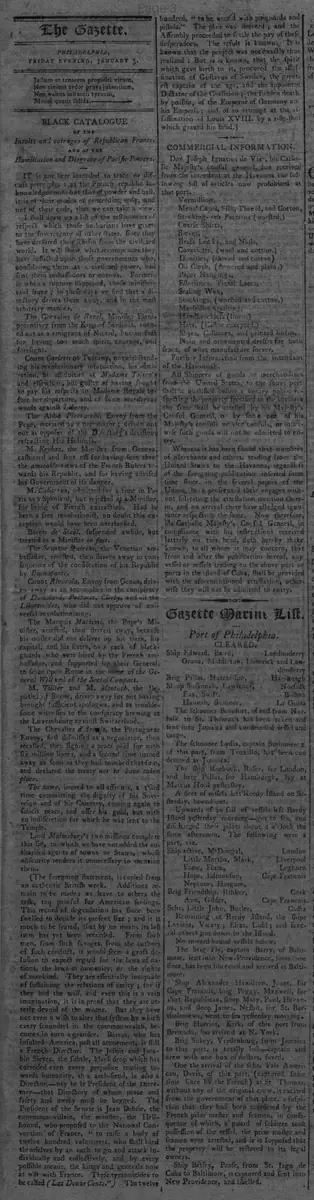
BLACK CATALOGUE
OF THE
Insults and outrages of Republican France,
AND OF THE
Humiliation and Disgrace of Pacific Powers.
IT is not here intended to trace or discuss principles: as the French republic acknowledges none but that of powder and ball, it is of their modes of proceeding only, and not of their code, that we can take a view.
I shall draw up a list of the testimonies of respect which those barbarians have given to the sovereignty of other states, since they have declared their secession from the civilized world. It will show what recompenses they have inflicted upon those governments who, considering them as a civilized power, had sent them ambassadors or envoys. Formerly when a rupture happened, those ministers took leave; in these days we find that a directory drives them away, and in the most arbitrary manner.
The Chevalier de Revel, Minister Plenipotentiary from the King of Sardinia, turned out as an emigrant of Nice, but in fact for having too much spirit, courage, and foresight.
Count Carletti of Tuscany, notwithstanding his revolutionary infatuation, his adulation, his assiduities at Madame Talien's and elsewhere, but guilty of having sought to pay his respects to Madame Royale before her departure, and of some murderous words against Liberty.
The Abbé Pierrarchi, Envoy from the Pope, received as a negotiator; driven out as opposer of the Directory's decisions respecting His Holiness.
M. Reyboz, the Minister from Geneva cashiered and sent off for having seen through the amicable views of the French Rulers towards his Republic, and for having advised his Government of its danger.
M. Cabarrus, admitted for a time in Paris as a Spaniard, but rejected as a Minister for being of French extraction. Had he been a free revolutionist, no doubt this exception would have been overlooked.
Baron de Stael, suspended awhile, but treated as a Minister in fact.
The Senator Quirini, the Venetian ambassador, arrested, then driven away in consequence of the coalition of his Republic by Buonaparte.
Count Rivarola, Envoy from Genoa, driven away as an accomplice in the conspiracy of Dumouriez, Pache, Clootz, and all the Liberticides, who did not approve of universal revolutionizing.
The Marquis Massimi, the Pope's Minister, arrested, then driven away, because his master did not deliver up his tiara, his capital, and his states, to a pack of blackguards who were hired by the French ambassador, and supported by their General, to seize upon Rome in the name of the General Will and of the Social Compact.
M. Tillier and M. Moutach, the Deputies of Berne, driven away for not having brought sufficient apologies, and as troublesome witnesses to the conspiracy brewing at the Luxembourg against Switzerland.
The Chevalier d'Arasjo, the Portuguese Envoy, first denied as a negotiator, then recalled, then signing a peace paid for with six million livres, and a second time turned away as soon as they had touched that sum, and declared the treaty not to have taken place.
The same, inured to all affronts, a third time committing the dignity of his Sovereign and of his Country, coming again to solicit peace, and offer his gold, but with an indiscretion for which he was sent to the Temple.
Lord Malmesbury's two missions complete this list, to which we have not added the authorized agents of towns or States, whose obscurity renders it unnecessary to mention them.
The foregoing statement, is copied from an authentic British work. Additions remain to be made: we leave to others the task, too painful for American feelings.
This record of degradation has since been swelled to double its present size; and it is much to be feared, that by no means its last item has yet been recorded. From such men, from such avengers, from the authors of such conduct, it would seem a gross delusion to expect regard for the laws of nations, the laws of humanity, or the rights of mankind. They are essentially incapable of sustaining the relations of amity; or if they had the will, and even this is a vain imagination, it is in proof that they are utterly devoid of the means. But they have not even a wish to alter that system by which every scoundrel in the commonwealth, becomes in turn a grandee. Barras, who has insulted America, past all atonement, is still a French Director. The Jesuit and Jacobin Sieyes, the subtle, black drop which has corroded even every prejudice tending towards humanity, this arch-fiend, is also a Director,—nay he is President of the Directory—that Directory of whom peace and safety and mercy must be begged. The President of the Senate is Jean Debrie, the enormous villain, the monster, the Hell-hound, who proposed to the National Convention of France, "to raise a body of twelve hundred volunteers, who shall bind themselves by an oath to go and attack individually and collectively, and by every possible means, the kings and generals now at war with France. These tyrannicides to be called (Les Douze Cents.)" The twelve
hundred, "to be armed with poignards and pistols." The plan was decreed: and the Assembly proceeded to settle the pay of these desperadoes. The result is known. It is known that the project was not exactly thus realized: But it is known, that the spirit which gave birth to it, procured the assassination of Gustavus of Sweden, the greatest captain of the age, and the appointed Dictator of the Coalition; the sudden death, by poison, of the Emperor of Germany and his Empress; and of an attempt at the assassination of Louis XVIII. by a rifle-shot which grazed his head.
OF THE
Insults and outrages of Republican France,
AND OF THE
Humiliation and Disgrace of Pacific Powers.
IT is not here intended to trace or discuss principles: as the French republic acknowledges none but that of powder and ball, it is of their modes of proceeding only, and not of their code, that we can take a view.
I shall draw up a list of the testimonies of respect which those barbarians have given to the sovereignty of other states, since they have declared their secession from the civilized world. It will show what recompenses they have inflicted upon those governments who, considering them as a civilized power, had sent them ambassadors or envoys. Formerly when a rupture happened, those ministers took leave; in these days we find that a directory drives them away, and in the most arbitrary manner.
The Chevalier de Revel, Minister Plenipotentiary from the King of Sardinia, turned out as an emigrant of Nice, but in fact for having too much spirit, courage, and foresight.
Count Carletti of Tuscany, notwithstanding his revolutionary infatuation, his adulation, his assiduities at Madame Talien's and elsewhere, but guilty of having sought to pay his respects to Madame Royale before her departure, and of some murderous words against Liberty.
The Abbé Pierrarchi, Envoy from the Pope, received as a negotiator; driven out as opposer of the Directory's decisions respecting His Holiness.
M. Reyboz, the Minister from Geneva cashiered and sent off for having seen through the amicable views of the French Rulers towards his Republic, and for having advised his Government of its danger.
M. Cabarrus, admitted for a time in Paris as a Spaniard, but rejected as a Minister for being of French extraction. Had he been a free revolutionist, no doubt this exception would have been overlooked.
Baron de Stael, suspended awhile, but treated as a Minister in fact.
The Senator Quirini, the Venetian ambassador, arrested, then driven away in consequence of the coalition of his Republic by Buonaparte.
Count Rivarola, Envoy from Genoa, driven away as an accomplice in the conspiracy of Dumouriez, Pache, Clootz, and all the Liberticides, who did not approve of universal revolutionizing.
The Marquis Massimi, the Pope's Minister, arrested, then driven away, because his master did not deliver up his tiara, his capital, and his states, to a pack of blackguards who were hired by the French ambassador, and supported by their General, to seize upon Rome in the name of the General Will and of the Social Compact.
M. Tillier and M. Moutach, the Deputies of Berne, driven away for not having brought sufficient apologies, and as troublesome witnesses to the conspiracy brewing at the Luxembourg against Switzerland.
The Chevalier d'Arasjo, the Portuguese Envoy, first denied as a negotiator, then recalled, then signing a peace paid for with six million livres, and a second time turned away as soon as they had touched that sum, and declared the treaty not to have taken place.
The same, inured to all affronts, a third time committing the dignity of his Sovereign and of his Country, coming again to solicit peace, and offer his gold, but with an indiscretion for which he was sent to the Temple.
Lord Malmesbury's two missions complete this list, to which we have not added the authorized agents of towns or States, whose obscurity renders it unnecessary to mention them.
The foregoing statement, is copied from an authentic British work. Additions remain to be made: we leave to others the task, too painful for American feelings.
This record of degradation has since been swelled to double its present size; and it is much to be feared, that by no means its last item has yet been recorded. From such men, from such avengers, from the authors of such conduct, it would seem a gross delusion to expect regard for the laws of nations, the laws of humanity, or the rights of mankind. They are essentially incapable of sustaining the relations of amity; or if they had the will, and even this is a vain imagination, it is in proof that they are utterly devoid of the means. But they have not even a wish to alter that system by which every scoundrel in the commonwealth, becomes in turn a grandee. Barras, who has insulted America, past all atonement, is still a French Director. The Jesuit and Jacobin Sieyes, the subtle, black drop which has corroded even every prejudice tending towards humanity, this arch-fiend, is also a Director,—nay he is President of the Directory—that Directory of whom peace and safety and mercy must be begged. The President of the Senate is Jean Debrie, the enormous villain, the monster, the Hell-hound, who proposed to the National Convention of France, "to raise a body of twelve hundred volunteers, who shall bind themselves by an oath to go and attack individually and collectively, and by every possible means, the kings and generals now at war with France. These tyrannicides to be called (Les Douze Cents.)" The twelve
hundred, "to be armed with poignards and pistols." The plan was decreed: and the Assembly proceeded to settle the pay of these desperadoes. The result is known. It is known that the project was not exactly thus realized: But it is known, that the spirit which gave birth to it, procured the assassination of Gustavus of Sweden, the greatest captain of the age, and the appointed Dictator of the Coalition; the sudden death, by poison, of the Emperor of Germany and his Empress; and of an attempt at the assassination of Louis XVIII. by a rifle-shot which grazed his head.
What sub-type of article is it?
Foreign Affairs
War Or Peace
Moral Or Religious
What keywords are associated?
French Republic
Diplomatic Insults
Directory Expulsions
International Law Violations
Anti French Sentiment
Barras
Sieyes
Tyrannicide Proposal
What entities or persons were involved?
French Directory
Barras
Sieyes
Jean Debrie
Chevalier De Revel
Count Carletti
Abbé Pierrarchi
M. Reyboz
M. Cabarrus
Baron De Stael
Senator Quirini
Count Rivarola
Marquis Massimi
M. Tillier
M. Moutach
Chevalier D'arasjo
Lord Malmesbury
Buonaparte
Editorial Details
Primary Topic
Catalogue Of Insults And Outrages By Republican France Against Foreign Diplomats
Stance / Tone
Strongly Condemnatory Of French Republic And Directory
Key Figures
French Directory
Barras
Sieyes
Jean Debrie
Chevalier De Revel
Count Carletti
Abbé Pierrarchi
M. Reyboz
M. Cabarrus
Baron De Stael
Senator Quirini
Count Rivarola
Marquis Massimi
M. Tillier
M. Moutach
Chevalier D'arasjo
Lord Malmesbury
Buonaparte
Key Arguments
French Republic Disregards Sovereignty Of Other States By Arbitrarily Expelling Diplomats
List Of Specific Expulsions And Humiliations Of Envoys From Sardinia, Tuscany, Papal States, Geneva, Spain, Venice, Genoa, Portugal, And Others
French Leaders Like Barras, Sieyes, And Debrie Promote Tyranny, Assassinations, And Disregard For Laws Of Nations
France Incapable Of Maintaining Amity Or Peace Due To Its Revolutionary System
Expect No Regard For Humanity Or Rights From Such A Regime