Thank you for visiting SNEWPapers!
Sign up free
Story
January 21, 1842
Southern Christian Advocate
Charleston, Charleston County, South Carolina
What is this article about?
In rural graveyard near Lowell, a blacksmith husband erects a fine granite monument by hand over his young wife's isolated grave after her death from smallpox, amid community fears preventing proper rites; it symbolizes his unchanging love.
Clipping
OCR Quality
95%
Excellent
Full Text
A HUSBAND’S LOVE
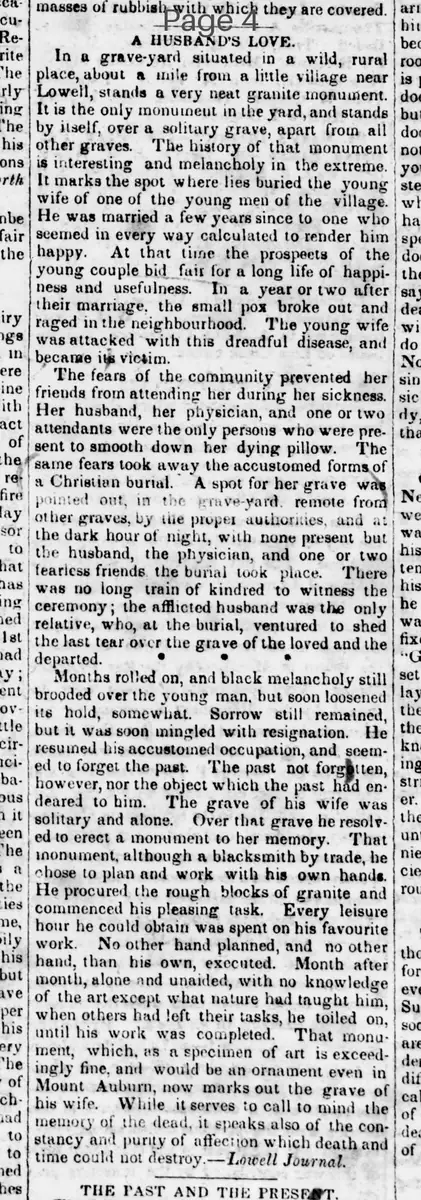
In a grave-yard situated in a wild, rural place, about a mile from a little village near Lowell, stands a very neat granite monument. It is the only monument in the yard, and stands by itself, over a solitary grave, apart from all other graves. The history of that monument is interesting and melancholy in the extreme. It marks the spot where lies buried the young wife of one of the young men of the village. He was married a few years since to one who seemed in every way calculated to render him happy. At that time the prospects of the young couple bid fair for a long life of happiness and usefulness. In a year or two after their marriage, the small pox broke out and raged in the neighbourhood. The young wife was attacked with this dreadful disease, and became its victim. The fears of the community prevented her friends from attending her during her sickness. Her husband, her physician, and one or two attendants were the only persons who were present to smooth down her dying pillow. The same fears took away the accustomed forms of a Christian burial. A spot for her grave was pointed out, in the grave-yard, remote from other graves, by the proper authorities, and at the dark hour of night, with none present but the husband, the physician, and one or two fearless friends the burial took place. There was no long train of kindred to witness the ceremony; the afflicted husband was the only relative, who, at the burial, ventured to shed the last tear over the grave of the loved and the departed. Months rolled on, and black melancholy still brooded over the young man, but soon loosened its hold, somewhat. Sorrow still remained, but it was soon mingled with resignation. He resumed his accustomed occupation, and seemed to forget the past. The past not forgotten, however, nor the object which the past had endeared to him. The grave of his wife was solitary and alone. Over that grave he resolved to erect a monument to her memory. That monument, although a blacksmith by trade, he chose to plan and work with his own hands. He procured the rough blocks of granite and commenced his pleasing task. Every leisure hour he could obtain was spent on his favourite work. No other hand planned, and no other hand, than his own, executed. Month after month, alone and unaided, with no knowledge of the art except what nature had taught him, when others had left their tasks, he toiled on, until his work was completed. That monument, which, as a specimen of art is exceedingly fine, and would be an ornament even in Mount Auburn, now marks out the grave of his wife. While it serves to call to mind the memory of the dead, it speaks also of the constancy and purity of affection which death and time could not destroy.—Lowell Journal.
In a grave-yard situated in a wild, rural place, about a mile from a little village near Lowell, stands a very neat granite monument. It is the only monument in the yard, and stands by itself, over a solitary grave, apart from all other graves. The history of that monument is interesting and melancholy in the extreme. It marks the spot where lies buried the young wife of one of the young men of the village. He was married a few years since to one who seemed in every way calculated to render him happy. At that time the prospects of the young couple bid fair for a long life of happiness and usefulness. In a year or two after their marriage, the small pox broke out and raged in the neighbourhood. The young wife was attacked with this dreadful disease, and became its victim. The fears of the community prevented her friends from attending her during her sickness. Her husband, her physician, and one or two attendants were the only persons who were present to smooth down her dying pillow. The same fears took away the accustomed forms of a Christian burial. A spot for her grave was pointed out, in the grave-yard, remote from other graves, by the proper authorities, and at the dark hour of night, with none present but the husband, the physician, and one or two fearless friends the burial took place. There was no long train of kindred to witness the ceremony; the afflicted husband was the only relative, who, at the burial, ventured to shed the last tear over the grave of the loved and the departed. Months rolled on, and black melancholy still brooded over the young man, but soon loosened its hold, somewhat. Sorrow still remained, but it was soon mingled with resignation. He resumed his accustomed occupation, and seemed to forget the past. The past not forgotten, however, nor the object which the past had endeared to him. The grave of his wife was solitary and alone. Over that grave he resolved to erect a monument to her memory. That monument, although a blacksmith by trade, he chose to plan and work with his own hands. He procured the rough blocks of granite and commenced his pleasing task. Every leisure hour he could obtain was spent on his favourite work. No other hand planned, and no other hand, than his own, executed. Month after month, alone and unaided, with no knowledge of the art except what nature had taught him, when others had left their tasks, he toiled on, until his work was completed. That monument, which, as a specimen of art is exceedingly fine, and would be an ornament even in Mount Auburn, now marks out the grave of his wife. While it serves to call to mind the memory of the dead, it speaks also of the constancy and purity of affection which death and time could not destroy.—Lowell Journal.
What sub-type of article is it?
Biography
Romance
Tragedy
What themes does it cover?
Love
Tragedy
Moral Virtue
What keywords are associated?
Smallpox Victim
Isolated Burial
Handmade Monument
Enduring Love
What entities or persons were involved?
Husband
Young Wife
Where did it happen?
Grave Yard Near Lowell
Story Details
Key Persons
Husband
Young Wife
Location
Grave Yard Near Lowell
Event Date
A Few Years Since Marriage, Year Or Two After
Story Details
Young wife dies of smallpox; husband and few others bury her at night in isolated grave due to community fears. Months later, husband, a blacksmith, builds fine granite monument by hand to her memory, symbolizing enduring affection.