Thank you for visiting SNEWPapers!
Sign up free
Letter to Editor
March 7, 1844
South Carolina Temperance Advocate And Register Of Agriculture And General Literature
Columbia, Richland County, South Carolina
What is this article about?
A reflective essay advocating for classical education's role in mental discipline and moral development, countering modern impatience and prejudices. Contrasts U.S. practices favorably with English excesses, drawing on reviews and classical authors. Signed W. Hooper, S.C. College.
Clipping
OCR Quality
98%
Excellent
Full Text
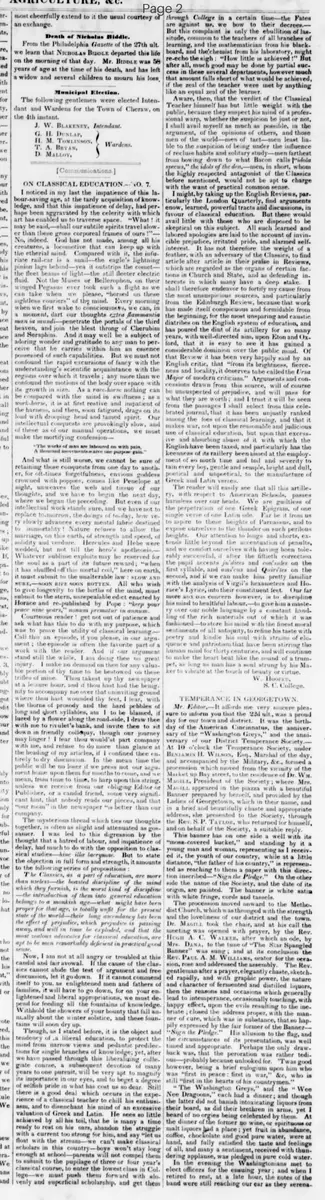
ON CLASSICAL EDUCATION.—O. T.
I noticed in my last the impatience of this labour-saving age, at the tardy acquisition of knowledge, and that this impatience of delay, had perhaps been aggravated by the celerity with which art has enabled us to traverse space. "What! it may be said,—shall our subtile spirits travel slower than these gross corporeal frames of ours!" No, indeed. God has not made, among all his creatures, a locomotive that can keep up with the ethereal mind. Compared with it, the infuriate rail-car is a snail—the eagle's lightning pinion lags behind—yea it outstrips the comet—the fleet beams of light the still fleeter electric fluid. Not the Muses or Bellerophon, on their winged Pegasus ever took such a flight as we can take when we please, "horsed on these sightless couriers" of the mind. Every morning when we first wake to consciousness, we can, in a moment, dart our thoughts extra flammantia moenia mundi—penetrate the portals of the third heaven, and join the blest throng of Cherubim and Seraphim. And it may well be a subject of adoring wonder and gratitude to any man to perceive that he carries within him an essence possessed of such capabilities. But we must not confound the rapid excursions of fancy with the understanding's scientific acquaintance with the regions over which it travels: any more than we confound the motions of the body over space with its growth in size. As a race-horse nothing can be compared with the mind in swiftness; as a work-horse, it is at first restive and impatient of the harness, and then, soon fatigued, drags on its load with drooping head and tamed spirit. Our intellectual conquests are provokingly slow, and of these as of our manual operations, we must make the mortifying confession—
The works of man are laboured on with pain.
A thousand movements scarce one purpose gain.
And what is still worse, we cannot be sure of retaining those conquests from one day to another, for oft-times forgetfulness, envious goddess crowned with poppies, comes like Penelope at night, unweaves the web and tissue of our thoughts, and we have to begin the next day, where we began the preceding. But even if our intellectual work stands sure, and we have not to replace to-morrow, the doings of to-day, how very slowly advances every mental fabric destined to immortality! Nature refuses to allow the marriage, on this earth, of strength and speed, of solidity and verdure. Hercules and Hebe were wedded, but not til the hero's apotheosis.— Whatever sublime exploits may be reserved for the soul as a part of its future reward; "when it has shuffled off this mortal coil," here on earth, it must submit to the unalterable law: SLOW AND SURE,—SOON RIPE SOON ROTTEN. All who wish to give longevity to the births of the mind, must submit to the stern, unrepealable edict enacted by Horace and re-published by Pope: "keep your piece nine years," nonum prematur in annum.
Courteous reader! get not out of patience and ask what has this to do with my purpose, which was to prove the utility of classical learning— Call this an episode, if you please, in our argument; the episode is often the favorite part of a work with the reader. And if our argument stand still the while, I am doing thee no great injury. I make no demand on thee for any valuable portion of thy time to be bestowed on these tritles of mine. Thou takest up thy newspaper at a leisure hour, and if thou hast had the benignity to accompany me over that uninviting ground where thou hast wounded thy feet, I fear, with the thorns of prosody and the hard pebbles of long and short syllables, am I to be blamed, if lured by a flower along the road-side, I draw thee with me to rivulet's bank, and invite thee to sit down in friendly colloquy, though our journey may linger! I fear thou would'st part company with me, and refuse to do more than glance at the heading of my articles, if I confined thee entirely to dry discussion. In the mean time the public will be no loser if we press not our argument home upon them for months to come, and we mean, from time to time, to harp upon this string, unless we receive from our obliging Editor or Publisher, or a candid friend, some very significant hint, that nobody reads our pieces, and that "our room" in the newspaper "is better than our company."
The mysterious thread which ties our thoughts together, is often as slight and attenuated as gossamer. I was led to this digression by the thought that a hatred of labour, and impatience of delay, had much to do with the opposition to classical studies—hinc illae lacrymae. But to state the objection in full form and strength, it amounts to the following series of propositions: The Classics, as a part of education, are more than useless—the boasted discipline of the mind which they furnish, is the worst kind of discipline —the introduction of them into general education belongs to a monkish age—what might have been proper for that age, is totally unfit for the present state of the world their long ascendancy has been the effect of prejudice, which prejudice is passing away, and will in time be exploded, and that the most zealous advocates for classical education, are apt to be men remarkably deficient in practical good sense.
Now, I am not at all angry or troubled at this candid and fair avowal. If the cause of the classics cannot abide the test of argument and free discussion, let it go down. If it cannot commend itself to you, as enlightened men and fathers of families, it will have to go down, for on your enlightened and liberal appropriations, we must depend for feeding all the fountains of knowledge. Withhold the showers of your bounty that fall annually about the winter solstice, and these fountains will soon dry up.
Though, as I stated before, it is the object and tendency of a liberal education, to protect the mind from narrow views and pedantic predilections for single branches of knowledge; yet, after we have passed through this liberalizing collegiate course, a subsequent devotion of many years to one pursuit, will be very apt to magnify its importance in our eyes, and to beget a degree of selfish pride in what has cost us so dear. Still there is a good deal which occurs in the experience of a classical teacher to chill his enthusiasm, and to disenchant his mind of an excessive valuation of Greek and Latin. He sees so little achieved by all his toil, that he is many a time ready to rest on his oars, abandon the struggle with a current too strong for him, and say "let us float with the stream—we can't make classical scholars in this country—boys won't stay long enough at school—parents will not compel them to submit to the pupilage of three or four years' classical course, to enter the lowest class in College—we must push them forward with slovenly and superficial scholarship, and get them through College in a certain time—the Fates are against us, we bow to their decrees.—"
But this complaint is only the ebullition of lassitude, common to the teachers of all branches of learning, and the mathematician from his black-board, and the chemist from his laboratory, might re-echo the sigh: "How little is achieved!" But after all, much good may be done by partial success in these several departments, however much that amount falls short of what would be achieved, if the zeal of the teacher were met by anything like an equal zeal of the learner.
Aware, then, that the verdict of the Classical Teacher himself has but little weight with the public, because they suspect his mind of a professional warp, whether the suspicion be just or not, I shall avail myself as much as possible, in the argument, of the opinions of others, and those men of the world—men of tact—men least liable to the suspicion of being under the influence of recluse habits and solitary study—men farthest from bowing down to what Bacon calls "Idola specus," the idols of the den—men, in short, whom the highly respected antagonist of the Classics before mentioned, would not be apt to charge with the want of practical common sense.
I might, by taking up the English Reviews, particularly the London Quarterly, find arguments enow, learned, powerful tracts and discussions, in favour of classical education. But these would avail little with those who are disposed to be skeptical on this subject. All such learned and labored apologies are laid to the account of invincible prejudice, irritated pride, and alarmed self-interest. It has not therefore the weight of a feather, with an adversary of the Classics, to find article after article in their praise in Reviews, which are regarded as the organs of certain factions in Church and State, and as defending interests in which many have a deep stake. I shall therefore endeavor to fortify my cause from the most unsuspicious sources, and particularly from the Edinburgh Review, because that work has made itself conspicuous and formidable from the beginning, for the most unsparing and caustic diatribes on the English system of education, and has poured the dint of its artillery for so many years, with well-directed aim, upon Eton and Oxford, that it is easy to see it has gained a considerable dominion over the public mind. Of that Review it has been very happily said by an English critic, that "from its brightness, fierceness and locality, it deserves to be called the Ursa Major of modern criticism." Arguments and concessions drawn from this source, will of course be unsuspected of prejudice, and will pass for what they are worth: and I trust it will be seen from the passages I shall select from this celebrated journal, that it has been unjustly ranked among the foes of classical learning, and that it makes war, not upon the reasonable and judicious use of classical education, but upon that excessive and absorbing abuse of it with which the English have been taxed, and particularly has the keenness of its raillery been aimed at the employment of so much time and toil and severity to attain every boy, gentle and simple, bright and dull, poetical and unpoetical, to the manufacture of Greek and Latin verses,
The reader will easily see that all this artillery, with respect to American Schools, passes harmless over our heads. We are guiltless of the perpetration of one Greek Epigram, of one single verse of one Latin ode. Far be it from us to aspire to these heights of Parnassus, and to expose ourselves to the thunder on such perilous heights. Our attention to longs and shorts, extends little beyond the accentuation of penults, and we comfort ourselves with having been tolerably successful, if after the fiftieth correction the pupils accent judices and consules on the first syllable, and amicus and Quirites on the second, and if we can make him pretty familiar with the analysis of Virgil's hexameters and Horace's Lyrica, into their constituent feet. Our far more anxious concern however, is to discipline his mind to healthful labour,—to give him a mastery over our noble language by a constant handling of the rich materials out of which it was fashioned—to store his mind with the finest moral sentiments of all antiquity, to refine his taste with poetry and kindle his soul with strains of eloquence and patriotism that have been stirring the human mind for thirty centuries, and will continue to make the heart beat like the sound of a trumpet, as long as man has a soul strung by his Maker to vibrate at the touch of beauty or virtue.
W. HOOPER.
S. C. College.
I noticed in my last the impatience of this labour-saving age, at the tardy acquisition of knowledge, and that this impatience of delay, had perhaps been aggravated by the celerity with which art has enabled us to traverse space. "What! it may be said,—shall our subtile spirits travel slower than these gross corporeal frames of ours!" No, indeed. God has not made, among all his creatures, a locomotive that can keep up with the ethereal mind. Compared with it, the infuriate rail-car is a snail—the eagle's lightning pinion lags behind—yea it outstrips the comet—the fleet beams of light the still fleeter electric fluid. Not the Muses or Bellerophon, on their winged Pegasus ever took such a flight as we can take when we please, "horsed on these sightless couriers" of the mind. Every morning when we first wake to consciousness, we can, in a moment, dart our thoughts extra flammantia moenia mundi—penetrate the portals of the third heaven, and join the blest throng of Cherubim and Seraphim. And it may well be a subject of adoring wonder and gratitude to any man to perceive that he carries within him an essence possessed of such capabilities. But we must not confound the rapid excursions of fancy with the understanding's scientific acquaintance with the regions over which it travels: any more than we confound the motions of the body over space with its growth in size. As a race-horse nothing can be compared with the mind in swiftness; as a work-horse, it is at first restive and impatient of the harness, and then, soon fatigued, drags on its load with drooping head and tamed spirit. Our intellectual conquests are provokingly slow, and of these as of our manual operations, we must make the mortifying confession—
The works of man are laboured on with pain.
A thousand movements scarce one purpose gain.
And what is still worse, we cannot be sure of retaining those conquests from one day to another, for oft-times forgetfulness, envious goddess crowned with poppies, comes like Penelope at night, unweaves the web and tissue of our thoughts, and we have to begin the next day, where we began the preceding. But even if our intellectual work stands sure, and we have not to replace to-morrow, the doings of to-day, how very slowly advances every mental fabric destined to immortality! Nature refuses to allow the marriage, on this earth, of strength and speed, of solidity and verdure. Hercules and Hebe were wedded, but not til the hero's apotheosis.— Whatever sublime exploits may be reserved for the soul as a part of its future reward; "when it has shuffled off this mortal coil," here on earth, it must submit to the unalterable law: SLOW AND SURE,—SOON RIPE SOON ROTTEN. All who wish to give longevity to the births of the mind, must submit to the stern, unrepealable edict enacted by Horace and re-published by Pope: "keep your piece nine years," nonum prematur in annum.
Courteous reader! get not out of patience and ask what has this to do with my purpose, which was to prove the utility of classical learning— Call this an episode, if you please, in our argument; the episode is often the favorite part of a work with the reader. And if our argument stand still the while, I am doing thee no great injury. I make no demand on thee for any valuable portion of thy time to be bestowed on these tritles of mine. Thou takest up thy newspaper at a leisure hour, and if thou hast had the benignity to accompany me over that uninviting ground where thou hast wounded thy feet, I fear, with the thorns of prosody and the hard pebbles of long and short syllables, am I to be blamed, if lured by a flower along the road-side, I draw thee with me to rivulet's bank, and invite thee to sit down in friendly colloquy, though our journey may linger! I fear thou would'st part company with me, and refuse to do more than glance at the heading of my articles, if I confined thee entirely to dry discussion. In the mean time the public will be no loser if we press not our argument home upon them for months to come, and we mean, from time to time, to harp upon this string, unless we receive from our obliging Editor or Publisher, or a candid friend, some very significant hint, that nobody reads our pieces, and that "our room" in the newspaper "is better than our company."
The mysterious thread which ties our thoughts together, is often as slight and attenuated as gossamer. I was led to this digression by the thought that a hatred of labour, and impatience of delay, had much to do with the opposition to classical studies—hinc illae lacrymae. But to state the objection in full form and strength, it amounts to the following series of propositions: The Classics, as a part of education, are more than useless—the boasted discipline of the mind which they furnish, is the worst kind of discipline —the introduction of them into general education belongs to a monkish age—what might have been proper for that age, is totally unfit for the present state of the world their long ascendancy has been the effect of prejudice, which prejudice is passing away, and will in time be exploded, and that the most zealous advocates for classical education, are apt to be men remarkably deficient in practical good sense.
Now, I am not at all angry or troubled at this candid and fair avowal. If the cause of the classics cannot abide the test of argument and free discussion, let it go down. If it cannot commend itself to you, as enlightened men and fathers of families, it will have to go down, for on your enlightened and liberal appropriations, we must depend for feeding all the fountains of knowledge. Withhold the showers of your bounty that fall annually about the winter solstice, and these fountains will soon dry up.
Though, as I stated before, it is the object and tendency of a liberal education, to protect the mind from narrow views and pedantic predilections for single branches of knowledge; yet, after we have passed through this liberalizing collegiate course, a subsequent devotion of many years to one pursuit, will be very apt to magnify its importance in our eyes, and to beget a degree of selfish pride in what has cost us so dear. Still there is a good deal which occurs in the experience of a classical teacher to chill his enthusiasm, and to disenchant his mind of an excessive valuation of Greek and Latin. He sees so little achieved by all his toil, that he is many a time ready to rest on his oars, abandon the struggle with a current too strong for him, and say "let us float with the stream—we can't make classical scholars in this country—boys won't stay long enough at school—parents will not compel them to submit to the pupilage of three or four years' classical course, to enter the lowest class in College—we must push them forward with slovenly and superficial scholarship, and get them through College in a certain time—the Fates are against us, we bow to their decrees.—"
But this complaint is only the ebullition of lassitude, common to the teachers of all branches of learning, and the mathematician from his black-board, and the chemist from his laboratory, might re-echo the sigh: "How little is achieved!" But after all, much good may be done by partial success in these several departments, however much that amount falls short of what would be achieved, if the zeal of the teacher were met by anything like an equal zeal of the learner.
Aware, then, that the verdict of the Classical Teacher himself has but little weight with the public, because they suspect his mind of a professional warp, whether the suspicion be just or not, I shall avail myself as much as possible, in the argument, of the opinions of others, and those men of the world—men of tact—men least liable to the suspicion of being under the influence of recluse habits and solitary study—men farthest from bowing down to what Bacon calls "Idola specus," the idols of the den—men, in short, whom the highly respected antagonist of the Classics before mentioned, would not be apt to charge with the want of practical common sense.
I might, by taking up the English Reviews, particularly the London Quarterly, find arguments enow, learned, powerful tracts and discussions, in favour of classical education. But these would avail little with those who are disposed to be skeptical on this subject. All such learned and labored apologies are laid to the account of invincible prejudice, irritated pride, and alarmed self-interest. It has not therefore the weight of a feather, with an adversary of the Classics, to find article after article in their praise in Reviews, which are regarded as the organs of certain factions in Church and State, and as defending interests in which many have a deep stake. I shall therefore endeavor to fortify my cause from the most unsuspicious sources, and particularly from the Edinburgh Review, because that work has made itself conspicuous and formidable from the beginning, for the most unsparing and caustic diatribes on the English system of education, and has poured the dint of its artillery for so many years, with well-directed aim, upon Eton and Oxford, that it is easy to see it has gained a considerable dominion over the public mind. Of that Review it has been very happily said by an English critic, that "from its brightness, fierceness and locality, it deserves to be called the Ursa Major of modern criticism." Arguments and concessions drawn from this source, will of course be unsuspected of prejudice, and will pass for what they are worth: and I trust it will be seen from the passages I shall select from this celebrated journal, that it has been unjustly ranked among the foes of classical learning, and that it makes war, not upon the reasonable and judicious use of classical education, but upon that excessive and absorbing abuse of it with which the English have been taxed, and particularly has the keenness of its raillery been aimed at the employment of so much time and toil and severity to attain every boy, gentle and simple, bright and dull, poetical and unpoetical, to the manufacture of Greek and Latin verses,
The reader will easily see that all this artillery, with respect to American Schools, passes harmless over our heads. We are guiltless of the perpetration of one Greek Epigram, of one single verse of one Latin ode. Far be it from us to aspire to these heights of Parnassus, and to expose ourselves to the thunder on such perilous heights. Our attention to longs and shorts, extends little beyond the accentuation of penults, and we comfort ourselves with having been tolerably successful, if after the fiftieth correction the pupils accent judices and consules on the first syllable, and amicus and Quirites on the second, and if we can make him pretty familiar with the analysis of Virgil's hexameters and Horace's Lyrica, into their constituent feet. Our far more anxious concern however, is to discipline his mind to healthful labour,—to give him a mastery over our noble language by a constant handling of the rich materials out of which it was fashioned—to store his mind with the finest moral sentiments of all antiquity, to refine his taste with poetry and kindle his soul with strains of eloquence and patriotism that have been stirring the human mind for thirty centuries, and will continue to make the heart beat like the sound of a trumpet, as long as man has a soul strung by his Maker to vibrate at the touch of beauty or virtue.
W. HOOPER.
S. C. College.
What sub-type of article is it?
Persuasive
Reflective
Philosophical
What themes does it cover?
Education
Morality
What keywords are associated?
Classical Education
Mental Discipline
Learning Pace
Greek Latin
Moral Sentiments
American Schools
Edinburgh Review
What entities or persons were involved?
W. Hooper
Letter to Editor Details
Author
W. Hooper
Main Argument
the letter defends the utility of classical education against objections, arguing it provides essential mental discipline, moral sentiments, and cultural refinement, despite the slow pace of learning and opposition from those impatient with labor.
Notable Details
References To Horace And Pope On Revising Work
Cites Edinburgh Review's Critiques Of English Education
Contrasts American Classical Teaching With English Verse Making Excesses
Mentions S.C. College