Thank you for visiting SNEWPapers!
Sign up free
Editorial
September 5, 1863
The Burlington Weekly Hawk Eye
Burlington, Des Moines County, Iowa
What is this article about?
The editorial defends President Lincoln's Emancipation Proclamation, issued conditionally on September 22, 1862, and effective January 1, 1863, after Southern states chose continued rebellion over returning to the Union and retaining slavery. It rebukes critics and asserts the rebels cannot now reverse their decision, expressing moral outrage at any suggestion to reinstate slavery.
Clipping
OCR Quality
98%
Excellent
Full Text
rest, that repelling force which drives them apart from each other, must be eliminated, or there will be no true harmony among them.
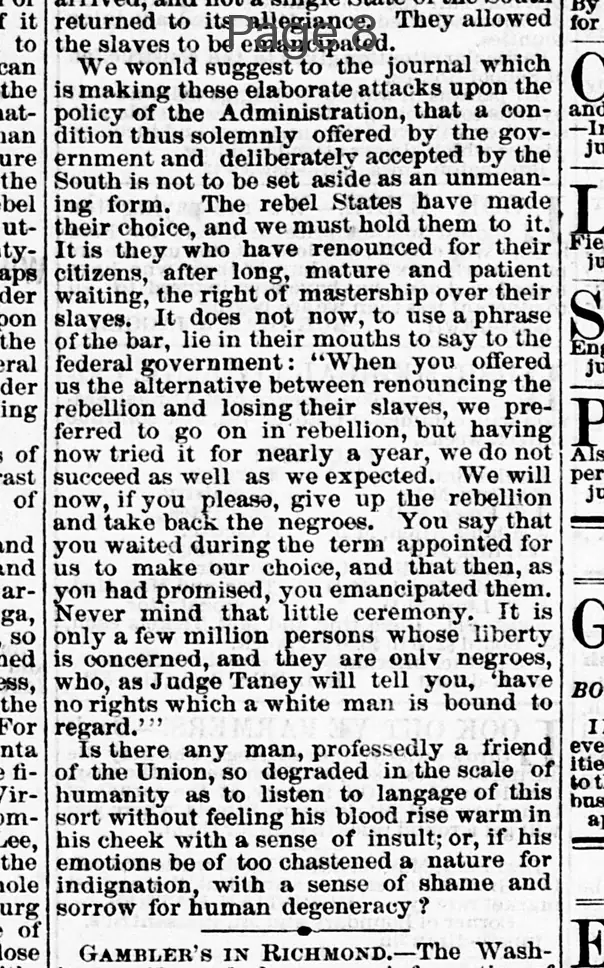
The President meditated, his friends say, for more than a year, on the question of declaring the freedom of the working people of the rebel States. He patiently listened to all that could be said both on the one side and the other. When at length he saw himself moved to take that step by the force of various reasons, he hesitated with regard to the proper moment; he feared to out-strip the progress of public opinion; he dreaded the unfavorable effect of a premature measure. At length he issued the proclamation on the 22d of September, 1862, but he issued it with a condition. If any State previous to the first of January, says that State paper, shall return to its allegiance and duty, the proclamation shall have no effect within its limits. The President gave them their choice between desisting from rebellion and losing their slaves; they chose rebellion. To such a degree was the President resolved to refrain from touching what they called their rights, that he gave them the opportunity to keep those slaves if they would. They preferred to run the risk of losing them. More than three months elapsed, the 1st of January arrived, and not a single State of the South returned to its allegiance. They allowed the slaves to be emancipated.
We would suggest to the journal which is making these elaborate attacks upon the policy of the Administration, that a condition thus solemnly offered by the government and deliberately accepted by the South is not to be set aside as an unmeaning form.
The rebel States have made their choice, and we must hold them to it. It is they who have renounced for their citizens, after long, mature and patient waiting, the right of mastership over their slaves. It does not now, to use a phrase of the bar, lie in their mouths to say to the federal government: "When you offered us the alternative between renouncing the rebellion and losing their slaves, we preferred to go on in rebellion, but having now tried it for nearly a year, we do not succeed as well as we expected. We will now, if you please, give up the rebellion and take back the negroes. You say that you waited during the term appointed for us to make our choice, and that then, as you had promised, you emancipated them. Never mind that little ceremony. It is only a few million persons whose liberty is concerned, and they are only negroes who, as Judge Taney will tell you, have no rights which a white man is bound to regard."
Is there any man, professedly a friend of the Union, so degraded in the scale of humanity as to listen to language of this sort without feeling his blood rise warm in his cheek with a sense of insult; or, if his emotions be of too chastened a nature for indignation, with a sense of shame and sorrow for human degeneracy?
The President meditated, his friends say, for more than a year, on the question of declaring the freedom of the working people of the rebel States. He patiently listened to all that could be said both on the one side and the other. When at length he saw himself moved to take that step by the force of various reasons, he hesitated with regard to the proper moment; he feared to out-strip the progress of public opinion; he dreaded the unfavorable effect of a premature measure. At length he issued the proclamation on the 22d of September, 1862, but he issued it with a condition. If any State previous to the first of January, says that State paper, shall return to its allegiance and duty, the proclamation shall have no effect within its limits. The President gave them their choice between desisting from rebellion and losing their slaves; they chose rebellion. To such a degree was the President resolved to refrain from touching what they called their rights, that he gave them the opportunity to keep those slaves if they would. They preferred to run the risk of losing them. More than three months elapsed, the 1st of January arrived, and not a single State of the South returned to its allegiance. They allowed the slaves to be emancipated.
We would suggest to the journal which is making these elaborate attacks upon the policy of the Administration, that a condition thus solemnly offered by the government and deliberately accepted by the South is not to be set aside as an unmeaning form.
The rebel States have made their choice, and we must hold them to it. It is they who have renounced for their citizens, after long, mature and patient waiting, the right of mastership over their slaves. It does not now, to use a phrase of the bar, lie in their mouths to say to the federal government: "When you offered us the alternative between renouncing the rebellion and losing their slaves, we preferred to go on in rebellion, but having now tried it for nearly a year, we do not succeed as well as we expected. We will now, if you please, give up the rebellion and take back the negroes. You say that you waited during the term appointed for us to make our choice, and that then, as you had promised, you emancipated them. Never mind that little ceremony. It is only a few million persons whose liberty is concerned, and they are only negroes who, as Judge Taney will tell you, have no rights which a white man is bound to regard."
Is there any man, professedly a friend of the Union, so degraded in the scale of humanity as to listen to language of this sort without feeling his blood rise warm in his cheek with a sense of insult; or, if his emotions be of too chastened a nature for indignation, with a sense of shame and sorrow for human degeneracy?
What sub-type of article is it?
Slavery Abolition
War Or Peace
Partisan Politics
What keywords are associated?
Emancipation Proclamation
Civil War
Slavery
Southern Rebellion
Lincoln Policy
Union Friends
What entities or persons were involved?
President
Rebel States
South
Judge Taney
Administration
Editorial Details
Primary Topic
Defense Of The Emancipation Proclamation
Stance / Tone
Strongly Supportive Of Emancipation And Indignant Towards Critics
Key Figures
President
Rebel States
South
Judge Taney
Administration
Key Arguments
President Meditated For Over A Year Before Issuing The Conditional Emancipation Proclamation On September 22, 1862
Proclamation Allowed Southern States To Retain Slavery By Returning To Allegiance Before January 1, 1863
Southern States Chose Continued Rebellion, Leading To Emancipation
Critics Cannot Dismiss The Solemn Condition Accepted By The South
Rebels Cannot Now Demand Reinstatement Of Slavery After Their Choice
Moral Outrage At Suggestions To Disregard Emancipation As Mere Ceremony