Thank you for visiting SNEWPapers!
Sign up free
Gazette Of The United States, & Philadelphia Daily Advertiser
Philadelphia, Philadelphia County, Pennsylvania
What is this article about?
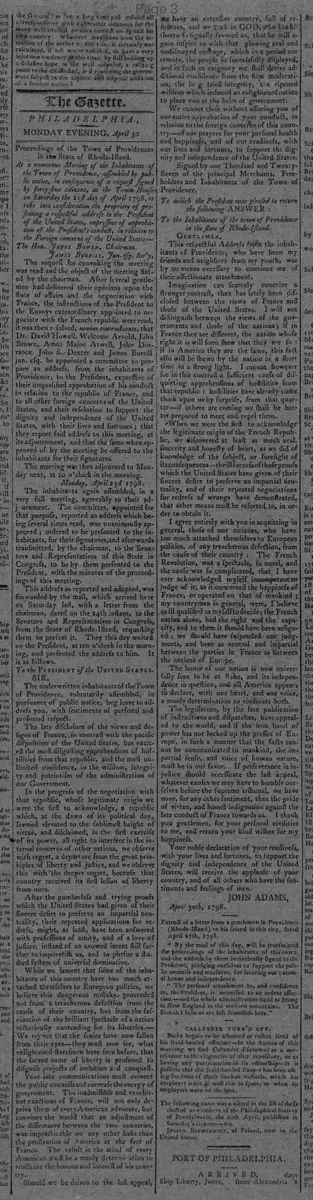
Inhabitants of Providence, Rhode Island, convened on April 21-23, 1798, to approve and sign an address expressing support for President John Adams' conduct in foreign affairs, particularly relations with France, amid tensions. Signed by 1,027 residents, it was presented to Adams, who responded appreciatively.
Clipping
OCR Quality
Full Text
PHILADELPHIA,
MONDAY EVENING, April 30
Proceedings of the Town of Providence in the State of Rhode-Island.
At a numerous Meeting of the Inhabitants of the Town of Providence, assembled by public notice, in consequence of a request signed by forty-five citizens, at the Town House on Saturday the 21st day of April 1798, to take into consideration the propriety of presenting a respectful address to the President of the United States, expressive of approbation of the President's conduct, in relation to the Foreign concerns of the United States—
The Hon. Fazeb Bowen, Chairman.
JAMES BURRILL, Jun. esq. Sec'y,
The request for convoking the meeting was read and the object of the meeting stated by the chairman. After several gentlemen had delivered their opinions upon the state of affairs and the negotiation with France, the instructions of the President to the Envoys extraordinary appointed to negotiate with the French republic were read, it was then resolved, nemine contradicente, that Dr. David Howell, Welcome Arnold, John Brown, Amos Martin Atwell, John Dorrance, John S. Dexter and James Burrill jun. esq. be appointed a committee to prepare an address, from the inhabitants of Providence, to the President, expressive of their unqualified approbation of his conduct in relation to the republic of France, and to all other foreign concerns of the United States, and their resolution to support the dignity and independence of the United States, with their lives and fortunes; that they report said address to this meeting, at its adjournment, and that the same when approved of by the meeting be offered to the inhabitants for their signatures.
The meeting was then adjourned to Monday next, at 10 o'clock in the morning.
Monday, April 23d 1798.
The inhabitants again assembled, in a very full meeting, agreeably to their adjournment. The committee, appointed for that purpose, reported an address which being several times read, was unanimously approved; ordered to be presented to the inhabitants, for their signatures, and afterwards transmitted, by the chairman, to the Senators and Representatives of this State in Congress, to be by them presented to the President, with the minutes of the proceedings of this meeting.
This address as reported and adopted, was forwarded by the mail, which arrived here on Saturday last, with a letter from the chairman, dated on the 24th instant, to the Senators and Representatives in Congress, from the State of Rhode-Island, requesting them to present it. They this day waited on the President, at ten o'clock in the morning, and presented the address to him. It is as follows.
To the President of the United States.
SIR,
The underwritten inhabitants of the Town of Providence, voluntarily assembled, in pursuance of public notice, beg leave to address you, with sentiments of personal and profound respect.
The late disclosure of the views and designs of France, in contrast with the pacific disposition of the United States, has excited the most disgusting apprehensions of hostilities from that republic, and the most unlimited confidence, in the wisdom, integrity and patriotism of the administration of our Government.
In the progress of the negotiation with that republic, whose legitimate origin we were the first to acknowledge, a republic which, at the dawn of its political day, seemed elevated to the sublimest height of virtue, and disclaimed, in the first exercise of its power, all right to interfere in the internal concerns of other nations, we observe with regret, a departure from the great principles of liberty and justice, and we observe this with the deeper regret, because that country received its first lesson of liberty from ours.
After the numberless and trying proofs which the United States had given of their sincere desire to preserve an impartial neutrality, their repeated applications for redress, might, at least, have been answered with professions of amity, and of a love of justice, instead of an avowed intent still further to impoverish us, and to pursue a studied system of universal domination.
While we lament that some of the inhabitants of this country have too much attached themselves to European politics, we believe this dangerous mistake proceeded not from a treacherous defection from the cause of their country, but from the fascination of the brilliant spectacle of a nation victoriously contending for its liberties.
We rejoice that the scales have now fallen from their eyes—they must now see, what enlightened statesmen have seen before, that the sacred name of liberty is profaned to disguise projects of ambition and conquest.
Your late communications must cement the public councils and increase the energy of government. The inadmissible and exorbitant exactions of France, will not only deprive them of every American advocate, but convince the world that an adjustment of the differences between the two countries, was impracticable on any other basis than the prostration of America at the feet of France. The result in the mind of every American must be a manly determination to vindicate the honour and interest of his country.
Should we be driven to the last appeal, we have an extensive country, full of resources, and we trust in GOD, who has hitherto so signally favored us, that he will again inspire us with that glowing zeal and undismayed courage, which in a period not remote, the people so successfully displayed, and in such an exigency we shall derive additional confidence from the firm moderation, the long tried integrity, the ripened wisdom which induced an enlightened nation to place you at the helm of government.
We cannot close without assuring you of our entire approbation of your conduct, in relation to the foreign concerns of this country—of our prayers for your personal health and happiness, and of our readiness, with our lives and fortunes, to support the dignity and independence of the United States.
Signed by one Thousand and Twenty-Seven of the principal Merchants, Freeholders and Inhabitants of the Town of Providence.
To which the President was pleased to return the following ANSWER:
To the Inhabitants of the town of Providence in the state of Rhode-Island.
GENTLEMEN,
This respectful Address from the inhabitants of Providence, who have been my friends and neighbors from my youth, was by no means necessary to convince me of their affectionate attachment.
Imagination can scarcely conceive a stronger contrast, than has lately been disclosed between the views of France and those of the United States. I will not distinguish between the views of the governments and those of the nations; if in France they are different, the nation whose right it is will soon shew that they are so: if in America they are the same, this fact also will be shewn by the nation in a short time in a strong light. I cannot however see in this contrast a sufficient cause of disquieting apprehensions of hostilities from that republic: hostilities have already come thick upon us by surprise, from that quarter—if others are coming we shall be better prepared to meet and repel them.
—When we were the first to acknowledge the legitimate origin of the French Republic, we discovered at least as much zeal, sincerity and honesty of heart, as we did of knowledge of the subject, or foresight of its consequences—the ill success of those proofs which the United States have given of their sincere desire to preserve an impartial neutrality, and of their repeated negotiations for redress of wrongs have demonstrated, that other means must be resorted to, in order to obtain it.
I agree entirely with you in acquitting in general, those of our citizens, who have too much attached themselves to European politics, of any treacherous defection, from the cause of their country: The French Revolution, was a spectacle, so novel, and the cause was so complicated, that I have ever acknowledged myself incompetent to judge of it, as it concerned the happiness of France, or operated on that of mankind; my countrymen in general, were, I believe as ill qualified as myself to decide; the French nation alone, had the right and the capacity, and to them it should have been resigned; we should have suspended our judgments, and been as neutral and impartial between the parties in France as between the nations of Europe.
The honor of our nation is now universally seen to be at stake, and its independence in question, and all America appears to declare, with one heart, and one voice, a manly determination to vindicate both.
The legislature, by the late publication of instructions and dispatches, have appealed to the world, and if the iron hand of power has not locked up the press of Europe, in such a manner that the facts cannot be communicated to mankind, the impartial eye, and voice of human nature, must be in our favor. If perseverance in injustice should necessitate the last appeal, whatever causes we may have to humble ourselves before the supreme tribunal, we have none, for any other sentiment, than the pride of virtue, and honest indignation against the late conduct of France towards us. I thank you gentlemen, for your personal civilities to me, and return your kind wishes for my happiness.
Your noble declaration of your readiness, with your lives and fortunes, to support the dignity and independence of the United States, will receive the applause of your country, and of all others who have the sentiments and feelings of men.
JOHN ADAMS,
April 30th, 1798.
What sub-type of article is it?
What keywords are associated?
What entities or persons were involved?
Where did it happen?
Domestic News Details
Primary Location
Town Of Providence, State Of Rhode Island
Event Date
April 21 23, 1798
Key Persons
Outcome
address unanimously approved, signed by 1,027 principal merchants, freeholders, and inhabitants; presented to president john adams on april 30, 1798, who responded with appreciation and resolve.
Event Details
A numerous meeting of Providence inhabitants assembled on April 21, 1798, to consider an address supporting the President's foreign policy. A committee prepared the address, approved on April 23, expressing approbation of the President's conduct toward France and commitment to support U.S. dignity with lives and fortunes.