Thank you for visiting SNEWPapers!
Sign up free
Orleans Independent Standard
Irasburg, Barton, Orleans County, Vermont
What is this article about?
Letter to Mr. Earle argues that towns along the proposed railroad route (e.g., Newport, Troy, Derby) must raise funds themselves to extend the line to the Canadian border, avoiding burdening directors or existing stockholders, who already profit; cites past railroad failures in Vermont and estimates costs at $600,000 total.
Clipping
OCR Quality
Full Text
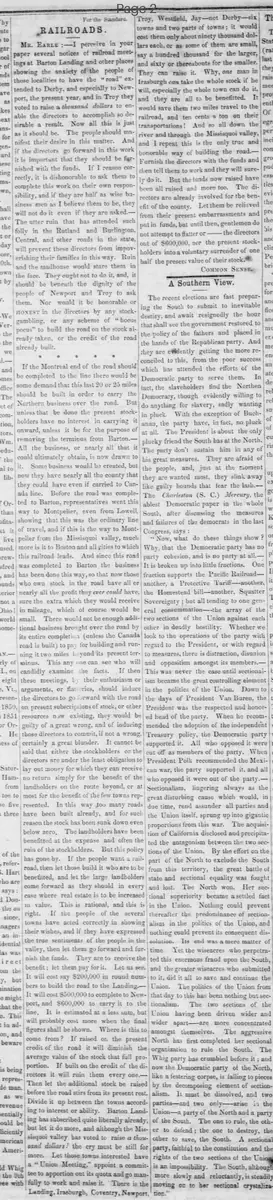
If the Montreal end of the road should be completed to the line there would be some demand that this last 20 or 25 miles should be built in order to carry the Northern business over the road. But unless that be done the present stock-holders have no interest in carrying it onward, unless it be for the purpose of removing the terminus from Barton. All the business, or nearly all that it could ultimately obtain, is now drawn to it. Some business would be created, but now they have nearly all the county that they could have even if carried to Canada line. Before the road was completed to Barton, representatives went this way to Montpelier, even from Lowell, showing that this was the ordinary line of travel, and if this is the way to Montpelier from the Missisquoi valley, much more is it to Boston and all cities to which this railroad leads. And since this road was completed to Barton the business has been done this way, so that now those who own stock in the road have all or nearly all the profit they ever could have. To be sure the extra which they would receive in mileage, which of course would be small. There would not be enough additional business brought over the road by its entire completion (unless the Canada road is built) to pay for building and running it two miles beyond its present terminus. This any one can see who will candidly examine the facts. If then these meetings, by their enthusiasm or arguments, or flatteries, should induce the directors to go forward with the road on present subscriptions of stock, or other resources now existing, they would be guilty of a great wrong, and of inducing those directors to commit, if not a wrong, certainly a great blunder. It cannot be said that either the stockholders or the directors are under the least obligation to lay out money for which they can receive no return simply for the benefit of the landholders on the route beyond, or at most for the benefit of the few towns represented. In this way too many roads have been built already, and for such reason the stock has been sunk down even below zero. The landholders have been benefitted at the expense and often the ruin of the stockholders. But this policy has gone by. If the people want a railroad, then let those build it who are to be benefitted, and let the large landholders come forward as they should in every case where real estate is to be increased in value. This is rational, and this is right. If the people of the several towns have acted correctly in showing their wishes, and if they have expressed the true sentiments of the people in the valley, then let them go forward and furnish the funds. They are to receive the benefit: let them pay for it. Let us see. It will cost say $200,000 in round numbers to build the road to the Landing. It will cost $500,000 to complete to Newport, and $600,000 to carry it to the line. It is estimated at a less sum, but will probably cost more when the final figures shall be shown. Where is this to come from? If raised on the present credit of the road it will diminish the average value of the stock that full proportion. If built on the credit of the directors it will ruin them every one. Then let the additional stock be raised before the road stirs from its present rest. Divide it up between the towns according to interest or ability. Barton Landing has subscribed quite liberally already, but let it do more, and although the Missisquoi valley has voted to raise a thousand dollars! the cry must be still for more. Let those towns interested have a "Union Meeting," appoint a committee to apportion out its quota and go manfully to work and raise it. There is the way to do it.
Troy, Westfield, Jay, Derby—six towns and two parts of towns: it would cost them only about ninety thousand dollars each, or as some of them are small, say a hundred thousand for the larger, and sixty or thereabouts for the smaller. They can raise it. Why, one man in Irasburgh can take the whole stock if he will, especially the whole town can do it, and they are all to be benefitted. It would save them two miles travel to the railroad, and ten cents a ton on their transportations! And so all down the river and through the Missisquoi valley, and I repeat this is the only true and honorable way of building the road. Furnish the directors with the funds and then tell them to work and they will surely do it. But the funds now raised have been all raised and more too. The directors are already involved for the benefit of the county. Let them be relieved from their present embarrassments and put in funds, but until then, gentlemen do not attempt to flatter or — the directors out of $600,000, nor the present stock-holders into a voluntary surrender of one half the present value of their stock.
COMMON SENSE.
What sub-type of article is it?
What themes does it cover?
What keywords are associated?
What entities or persons were involved?
Letter to Editor Details
Author
Common Sense.
Recipient
Mr. Earle
Main Argument
the people of towns like newport and troy should raise their own funds to extend the railroad, rather than asking directors to build on personal credit or existing stock, as this would lead to ruin like other vermont railroads; existing stockholders already benefit sufficiently without further extension unless the montreal line connects.
Notable Details