Thank you for visiting SNEWPapers!
Sign up free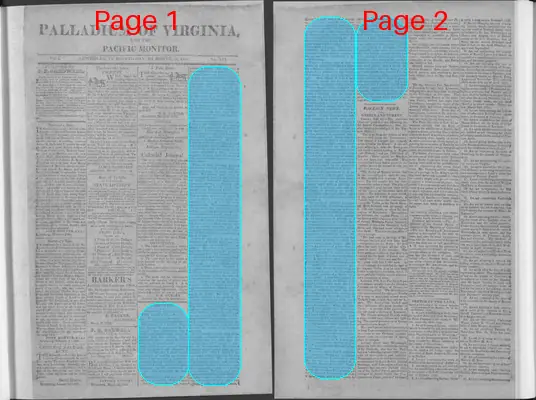
Palladium Of Virginia And The Pacific Monitor
Lewisburg, Greenbrier County, West Virginia
What is this article about?
In 'The Visitant No. III,' the author reflects on the female character, preferring women's natural insights to philosophers' abstractions. He praises wit, sense, and delicacy in female conversation, critiques superficial education fostering vanity, and advocates for intellectual virtues, positioning himself as a defender of women against societal aspersions.
Merged-components note: Continuation of the essay 'The Visitant No. III' on female character and society, spanning from page 1 to page 2; original label of second component changed from 'editorial' to 'literary' as it fits serialized essay/narrative.
Clippings
1 of 2
OCR Quality
Full Text
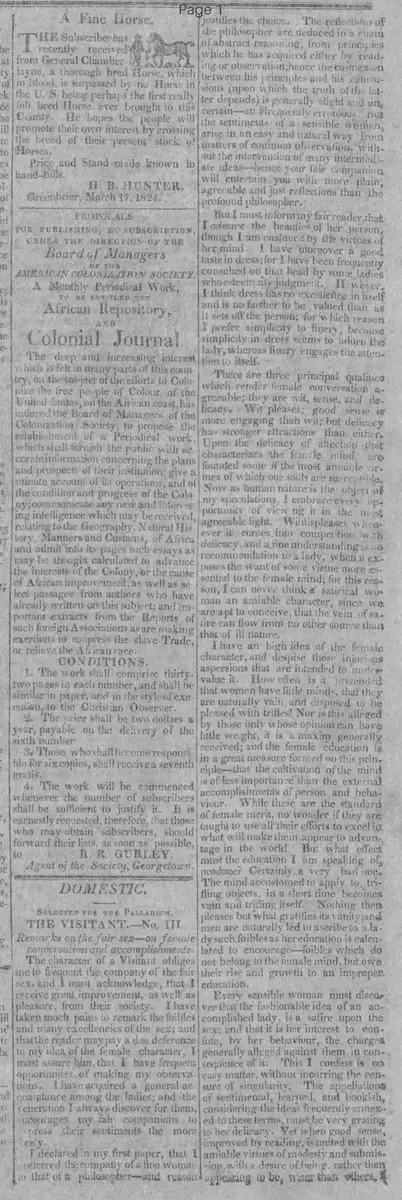
Selected for The Palladium.
THE VISITANT.--NO. III
Remarks on the fair sex--on female conversation and accomplishments.
The character of a Visitant obliges me to frequent the company of the fair sex, and I must acknowledge, that I receive great improvement, as well as pleasure, from their society. I have taken much pains to remark the foibles and many excellencies of the sex; and that the reader may pay a due deference to my idea of the female character, I must assure him, that I have frequent opportunities of making my observations. I have acquired a general acquaintance among the ladies; and the veneration I always discover for them, encourages my fair companions to express their sentiments the more freely.
I declared in my first paper, that I preferred the company of a fine woman to that of a philosopher--and reason justifies the choice. The reflections of the philosopher are deduced in a chain of abstract reasoning, from principles which he has acquired either by reading or observation; hence the connexion between his principles and his conclusions (upon which the truth of the latter depends) is generally slight and uncertain--at frequently erroneous. but the sentiments of a sensible woman, arise in an easy and natural way from matters of common observation, without the intervention of many intermediate ideas--hence your fair companion will entertain you with more plain, agreeable and just reflections than the profound philosopher.
But I must inform my fair reader, that I admire the beauties of her person, though I am enslaved by the virtues of her mind. I have moreover a good taste in dress; for I have been frequently consulted on that head by some ladies who esteem my judgment. However, I think dress has no excellence in itself and is no farther to be valued than as it sets off the person; for which reason I prefer simplicity to finery, because simplicity in dress seems to adorn the lady, whereas finery engages the attention to itself.
There are three principal qualities which render female conversation agreeable; they are wit, sense, and delicacy. Wit pleases; good sense is more engaging than wit; but delicacy has stronger attractions than either. Upon the delicacy of affection that characterizes the female mind are founded some of the most amiable virtues of which our souls are susceptible.
Now as human nature is the object of my speculations, I embrace every opportunity of viewing it in the most agreeable light. Wit displeases whenever it comes into competition with delicacy, and a fine understanding is no recommendation to a lady, when it exposes the want of some virtue more essential to the female mind; for this reason, I can never think a satirical woman an amiable character, since we are apt to conceive, that the vein of satire can flow from no other source than that of ill nature.
I have a high idea of the female character, and despise those injurious aspersions that are intended to undervalue it. How often is it pretended that women have little minds, that they are naturally vain, and disposed to be pleased with trifles! Nor is this alleged by those only whose opinion can have little weight, it is a maxim generally received; and the female education is in a great measure formed on this principle-that the cultivation of the mind is of less importance than the external accomplishments of person and behaviour. While these are the standard of female merit, no wonder if they are taught to use all their efforts to excel in what will make them appear to advantage in the world But what effect must the education I am speaking of produce? Certainly a very bad one. The mind accustomed to apply to trifling objects, in a short time becomes vain and trifling itself. Nothing then pleases but what gratifies its vanity; and men are naturally led to ascribe to a lady such foibles as her education is calculated to encourage--foibles which do not belong to the female mind, but owe their rise and growth to an improper education.
Every sensible woman must discover that the fashionable idea of an accomplished lady, is a satire upon the sex; and that it is her interest to confute, by her behaviour, the charges generally alleged against them in consequence of it. This I confess is no easy matter, without incurring the censure of singularity. The appellations of sentimental, learned, and bookish, considering the ideas frequently annexed to these terms, must be very grating to her delicacy. Yet when good sense, improved by reading, is united with the amiable virtues of modesty and submission, with a desire of being, rather than appearing to be, wiser than others, a woman will always secure to herself the respect and admiration of the world.
Do not imagine that it must engage unavoidable respect, and that even those who have never aimed at acquisition of intellectual endowments, would be forced to admire such a character—a character that exposes their own, without assuming the privilege of doing so. But there are two sorts of men whose admiration is not worth courting; they are the fop and the debauchee. The life of the debauchee makes him undervalue a virtuous woman; and the respects of the fop can be no compliment to her understanding.
There is another class of men to whom my regard for the fair sex makes me a declared enemy; I mean those who take a pleasure in representing their actions in the most unfavourable light. How difficult is it for a lady to conduct herself free from the censures of the ungenerous and ill-natured? There is no part of her behaviour but what is liable to misconstruction. Good nature is branded with the name of forwardness, and reserve with that of affection. If she behaves with an innocent freedom to one of our sex—no doubt she has a design upon him; if she resents any impropriety in his behaviour—she is immediately noted as a coquette. Is she offended at the indecent language in which some men's impudence allows them—she seems as if she would fain be thought more delicate than her neighbours; if she neglects shewing a proper resentment for it—this omission is construed into a criminal approbation. Every lady that has an handsome face is supposed to overvalue herself, and to expect universal adoration; every one that is not handsome is presumed of course to hate all that are so. Anything inadvertently said to the disadvantage of another is immediately resolved into envy; and a lady is generally supposed to think herself disparaged by the praises bestowed on the perfections of others.
Such are the insinuations of an unmanly spirit to stain the most amiable characters: and in these circumstances, it becomes every man of honour and virtue to stand forth an advocate for the ladies. A generous mind will take a pleasure in defending the weaker party, which is the least able to make resistance, and therefore more liable to be attacked.
Having given sufficient intimation of my favourable dispositions towards the fair sex, it will be proper to declare why I think myself qualified to assume the character of their public monitor. As my acquaintance is general, so I have spared no pains to observe their different sentiments and dispositions, & always endeavour to engage their minds upon such subjects as may give me an opportunity of observing them. My diligent application to those things that employ their attention, has made me more learned upon subjects that lie within the province of a lady, than the generality of my sex. This makes me a competent judge in matters that lie beyond the reach of other men's capacity. It opens to my mind a source of pleasure to which they are strangers; or merely discover a surprising taste and ingenuity exerted in discoursing on the mode of a cap, or in determining the proper position of a flower on a gauze apron. I have been induced to peruse such books as are thought to be adapted to the female taste, and I always examine in conversation with my fair companion, what has been most striking to her in her reading, the observations she has made upon it, & her manner of applying them. for I think these are generally descriptive of her real character. When the judgment I form of a lady is to her advantage I am pleased with my opinion, and never alter it without very good reasons; when it is unfavourable I am willing to believe myself mistaken, and carefully attend to every circumstance that may serve to correct my judgment.
I flatter myself that the sentiments I have advanced, have given my fair readers a favourable opinion of me and that in consequence of it, I may presume to request their attention to what I shall present them in the course of my publications.
No sooner, ladies, had I embraced this method of offering my sentiments to the public, than it occurred to me, that the fair sex were entitled to a principal share of my regard. Numerous and pleasing were the subjects to which the reflection led me, animated by the prospect, I resolved to dedicate a considerable part of my labours to your immediate service—flattering myself with the hope of laying an offering at your feet, not altogether unworthy of your notice.
Though I am ever attentive to female virtues, I am not blind to female foibles, I shall endeavour to mention the former without deserving the charge of partiality, and take notice of the latter, free from an air of severity. Though I generally judge upon the charitable side, in whatever regards the fair part of our species, I always avoid those arts of flattery which many of our sex have employed to insinuate themselves into your good graces, these I utterly disclaim; not only because flattery is in itself contemptible, but because I do not observe, whatever others may pretend to the contrary, that it meets in general with the expected success. But at the same time that I confess myself destitute of the boasted merits of a modern coxcomb, I flatter myself these papers will convince you that I deservedly assume the character of an humble servant of the ladies.
What sub-type of article is it?
What themes does it cover?
What keywords are associated?
Literary Details
Title
The Visitant. No. Iii
Subject
Remarks On The Fair Sex On Female Conversation And Accomplishments.
Key Lines