Thank you for visiting SNEWPapers!
Sign up free
Daily National Intelligencer
Washington, District Of Columbia
What is this article about?
Description of a satirical caricature engraving published in London during the American Revolutionary War, depicting King George III and savages cannibalizing a child, with British sailors and a bishop, highlighting hypocrisy in British support for Native American allies.
Clipping
OCR Quality
Full Text
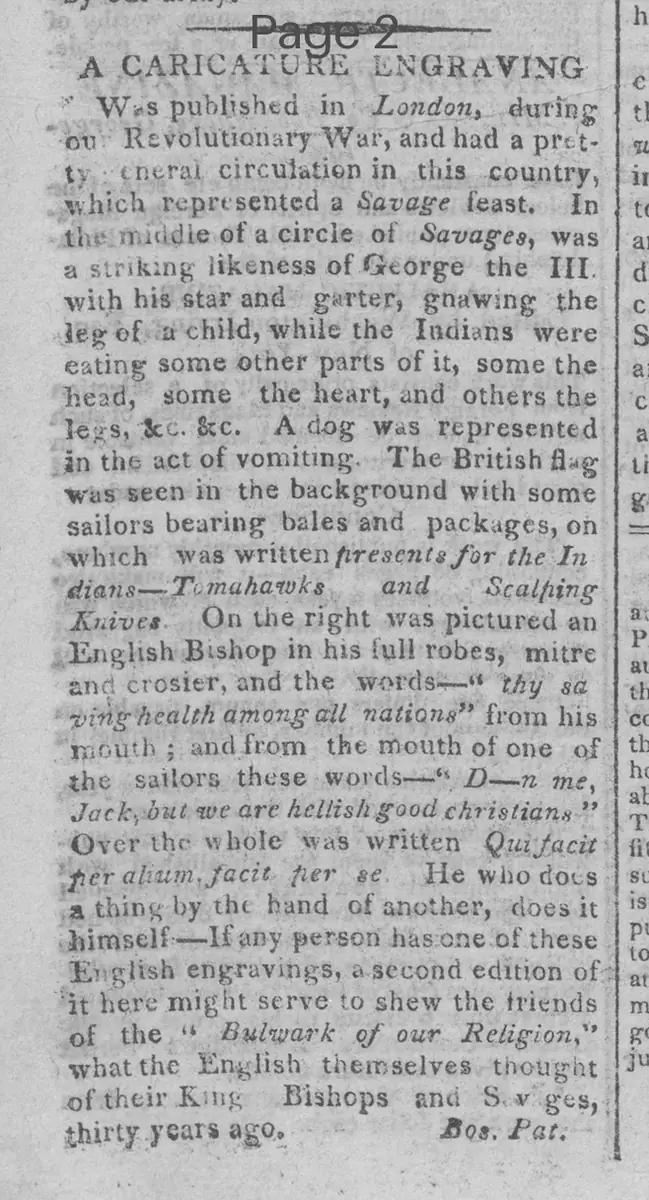
Was published in London, during our Revolutionary War, and had a pretty general circulation in this country, which represented a Savage feast. In the middle of a circle of Savages, was a striking likeness of George the III. with his star and garter, gnawing the leg of a child, while the Indians were eating some other parts of it, some the head, some the heart, and others the legs, &c. &c. A dog was represented in the act of vomiting. The British flag was seen in the background with some sailors bearing bales and packages, on which was written "presents for the Indians—Tomahawks and Scalping Knives." On the right was pictured an English Bishop in his full robes, mitre and crosier, and the words—“thy saving health among all nations" from his mouth; and from the mouth of one of the sailors these words—“D—n me, Jack, but we are hellish good christians." Over the whole was written Qui facit per alium. facit per se He who does a thing by the hand of another, does it himself—If any person has one of these English engravings, a second edition of it here might serve to shew the friends of the "Bulwark of our Religion," what the English themselves thought of their King Bishops and Savages, thirty years ago.
Bos. Pat.
What sub-type of article is it?
What themes does it cover?
What keywords are associated?
What entities or persons were involved?
Where did it happen?
Story Details
Key Persons
Location
London
Event Date
During Our Revolutionary War
Story Details
A satirical engraving shows King George III gnawing a child's leg amid savages eating the body, with vomiting dog, British flag, sailors with weapons for Indians, hypocritical bishop quoting scripture, and sailor mocking Christianity; Latin motto implies king's responsibility; suggests reprinting to show English views on their king, bishops, and savages thirty years prior.