Thank you for visiting SNEWPapers!
Sign up free
Editorial
March 1, 1951
Pick And Shovel
Bauxite, Saline County, Arkansas
What is this article about?
The editorial describes how the Pilgrims in Plymouth Colony abandoned communal resource sharing in 1623 for private enterprise under Governor Bradford, leading to prosperity and contentment, as a historical lesson against modern central government welfare systems.
Clipping
OCR Quality
98%
Excellent
Full Text
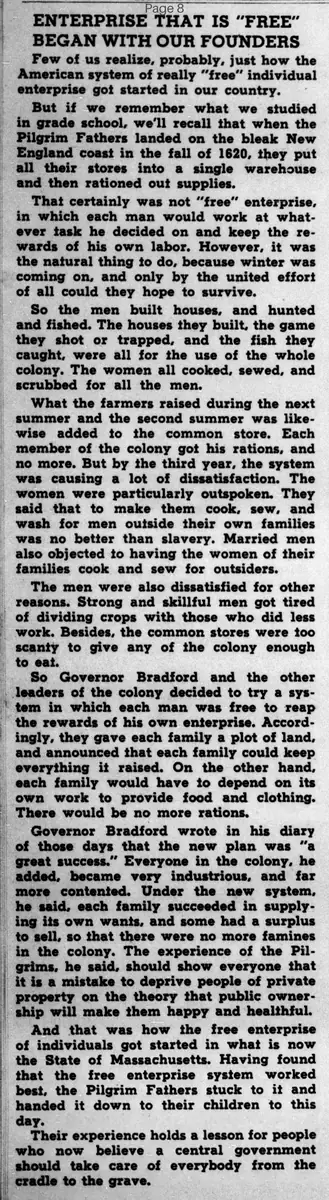
ENTERPRISE THAT IS "FREE"
BEGAN WITH OUR FOUNDERS
Few of us realize, probably, just how the American system of really "free" individual enterprise got started in our country. But if we remember what we studied in grade school, we'll recall that when the Pilgrim Fathers landed on the bleak New England coast in the fall of 1620, they put all their stores into a single warehouse and then rationed out supplies. That certainly was not "free" enterprise, in which each man would work at whatever task he decided on and keep the rewards of his own labor. However, it was the natural thing to do, because winter was coming on, and only by the united effort of all could they hope to survive.
So the men built houses, and hunted and fished. The houses they built, the game they shot or trapped, and the fish they caught, were all for the use of the whole colony. The women all cooked, sewed, and scrubbed for all the men. What the farmers raised during the next summer and the second summer was likewise added to the common store. Each member of the colony got his rations, and no more. But by the third year, the system was causing a lot of dissatisfaction. The women were particularly outspoken. They said that to make them cook, sew, and wash for men outside their own families was no better than slavery. Married men also objected to having the women of their families cook and sew for outsiders. The men were also dissatisfied for other reasons. Strong and skillful men got tired of dividing crops with those who did less work. Besides, the common stores were too scanty to give any of the colony enough to eat.
So Governor Bradford and the other leaders of the colony decided to try a system in which each man was free to reap the rewards of his own enterprise. Accordingly, they gave each family a plot of land, and announced that each family could keep everything it raised. On the other hand, each family would have to depend on its own work to provide food and clothing. There would be no more rations. Governor Bradford wrote in his diary of those days that the new plan was "a great success." Everyone in the colony, he added, became very industrious, and far more contented. Under the new system, he said, each family succeeded in supplying its own wants, and some had a surplus to sell, so that there were no more famines in the colony. The experience of the Pilgrims, he said, should show everyone that it is a mistake to deprive people of private property on the theory that public ownership will make them happy and healthful. And that was how the free enterprise of individuals got started in what is now the State of Massachusetts. Having found that the free enterprise system worked best, the Pilgrim Fathers stuck to it and handed it down to their children to this day.
Their experience holds a lesson for people who now believe a central government should take care of everybody from the cradle to the grave.
BEGAN WITH OUR FOUNDERS
Few of us realize, probably, just how the American system of really "free" individual enterprise got started in our country. But if we remember what we studied in grade school, we'll recall that when the Pilgrim Fathers landed on the bleak New England coast in the fall of 1620, they put all their stores into a single warehouse and then rationed out supplies. That certainly was not "free" enterprise, in which each man would work at whatever task he decided on and keep the rewards of his own labor. However, it was the natural thing to do, because winter was coming on, and only by the united effort of all could they hope to survive.
So the men built houses, and hunted and fished. The houses they built, the game they shot or trapped, and the fish they caught, were all for the use of the whole colony. The women all cooked, sewed, and scrubbed for all the men. What the farmers raised during the next summer and the second summer was likewise added to the common store. Each member of the colony got his rations, and no more. But by the third year, the system was causing a lot of dissatisfaction. The women were particularly outspoken. They said that to make them cook, sew, and wash for men outside their own families was no better than slavery. Married men also objected to having the women of their families cook and sew for outsiders. The men were also dissatisfied for other reasons. Strong and skillful men got tired of dividing crops with those who did less work. Besides, the common stores were too scanty to give any of the colony enough to eat.
So Governor Bradford and the other leaders of the colony decided to try a system in which each man was free to reap the rewards of his own enterprise. Accordingly, they gave each family a plot of land, and announced that each family could keep everything it raised. On the other hand, each family would have to depend on its own work to provide food and clothing. There would be no more rations. Governor Bradford wrote in his diary of those days that the new plan was "a great success." Everyone in the colony, he added, became very industrious, and far more contented. Under the new system, he said, each family succeeded in supplying its own wants, and some had a surplus to sell, so that there were no more famines in the colony. The experience of the Pilgrims, he said, should show everyone that it is a mistake to deprive people of private property on the theory that public ownership will make them happy and healthful. And that was how the free enterprise of individuals got started in what is now the State of Massachusetts. Having found that the free enterprise system worked best, the Pilgrim Fathers stuck to it and handed it down to their children to this day.
Their experience holds a lesson for people who now believe a central government should take care of everybody from the cradle to the grave.
What sub-type of article is it?
Economic Policy
What keywords are associated?
Free Enterprise
Pilgrim Fathers
Plymouth Colony
Governor Bradford
Communal Ownership
Private Property
What entities or persons were involved?
Pilgrim Fathers
Governor Bradford
Plymouth Colony
Editorial Details
Primary Topic
Origins Of Free Enterprise In Plymouth Colony
Stance / Tone
Supportive Of Free Enterprise And Critical Of Communal Ownership
Key Figures
Pilgrim Fathers
Governor Bradford
Plymouth Colony
Key Arguments
Communal System Caused Dissatisfaction Among Colonists, Especially Women And Skilled Workers
Shift To Private Property In 1623 Led To Increased Industriousness And Contentment
Free Enterprise Eliminated Famines And Allowed Surpluses
Experience Demonstrates Folly Of Depriving People Of Private Property For Public Ownership
Lesson Against Central Government Providing Cradle To Grave Care