Thank you for visiting SNEWPapers!
Sign up free
Literary
July 25, 1789
Gazette Of The United States
New York, New York County, New York
What is this article about?
This essay reflects on the Socratic method of education, quoting Plato on Socrates' midwifery analogy for drawing out innate knowledge. It critiques lazy teachers who neglect unpromising students, stresses the need for empathetic instructors who understand human nature, and warns of the lasting harm from poor schooling, promising to address erroneous education in the next paper.
Clipping
OCR Quality
98%
Excellent
Full Text
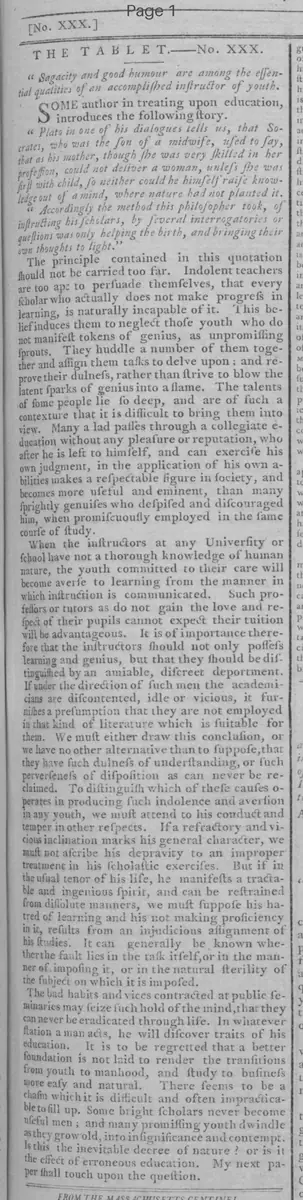
[No. XXX.]
THE TABLET. No. XXX.
"Sagacity and good humour are among the essential qualities of an accomplished instructor of youth. Some author in treating upon education, introduces the following story.
"Plato in one of his dialogues tells us, that Socrates, who was the son of a midwife, used to say, that as his mother, though she was very skilled in her profession, could not deliver a woman, unless she was first with child, so neither could he himself raise knowledge out of a mind, where nature had not planted it.
"Accordingly the method this philosopher took, of instructing his scholars, by several interrogatories or questions was only helping the birth, and bringing their own thoughts to light."
The principle contained in this quotation should not be carried too far. Indolent teachers are too apt to persuade themselves, that every scholar who actually does not make progress in learning, is naturally incapable of it. This belief induces them to neglect those youth who do not manifest tokens of genius, as unpromising sprouts. They huddle a number of them together and assign them tasks to delve upon; and reprove their dulness, rather than strive to blow the latent sparks of genius into a flame. The talents of some people lie so deep, and are of such a contexture that it is difficult to bring them into view. Many a lad passes through a collegiate education without any pleasure or reputation, who after he is left to himself, and can exercise his own judgment, in the application of his own abilities makes a respectable figure in society, and becomes more useful and eminent, than many sprightly geniuses who despised and discouraged him, when promiscuously employed in the same course of study.
When the instructors at any University or school have not a thorough knowledge of human nature, the youth committed to their care will become averse to learning from the manner in which instruction is communicated. Such professors or tutors as do not gain the love and respect of their pupils cannot expect their tuition will be advantageous. It is of importance therefore that the instructors should not only possess learning and genius, but that they should be distinguished by an amiable, discreet deportment.
If under the direction of such men the academicians are discontented, idle or vicious, it furnishes a presumption that they are not employed in that kind of literature which is suitable for them. We must either draw this conclusion, or we have no other alternative than to suppose, that they have such dulness of understanding, or such perverseness of disposition as can never be reclaimed. To distinguish which of these causes operates in producing such indolence and aversion in any youth, we must attend to his conduct and temper in other respects. If a refractory and vicious inclination marks his general character, we must not ascribe his depravity to an improper treatment in his scholastic exercises. But if in the usual tenor of his life, he manifests a tractable and ingenuous spirit, and can be restrained from dissolute manners, we must suppose his hatred of learning and his not making proficiency in it, results from an injudicious alignment of his studies. It can generally be known whether the fault lies in the task itself, or in the manner of imposing it, or in the natural sterility of the subject on which it is imposed.
The bad habits and vices contracted at public seminaries may seize such hold of the mind, that they can never be eradicated through life. In whatever station a man acts, he will discover traits of his education. It is to be regretted that a better foundation is not laid to render the transitions from youth to manhood, and study to business more easy and natural. There seems to be a chasm which it is difficult and often impracticable to fill up. Some bright scholars never become useful men; and many promising youth dwindle as they grow old, into insignificance and contempt.
Is this the inevitable decree of nature? or is it the effect of erroneous education. My next paper shall touch upon the question.
THE TABLET. No. XXX.
"Sagacity and good humour are among the essential qualities of an accomplished instructor of youth. Some author in treating upon education, introduces the following story.
"Plato in one of his dialogues tells us, that Socrates, who was the son of a midwife, used to say, that as his mother, though she was very skilled in her profession, could not deliver a woman, unless she was first with child, so neither could he himself raise knowledge out of a mind, where nature had not planted it.
"Accordingly the method this philosopher took, of instructing his scholars, by several interrogatories or questions was only helping the birth, and bringing their own thoughts to light."
The principle contained in this quotation should not be carried too far. Indolent teachers are too apt to persuade themselves, that every scholar who actually does not make progress in learning, is naturally incapable of it. This belief induces them to neglect those youth who do not manifest tokens of genius, as unpromising sprouts. They huddle a number of them together and assign them tasks to delve upon; and reprove their dulness, rather than strive to blow the latent sparks of genius into a flame. The talents of some people lie so deep, and are of such a contexture that it is difficult to bring them into view. Many a lad passes through a collegiate education without any pleasure or reputation, who after he is left to himself, and can exercise his own judgment, in the application of his own abilities makes a respectable figure in society, and becomes more useful and eminent, than many sprightly geniuses who despised and discouraged him, when promiscuously employed in the same course of study.
When the instructors at any University or school have not a thorough knowledge of human nature, the youth committed to their care will become averse to learning from the manner in which instruction is communicated. Such professors or tutors as do not gain the love and respect of their pupils cannot expect their tuition will be advantageous. It is of importance therefore that the instructors should not only possess learning and genius, but that they should be distinguished by an amiable, discreet deportment.
If under the direction of such men the academicians are discontented, idle or vicious, it furnishes a presumption that they are not employed in that kind of literature which is suitable for them. We must either draw this conclusion, or we have no other alternative than to suppose, that they have such dulness of understanding, or such perverseness of disposition as can never be reclaimed. To distinguish which of these causes operates in producing such indolence and aversion in any youth, we must attend to his conduct and temper in other respects. If a refractory and vicious inclination marks his general character, we must not ascribe his depravity to an improper treatment in his scholastic exercises. But if in the usual tenor of his life, he manifests a tractable and ingenuous spirit, and can be restrained from dissolute manners, we must suppose his hatred of learning and his not making proficiency in it, results from an injudicious alignment of his studies. It can generally be known whether the fault lies in the task itself, or in the manner of imposing it, or in the natural sterility of the subject on which it is imposed.
The bad habits and vices contracted at public seminaries may seize such hold of the mind, that they can never be eradicated through life. In whatever station a man acts, he will discover traits of his education. It is to be regretted that a better foundation is not laid to render the transitions from youth to manhood, and study to business more easy and natural. There seems to be a chasm which it is difficult and often impracticable to fill up. Some bright scholars never become useful men; and many promising youth dwindle as they grow old, into insignificance and contempt.
Is this the inevitable decree of nature? or is it the effect of erroneous education. My next paper shall touch upon the question.
What sub-type of article is it?
Essay
What themes does it cover?
Moral Virtue
Social Manners
What keywords are associated?
Education
Socratic Method
Teaching
Youth
Genius
Human Nature
University
Vices
Literary Details
Title
The Tablet. No. Xxx.
Subject
On Education And Teaching Methods
Key Lines
Plato In One Of His Dialogues Tells Us, That Socrates, Who Was The Son Of A Midwife, Used To Say, That As His Mother, Though She Was Very Skilled In Her Profession, Could Not Deliver A Woman, Unless She Was First With Child, So Neither Could He Himself Raise Knowledge Out Of A Mind, Where Nature Had Not Planted It.
Indolent Teachers Are Too Apt To Persuade Themselves, That Every Scholar Who Actually Does Not Make Progress In Learning, Is Naturally Incapable Of It.
Is This The Inevitable Decree Of Nature? Or Is It The Effect Of Erroneous Education. My Next Paper Shall Touch Upon The Question.