Thank you for visiting SNEWPapers!
Sign up free
The Hillsborough Recorder
Hillsboro, Orange County, North Carolina
What is this article about?
London commentary on Europe's condition in 1859, critiquing high military expenditures for Crimean War (£70M) and Indian insurrection (£20M), contrasting Christian peace ideals with 4.3M armed forces, war patents vs. agricultural innovations, and emigration promoting peace amid potential France-Austria conflict.
Clipping
OCR Quality
Full Text
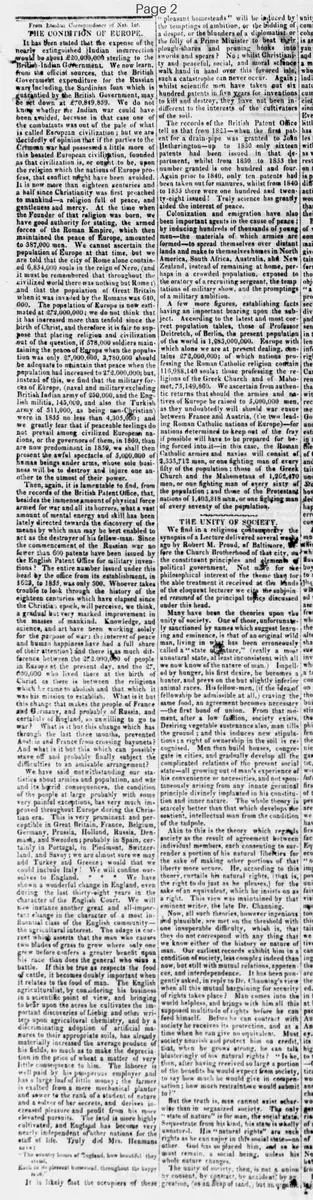
THE CONDITION OF EUROPE.
It has been stated that the expense of the nearly extinguished Indian insurrection would be about £20,000,000 sterling to the British-Indian Government. We now learn, from the official sources, that the British Government expenditure for the Russian war including the Sardinian loan which is guaranteed by the British Government, may be set down at £70,849,859. We do not know whether the Indian war could have been avoided, because in that case one of the combatants was out of the pale of what is called European civilization; but we are decidedly of opinion that if the parties to the Crimean war had possessed a little more of this boasted European civilization, founded as that civilization is, or ought to be, upon the religion which the nations of Europe profess, that conflict might have been avoided.
It is now more than eighteen centuries and a half since Christianity was first preached to mankind—a religion full of peace, and gentleness and mercy. At the time when the Founder of that religion was born, we have good authority for stating, the armed forces of the Roman Empire, which then maintained the peace of Europe, amounted to 387,000 men. We cannot ascertain the population of Europe at that time, but we are told that the city of Rome alone contained 6,854,000 souls in the reign of Nero, (and it must be remembered that throughout the civilized world there was nothing but Rome;) and that the population of Great Britain when it was invaded by the Romans was 640,000. The population of Europe is now estimated at 272,000,000; we do not think that it has increased more than tenfold since the birth of Christ, and therefore it is fair to suppose that placing religion and civilization out of the question, if 378,000 soldiers maintaining the peace of Europe when the population was only 27,000,000, 3,780,000 should be adequate to maintain that peace when the population had increased to 272,000,000; but instead of this, we find that the military forces of Europe, (naval and military excluding British Indian army of 250,000, and the English militia, 145,000, and also the Turkish army of 511,000, as being non-Christian) were in 1855 no less than 4,305,000; and we greatly fear that if peaceable feelings do not prevail among civilized European nations, or the governors of them, in 1860, than are now predominant in 1859, we shall then present the awful spectacle of 5,000,000 of human beings under arms, whose sole business will be to destroy and injure one another to the utmost of their power.
Then, again, it is lamentable to find, from the records of the British Patent Office, that, besides the immense amount of physical force armed for war and all its horrors, what a vast amount of mental energy and skill has been lately directed towards the discovery of the means by which man may be best enabled to act as the destroyer of his fellow-man. Since the commencement of the Russian war no fewer than 600 patents have been issued by the English Patent Office for military inventions! The entire number issued under this head by the office from its establishment, in 1623, to 1855, was only 300. Whoever takes trouble to look through the history of the eighteen centuries which have elapsed since the Christian epoch, will perceive, we think, a gradual but very marked improvement in the masses of mankind. Knowledge, and science, and art have been working solely for the purpose of war: the interest of peace and human happiness have had a full share of their attention: and there is as much difference between the 272,000,000 of people in Europe at the present day, and the 27,000,000 who lived there at the birth of Christ as there is between the religions which he came to abolish and that which it was his mission to establish. What is it but this change that makes the people of France and Germany, and probably of Russia, and certainly of England, so unwilling to go to war? What is it but this change which has through the last three months, prevented Austria and France from crossing bayonets? And what is it but this which can possibly stave off and probably finally subject the difficulties to an amicable arrangement?
We have said notwithstanding our statistics about armies and population, and war and its horrid consequences, the condition of the people at large probably with some very painful exceptions, has very much improved throughout Europe during the Christian era. This is very prominent and perceptible in Great Britain, France, Belgium, Germany, Prussia, Holland, Russia, Denmark, and Sweden; probably in Spain, certainly in Portugal, in Piedmont, Switzerland, and Savoy; we are almost sure we may add Turkey and Greece; would that we could include Italy! We will confine ourselves to England.
We have shown a wonderful change in England, even during the last thirty-eight years in the character of the English Court. We will now instance another great and all-important change in the character of a most influential class of the English community—the agricultural interest. The adage is correct which asserts that the man who causes two blades of grass to grow where only one grew before confers a greater benefit upon his race than does the general who wins a battle. If this be true as respects the food of cattle, it becomes doubly important when it relates to the food of man. The English agriculturalist, by considering his business in a scientific point of view, and bringing to bear upon the acres he cultivates the important discoveries of Liebig and others writers upon agricultural chemistry, and by a discriminating adoption of artificial manures to their appropriate soils, has already materially increased the average produce of his fields, so much as to make the depreciation in the price of wheat a matter of very little consequence to him. The laborer is well paid by his prosperous employer and has a large loaf of little money; the farmer is exalted from a mere mechanical planter and sower to the rank of a student of nature and a solver of her secrets, and derives increased pleasure and profit from his more elevated pursuits. The land is more highly cultivated, and England has become very nearly independent of other nations for the staff of life. Truly did Mrs. Hemans say:
"The country homes of England, how beautiful they stand,
Each in its pleasant homestead, throughout the happy land."
It is likely that the occupiers of these pleasant homesteads will be induced by the temptings of ambition, or the bidding of a despot, or the blunders of a diplomatist or the folly of a Prime Minister to beat their plough-shares and pruning hooks into swords and spears? No; whilst Christianity and peaceful, social, and moral science walk hand in hand over this favored isle, such a catastrophe can never occur. Again; whilst scientific men have taken out six hundred patents in five years for inventions to kill and destroy, they have not been indifferent to the interests of the cultivators of the soil.
The records of the British Patent Office tell us that from 1823—when the first patent for a drain-pipe was granted to John Hetherington—up to 1850 only sixteen patents had been issued in that department, whilst from 1850 to 1855 the number granted is one hundred and four. Again prior to 1840, only ten patents had been taken out for manures, whilst from 1840 to 1855 there were one hundred and twenty-eight issued! Truly science has greatly aided the interest of peace.
Colonization and emigration have also been important agents in the cause of peace by inducing hundreds of thousands of young men—the materials of which armies are formed—to spread themselves over distant lands and make to themselves homes in North America, South Africa, Australia, and New Zealand, instead of remaining at home, perhaps in a crowded population, exposed to the oratory of a recruiting sergeant, the temptations of military show, and the promptings of a military ambition.
A few more figures, establishing facts having an important bearing upon the subject. According to the latest and most correct population tables, those of Professor Deitretch, of Berlin, the present population of the world is 1,283,000,000. Europe with which alone we are at present dealing, contains 272,000,000; of which nations professing the Roman Catholic religion contain 116,988,140 souls; those professing the religions of the Greek Church and of Mahomet, 75,149,860. We ascertain from authentic returns that should the armies and navies of Europe be raised to 5,000,000 men, as they undoubtedly will should war ensue between France and Austria, (the two leading Roman Catholic nations of Europe)—for nations determined to keep out of the fray if possible will have to be prepared for being forced into it—in this case, the Roman Catholic armies and navies will consist of 2,333,712 men, or one fighting man of every fifty of the population: those of the Greek Church and the Mahometans of 1,262,470 men, or one fighting man of every sixty of the population; and those of the Protestant nations of 1,403,818 men, or one fighting man of every seventy of the population.
What sub-type of article is it?
What keywords are associated?
Where did it happen?
Foreign News Details
Primary Location
Europe
Event Date
As Of 1859
Outcome
british expenditure for russian war: £70,849,859; indian insurrection: £20,000,000; european military forces in 1855: 4,305,000; projected 1860: 5,000,000 under arms
Event Details
Commentary on high costs of recent wars, growth of European armies contrasting with Christian peace principles, surge in war patents (600 since Russian war vs. 300 prior), agricultural advancements promoting self-sufficiency and peace, emigration reducing military recruitment, and potential for amicable resolution of France-Austria tensions.