Thank you for visiting SNEWPapers!
Sign up free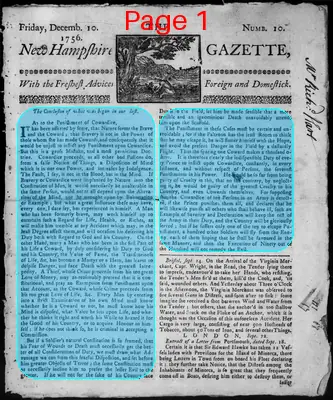
Editorial
December 10, 1756
The New Hampshire Gazette
Portsmouth, Rockingham County, New Hampshire
What is this article about?
This editorial concludes a prior piece by arguing that cowardice in soldiers stems from a changeable mindset, not nature, and requires severe, certain punishment to deter it, maintain army discipline, and protect the nation. It emphasizes duty to God and country over fear of death.
Clipping
OCR Quality
98%
Excellent
Full Text
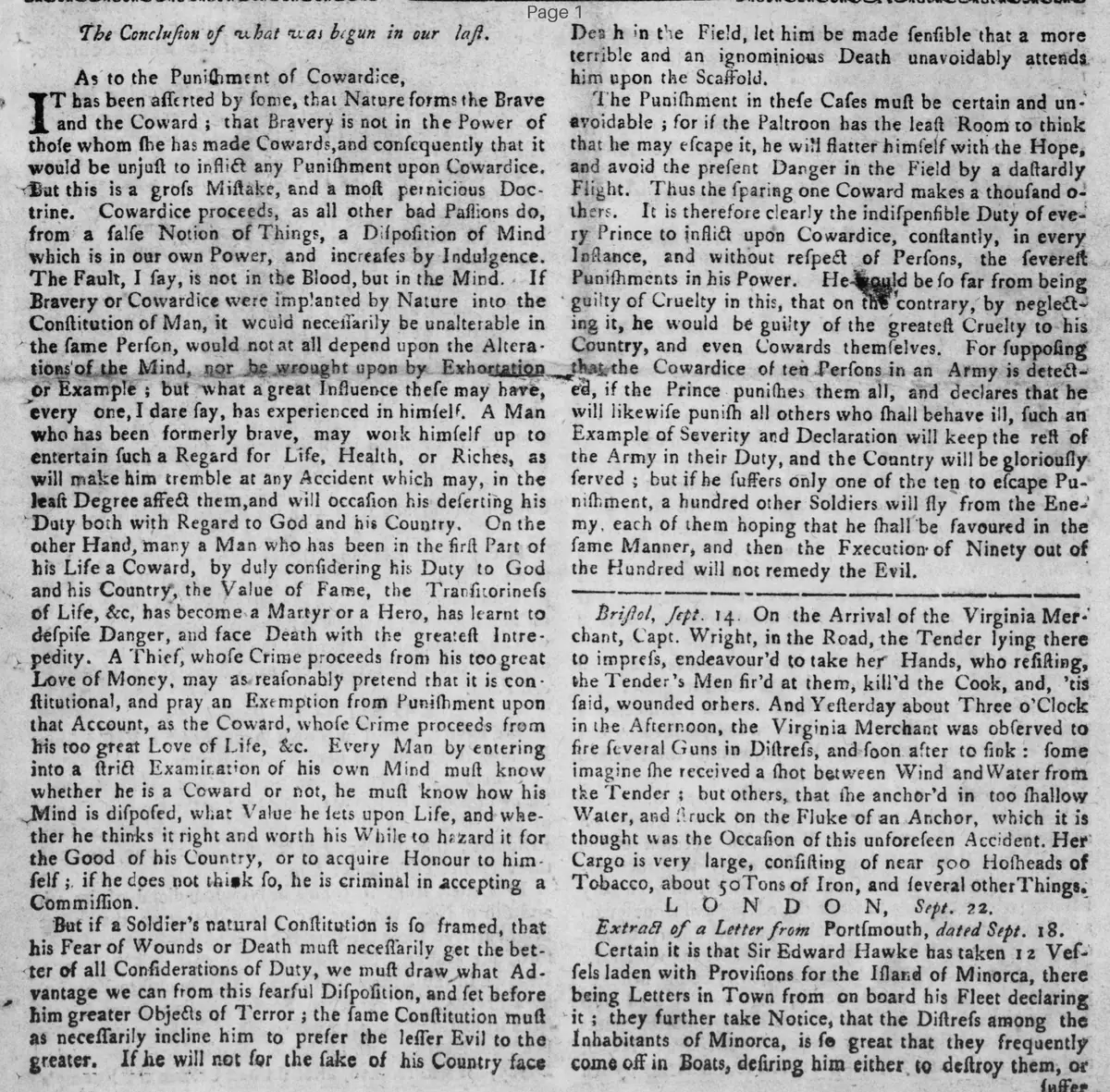
The Conclusion of what was begun in our last.
As to the Punishment of Cowardice.
It has been asserted by some, that Nature forms the Brave and the Coward; that Bravery is not in the Power of those whom he has made Cowards, and consequently that it would be unjust to inflict any Punishment upon Cowardice. But this is a gross Mistake, and a most pernicious Doctrine. Cowardice proceeds, as all other bad Passions do, from a false Notion of Things, a Disposition of Mind which is in our own Power, and increases by Indulgence. The Fault, I say, is not in the Blood, but in the Mind. If Bravery or Cowardice were implanted by Nature into the Constitution of Man, it would necessarily be unalterable in the same Person, would not at all depend upon the Alterations of the Mind, nor be wrought upon by Exhortation or Example; but what a great Influence these may have, every one, I dare say, has experienced in himself. A Man who has been formerly brave, may work himself up to entertain such a Regard for Life, Health, or Riches, as will make him tremble at any Accident which may, in the least Degree affect them, and will occasion his deserting his Duty both with Regard to God and his Country. On the other Hand, many a Man who has been in the first Part of his Life a Coward, by duly considering his Duty to God and his Country, the Value of Fame, the Transitoriness of Life, &c, has become a Martyr or a Hero, has learnt to despise Danger, and face Death with the greatest Intrepidity. A Thief, whose Crime proceeds from his too great Love of Money, may as reasonably pretend that it is constitutional, and pray an Exemption from Punishment upon that Account, as the Coward, whose Crime proceeds from his too great Love of Life, &c. Every Man by entering into a strict Examination of his own Mind must know whether he is a Coward or not, he must know how his Mind is disposed, what Value he sets upon Life, and whether he thinks it right and worth his While to hazard it for the Good of his Country, or to acquire Honour to himself; if he does not think so, he is criminal in accepting a Commission.
But if a Soldier's natural Constitution is so framed, that his Fear of Wounds or Death must necessarily get the better of all Considerations of Duty, we must draw what Advantage we can from this fearful Disposition, and set before him greater Objects of Terror; the same Constitution must as necessarily incline him to prefer the lesser Evil to the greater. If he will not for the sake of his Country face Death in the Field, let him be made sensible that a more terrible and an ignominious Death unavoidably attends him upon the Scaffold. The Punishment in these Cases must be certain and unavoidable; for if the Poltroon has the least Room to think that he may escape it, he will flatter himself with the Hope, and avoid the present Danger in the Field by a dastardly Flight. Thus the sparing one Coward makes a thousand others.
It is therefore clearly the indispensable Duty of every Prince to inflict upon Cowardice, constantly, in every Instance, and without respect of Persons, the severest Punishments in his Power. He should be so far from being guilty of Cruelty in this, that on the contrary, by neglecting it, he would be guilty of the greatest Cruelty to his Country, and even Cowards themselves. For supposing that the Cowardice of ten Persons in an Army is detected, if the Prince punishes them all, and declares that he will likewise punish all others who shall behave ill, such an Example of Severity and Declaration will keep the rest of the Army in their Duty, and the Country will be gloriously served; but if he suffers only one of the ten to escape Punishment, a hundred other Soldiers will fly from the Enemy, each of them hoping that he shall be favoured in the same Manner, and then the Execution of Ninety out of the Hundred will not remedy the Evil.
As to the Punishment of Cowardice.
It has been asserted by some, that Nature forms the Brave and the Coward; that Bravery is not in the Power of those whom he has made Cowards, and consequently that it would be unjust to inflict any Punishment upon Cowardice. But this is a gross Mistake, and a most pernicious Doctrine. Cowardice proceeds, as all other bad Passions do, from a false Notion of Things, a Disposition of Mind which is in our own Power, and increases by Indulgence. The Fault, I say, is not in the Blood, but in the Mind. If Bravery or Cowardice were implanted by Nature into the Constitution of Man, it would necessarily be unalterable in the same Person, would not at all depend upon the Alterations of the Mind, nor be wrought upon by Exhortation or Example; but what a great Influence these may have, every one, I dare say, has experienced in himself. A Man who has been formerly brave, may work himself up to entertain such a Regard for Life, Health, or Riches, as will make him tremble at any Accident which may, in the least Degree affect them, and will occasion his deserting his Duty both with Regard to God and his Country. On the other Hand, many a Man who has been in the first Part of his Life a Coward, by duly considering his Duty to God and his Country, the Value of Fame, the Transitoriness of Life, &c, has become a Martyr or a Hero, has learnt to despise Danger, and face Death with the greatest Intrepidity. A Thief, whose Crime proceeds from his too great Love of Money, may as reasonably pretend that it is constitutional, and pray an Exemption from Punishment upon that Account, as the Coward, whose Crime proceeds from his too great Love of Life, &c. Every Man by entering into a strict Examination of his own Mind must know whether he is a Coward or not, he must know how his Mind is disposed, what Value he sets upon Life, and whether he thinks it right and worth his While to hazard it for the Good of his Country, or to acquire Honour to himself; if he does not think so, he is criminal in accepting a Commission.
But if a Soldier's natural Constitution is so framed, that his Fear of Wounds or Death must necessarily get the better of all Considerations of Duty, we must draw what Advantage we can from this fearful Disposition, and set before him greater Objects of Terror; the same Constitution must as necessarily incline him to prefer the lesser Evil to the greater. If he will not for the sake of his Country face Death in the Field, let him be made sensible that a more terrible and an ignominious Death unavoidably attends him upon the Scaffold. The Punishment in these Cases must be certain and unavoidable; for if the Poltroon has the least Room to think that he may escape it, he will flatter himself with the Hope, and avoid the present Danger in the Field by a dastardly Flight. Thus the sparing one Coward makes a thousand others.
It is therefore clearly the indispensable Duty of every Prince to inflict upon Cowardice, constantly, in every Instance, and without respect of Persons, the severest Punishments in his Power. He should be so far from being guilty of Cruelty in this, that on the contrary, by neglecting it, he would be guilty of the greatest Cruelty to his Country, and even Cowards themselves. For supposing that the Cowardice of ten Persons in an Army is detected, if the Prince punishes them all, and declares that he will likewise punish all others who shall behave ill, such an Example of Severity and Declaration will keep the rest of the Army in their Duty, and the Country will be gloriously served; but if he suffers only one of the ten to escape Punishment, a hundred other Soldiers will fly from the Enemy, each of them hoping that he shall be favoured in the same Manner, and then the Execution of Ninety out of the Hundred will not remedy the Evil.
What sub-type of article is it?
Military Affairs
Moral Or Religious
What keywords are associated?
Cowardice
Punishment
Bravery
Military Discipline
Duty To Country
Soldierly Honor
Prince's Duty
What entities or persons were involved?
Princes
Soldiers
Cowards
Editorial Details
Primary Topic
Punishment Of Cowardice In Soldiers
Stance / Tone
Strong Advocacy For Severe And Certain Punishment Of Cowardice
Key Figures
Princes
Soldiers
Cowards
Key Arguments
Cowardice Arises From A Changeable Disposition Of Mind, Not Innate Nature.
Bravery And Cowardice Can Be Influenced By Exhortation, Example, And Consideration Of Duty.
Punishment Of Cowardice Is Just, Comparable To Punishing Theft.
Soldiers Who Accept Commissions Knowing Their Cowardice Are Criminal.
To Deter Cowardice, Punishment Must Be More Terrifying Than Battlefield Death And Certain.
Sparing Even One Coward Encourages Widespread Desertion.
Princes Have A Duty To Punish Cowardice Severely Without Exception To Protect The Country.