Thank you for visiting SNEWPapers!
Sign up free
Story
June 7, 1900
Ranche And Range
Yakima, Seattle, Spokane, Yakima County, King County, Spokane County, Washington
What is this article about?
Expert advice from C. F. Curtiss on influencing butter quality through cow feed selection, recommending balanced rations for firmness and flavor, especially for Pacific Coast export to the Orient. (187 chars)
Clipping
OCR Quality
98%
Excellent
Full Text
Feeding For Export Butter.
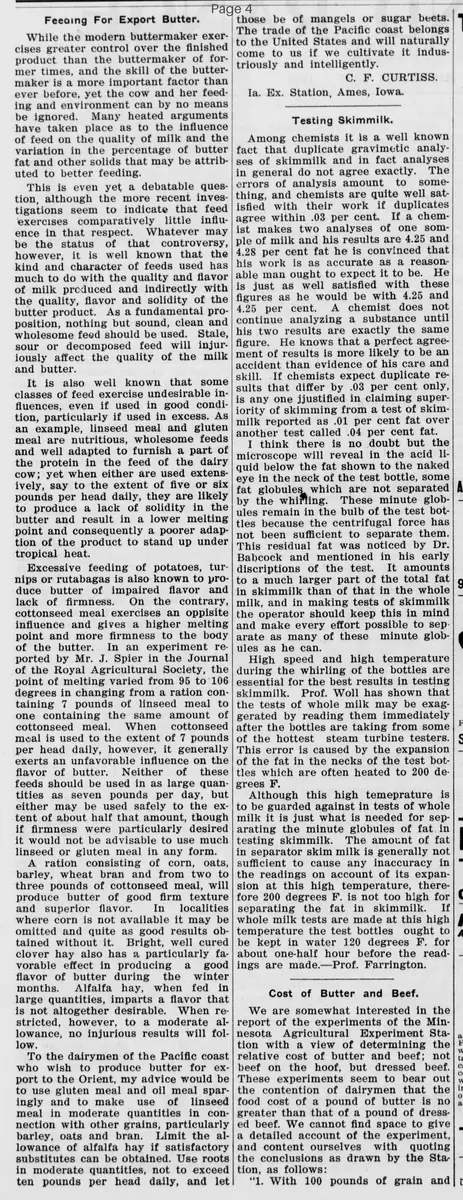
While the modern buttermaker exercises greater control over the finished product than the buttermaker of former times, and the skill of the buttermaker is a more important factor than ever before, yet the cow and her feeding and environment can by no means be ignored. Many heated arguments have taken place as to the influence of feed on the quality of milk and the variation in the percentage of butter fat and other solids that may be attributed to better feeding.
This is even yet a debatable question, although the more recent investigations seem to indicate that feed exercises comparatively little influence in that respect. Whatever may be the status of that controversy, however, it is well known that the kind and character of feeds used has much to do with the quality and flavor of milk produced and indirectly with the quality, flavor and solidity of the butter product. As a fundamental proposition, nothing but sound, clean and wholesome feed should be used. Stale, sour or decomposed feed will injuriously affect the quality of the milk and butter.
It is also well known that some classes of feed exercise undesirable influences, even if used in good condition, particularly if used in excess. As an example, linseed meal and gluten meal are nutritious, wholesome feeds and well adapted to furnish a part of the protein in the feed of the dairy cow; yet when either are used extensively, say to the extent of five or six pounds per head daily, they are likely to produce a lack of solidity in the butter and result in a lower melting point and consequently a poorer adaptation of the product to stand up under tropical heat.
Excessive feeding of potatoes, turnips or rutabagas is also known to produce butter of impaired flavor and lack of firmness. On the contrary, cottonseed meal exercises an opposite influence and gives a higher melting point and more firmness to the body of the butter. In an experiment reported by Mr. J. Spier in the Journal of the Royal Agricultural Society, the point of melting varied from 95 to 106 degrees in changing from a ration containing 7 pounds of linseed meal to one containing the same amount of cottonseed meal. When cottonseed meal is used to the extent of 7 pounds per head daily, however, it generally exerts an unfavorable influence on the flavor of butter. Neither of these feeds should be used in as large quantities as seven pounds per day, but either may be used safely to the extent of about half that amount, though if firmness were particularly desired it would not be advisable to use much linseed or gluten meal in any form.
A ration consisting of corn, oats, barley, wheat bran and from two to three pounds of cottonseed meal, will produce butter of good firm texture and superior flavor. In localities where corn is not available it may be omitted and quite as good results obtained without it. Bright, well cured clover hay also has a particularly favorable effect in producing a good flavor of butter during the winter months. Alfalfa hay, when fed in large quantities, imparts a flavor that is not altogether desirable. When restricted, however, to a moderate allowance, no injurious results will follow.
To the dairymen of the Pacific coast who wish to produce butter for export to the Orient, my advice would be to use gluten meal and oil meal sparingly and to make use of linseed meal in moderate quantities in connection with other grains, particularly barley, oats and bran. Limit the allowance of alfalfa hay if satisfactory substitutes can be obtained. Use roots in moderate quantities, not to exceed ten pounds per head daily, and let those be of mangels or sugar beets.
The trade of the Pacific coast belongs to the United States and will naturally come to us if we cultivate it industriously and intelligently.
C. F. CURTISS.
Ia. Ex. Station, Ames, Iowa.
While the modern buttermaker exercises greater control over the finished product than the buttermaker of former times, and the skill of the buttermaker is a more important factor than ever before, yet the cow and her feeding and environment can by no means be ignored. Many heated arguments have taken place as to the influence of feed on the quality of milk and the variation in the percentage of butter fat and other solids that may be attributed to better feeding.
This is even yet a debatable question, although the more recent investigations seem to indicate that feed exercises comparatively little influence in that respect. Whatever may be the status of that controversy, however, it is well known that the kind and character of feeds used has much to do with the quality and flavor of milk produced and indirectly with the quality, flavor and solidity of the butter product. As a fundamental proposition, nothing but sound, clean and wholesome feed should be used. Stale, sour or decomposed feed will injuriously affect the quality of the milk and butter.
It is also well known that some classes of feed exercise undesirable influences, even if used in good condition, particularly if used in excess. As an example, linseed meal and gluten meal are nutritious, wholesome feeds and well adapted to furnish a part of the protein in the feed of the dairy cow; yet when either are used extensively, say to the extent of five or six pounds per head daily, they are likely to produce a lack of solidity in the butter and result in a lower melting point and consequently a poorer adaptation of the product to stand up under tropical heat.
Excessive feeding of potatoes, turnips or rutabagas is also known to produce butter of impaired flavor and lack of firmness. On the contrary, cottonseed meal exercises an opposite influence and gives a higher melting point and more firmness to the body of the butter. In an experiment reported by Mr. J. Spier in the Journal of the Royal Agricultural Society, the point of melting varied from 95 to 106 degrees in changing from a ration containing 7 pounds of linseed meal to one containing the same amount of cottonseed meal. When cottonseed meal is used to the extent of 7 pounds per head daily, however, it generally exerts an unfavorable influence on the flavor of butter. Neither of these feeds should be used in as large quantities as seven pounds per day, but either may be used safely to the extent of about half that amount, though if firmness were particularly desired it would not be advisable to use much linseed or gluten meal in any form.
A ration consisting of corn, oats, barley, wheat bran and from two to three pounds of cottonseed meal, will produce butter of good firm texture and superior flavor. In localities where corn is not available it may be omitted and quite as good results obtained without it. Bright, well cured clover hay also has a particularly favorable effect in producing a good flavor of butter during the winter months. Alfalfa hay, when fed in large quantities, imparts a flavor that is not altogether desirable. When restricted, however, to a moderate allowance, no injurious results will follow.
To the dairymen of the Pacific coast who wish to produce butter for export to the Orient, my advice would be to use gluten meal and oil meal sparingly and to make use of linseed meal in moderate quantities in connection with other grains, particularly barley, oats and bran. Limit the allowance of alfalfa hay if satisfactory substitutes can be obtained. Use roots in moderate quantities, not to exceed ten pounds per head daily, and let those be of mangels or sugar beets.
The trade of the Pacific coast belongs to the United States and will naturally come to us if we cultivate it industriously and intelligently.
C. F. CURTISS.
Ia. Ex. Station, Ames, Iowa.
What sub-type of article is it?
Agricultural Advice
Dairy Guide
What keywords are associated?
Butter Production
Cow Feeding
Dairy Advice
Feed Influence
Export Butter
What entities or persons were involved?
C. F. Curtiss
Where did it happen?
Pacific Coast, Ames, Iowa
Story Details
Key Persons
C. F. Curtiss
Location
Pacific Coast, Ames, Iowa
Story Details
Article advises on cow feeding practices to optimize butter quality and flavor for export, emphasizing wholesome feeds, limits on certain meals like linseed and cottonseed, and suitable rations including grains and hays.