Thank you for visiting SNEWPapers!
Sign up free
Lynchburg Virginian
Lynchburg, Virginia
What is this article about?
In the U.S. House of Representatives on January 24, 1840, Rep. Bynum accused Rep. Peck of being an Abolitionist during a debate on abolition petitions, leading to heated exchanges, insults, calls for order, and an eventual apology to the House but refusal to retract words against Peck.
Clipping
OCR Quality
Full Text
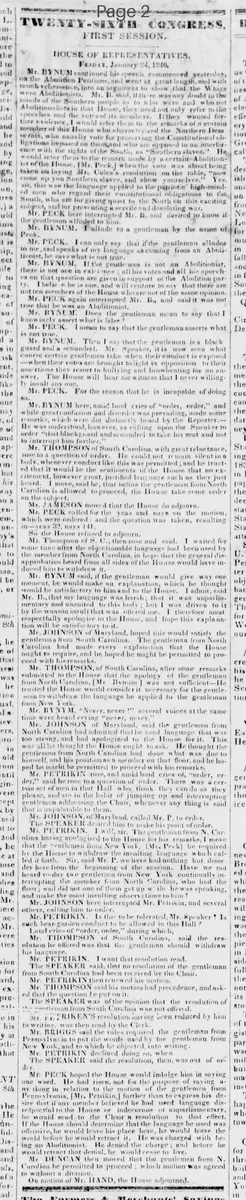
Mr. BYNUM continued his speech commenced yesterday, on the Abolition Petitions, and went at great length, and with much vehemence, into an argument to show that the Whigs were Abolitionists. Mr. B. said, if there was any doubt in the minds of the Southern people as to who were and who not Abolitionists in that House, they need not only refer to the speeches and the votes of its members. If they wanted further evidence, he would refer them to the remarks of a certain member of this House who characterized the Northern Democrats, who usually vote for preserving the Constitutional obligations imposed on them and who are opposed to an interference with the rights of the South, as "Southern slaves." He would refer them to the remark made by a certain Abolitionist of the House, [Mr. Peck,] when the vote was about being taken on laying Mr. Coles's resolution on the table, "now come up you Southern slaves, and show yourselves." Yes, sir, this was the language applied to the patriotic high-minded men who regard their constitutional obligations to the South, who are for giving quiet to the North on this exciting subject, and for preventing a servile and desolating war.
Mr. PECK here interrupted Mr. B. and desired to know if the gentleman alluded to him.
Mr. BYNUM. I allude to a gentleman by the name of Peck.
Mr. PECK. I can only say that if the gentleman alludes to me, and speaks of my language as coming from an Abolitionist, he says what is not true.
Mr. BYNUM. If the gentleman is not an Abolitionist, there is not one in existence: all his votes and all his speeches on that question are given in support of the Abolition party. I believe he is one, and will venture to say that there are not ten members of the House who are not of the same opinion.
Mr. PECK again interrupted Mr. B., and said it was not true that he was an Abolitionist.
Mr. BYNUM. Does the gentleman mean to say that I knowingly assert what is false?
Mr. PECK. I mean to say that the gentleman asserts what is not true.
Mr. BYNUM. Then I say that the gentleman is a blackguard and a scoundrel. Mr. Speaker, it is now seen what course certain gentlemen take when their conduct is exposed—when their votes are brought to light in opposition to their assertions they resort to bullying and browbeating for an answer. The House will bear me witness that I never willingly insult any one.
Mr. PECK. For the reason that he is incapable of doing so.
Mr. BYNUM here, amid loud cries of "order, order," and while great confusion and disorder was prevailing, made some remarks, which were not distinctly heard by the Reporter.—He was understood, however, as calling upon the Speaker to order "that blackguard and scoundrel to take his seat and not to interrupt him further."
Mr. THOMPSON of South Carolina, with great reluctance, rose to a question of order. He could not remain silent in a body, whenever conduct like this was permitted; and he trusted that it would be the sentiments of the House that no excitement, however great, justified language such as they just heard. I move, said he, that before the gentleman from North Carolina is allowed to proceed, the House take some order on the subject.
Mr. JAMESON moved that the House do adjourn.
Mr. PECK called for the yeas and nays on the motion, which were ordered: and the question was taken, resulting in—yeas 32, nays 141.
So the House refused to adjourn.
Mr. Thompson of S. C., then rose and said. I waited for some time after the objectionable language had been used by the member from North Carolina, in hope that the general disapprobation heard from all sides of the House would have induced him to withdraw it.
Mr. BYNUM said, if the gentleman would give way one moment, he would make an explanation, which he thought would be satisfactory to him and to the House. I admit, said Mr. B., that my language was harsh; that it was unparliamentary and unsuited to this body; but I was driven to it by the wanton insult that was offered me. I therefore most respectfully apologise to the House, and hope this explanation will be satisfactory to it.
Mr. JOHNSON of Maryland, hoped this would satisfy the gentleman from South Carolina. The gentleman from North Carolina had made every explanation that the House ought to require, and he hoped he might be permitted to proceed with his remarks.
Mr. THOMPSON, of South Carolina, after some remarks submitted to the House that the apology of the gentleman from North Carolina, [Mr. Bynum] was not sufficient—He trusted the House would consider it necessary for the gentleman to withdraw the language he applied to the gentleman from New York.
Mr. BYNUM, "Never, never" several voices at the same time were heard crying "never, never."
Mr. JOHNSON of Maryland, said the gentleman from North Carolina had admitted that he used language that was too strong, and had apologized to the House for it. This was all he thought the House ought to ask. He thought the gentleman from North Carolina had done what was due to himself, and his position as a member on that floor, and he hoped he might be permitted to proceed with his remarks.
Mr. PETRIKIN rose, and amid loud cries of, "order, order," said he rose to a question of order. There was a certain set of men in that Hall who think they can do as they please, and are in the habit of jumping up and interrupting gentlemen addressing the Chair, whenever any thing is said that is unpalatable to them.
Mr. JOHNSON, of Maryland, called Mr. P. to order.
The SPEAKER desired him to make his point of order.
Mr. PETRIKIN. I will, sir. The gentleman from N. Carolina having apologised to the House for his remarks, I move that the gentleman from New York, (Mr. Peck) be required by the House to withdraw the insulting language which called it forth. Sir, said Mr. P. we have had nothing but disorder here from the beginning of the session. Have we not heard to-day two gentlemen from New York continually interrupting the member from North Carolina, who had the floor; and did not one of them get up while he was speaking, and make the most insulting observations to him ?
Mr. JOHNSON here interrupted Mr. Petrikin, and several others, calling him to order.
Mr. PETRIKIN. Is this to be tolerated, Mr. Speaker? Is such bear-garden conduct to be allowed in this Hall ?
Loud cries of "order, order." during which,
Mr. THOMPSON of South Carolina, said the resolution he offered was that the gentleman should withdraw his language.
Mr. PETRIKIN. I want that resolution read.
The SPEAKER said, that no resolution of the gentleman from South Carolina had been received by the Chair.
Mr. PETRIKIN then renewed his motion.
Mr. THOMPSON said his motion had precedence, and asked that the question be put on it.
The SPEAKER was of the opinion that the resolution of the gentleman from South Carolina was not offered.
Mr. PETRIKIN'S resolution having been reduced by him to writing, was then read by the Clerk.
Mr. BRIGGS said the rules required the gentleman from Pennsylvania to put the words used by the gentleman from New York, and to which he objected, into writing.
Mr. PETRIKIN declined doing so, when
The SPEAKER said the resolution, then, was out of order.
Mr. PECK hoped the House would indulge him in saying one word. He had risen, not for the purpose of saying anything in relation to the motion of the gentleman from Pennsylvania, [Mr. Petrikin,] further than to express his desire that if any member believed he had used language disrespectful to the House or indecorous or unparliamentary, he would send to the Chair a resolution to that effect. If the House should determine that the language he used was offensive, he would leave his place here, he would leave the world before he would retract it. He was charged with being an Abolitionist. He denied the charge: and before he would retract that denial, he would cease to live.
Mr. DUNCAN then moved that the gentleman from N. Carolina be permitted to proceed, which motion was agreed to without a division.
On motion of Mr. HAND, the House adjourned.
What sub-type of article is it?
What themes does it cover?
What keywords are associated?
What entities or persons were involved?
Where did it happen?
Story Details
Key Persons
Location
House Of Representatives
Event Date
January 24, 1840
Story Details
During a debate on abolition petitions, Rep. Bynum accuses Rep. Peck of being an Abolitionist, leading to interruptions, insults calling Peck a 'blackguard and scoundrel,' calls for order, an apology to the House by Bynum but refusal to retract against Peck, motions for retraction, and eventual resumption after adjournment motion fails.