Thank you for visiting SNEWPapers!
Sign up free
Editorial
August 16, 1919
The Times Herald
Burns, Harney County, Oregon
What is this article about?
The editorial enthusiastically supports a new law effective January 1, 1920, establishing a joint Senate-House committee to centralize and control federal expenditures, arguing it will curb wasteful spending by multiple committees and reduce burdensome taxes on everyday items.
Clipping
OCR Quality
95%
Excellent
Full Text
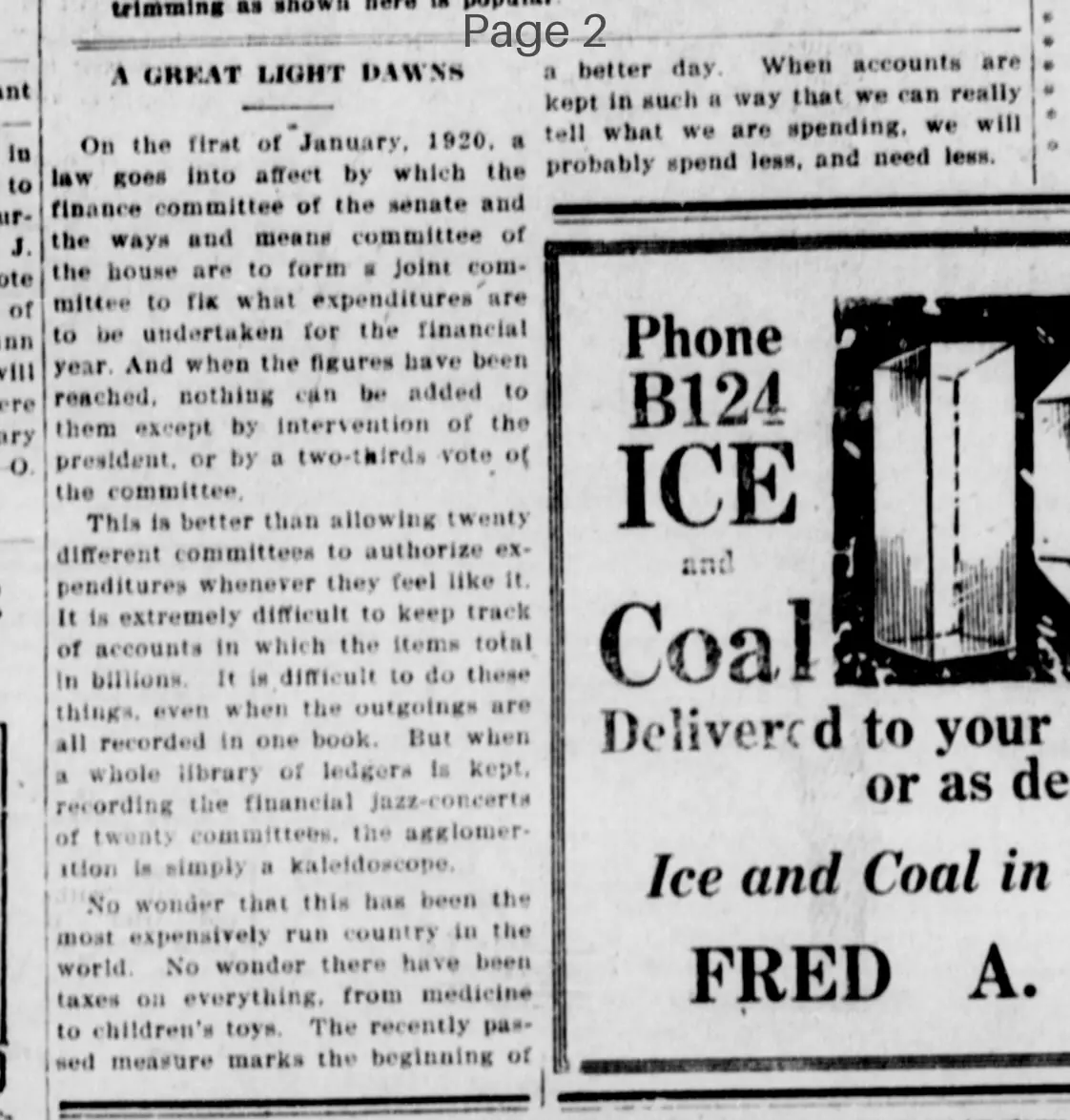
A GREAT LIGHT DAWNS
a better day.
When accounts are kept in such a way that we can really tell what we are spending, we will probably spend less, and need less.
On the first of January, 1920, a law goes into effect by which the finance committee of the senate and the ways and means committee of the house are to form a joint committee to fix what expenditures are to be undertaken for the financial year. And when the figures have been reached, nothing can be added to them except by intervention of the president, or by a two-thirds vote of the committee.
This is better than allowing twenty different committees to authorize expenditures whenever they feel like it. It is extremely difficult to keep track of accounts in which the items total in billions. It is difficult to do these things, even when the outgoings are all recorded in one book. But when a whole library of ledgers is kept, recording the financial jazz-concerts of twenty committees, the agglomeration is simply a kaleidoscope.
No wonder that this has been the most expensively run country in the world. No wonder there have been taxes on everything, from medicine to children's toys.
The recently passed measure marks the beginning of
a better day.
When accounts are kept in such a way that we can really tell what we are spending, we will probably spend less, and need less.
On the first of January, 1920, a law goes into effect by which the finance committee of the senate and the ways and means committee of the house are to form a joint committee to fix what expenditures are to be undertaken for the financial year. And when the figures have been reached, nothing can be added to them except by intervention of the president, or by a two-thirds vote of the committee.
This is better than allowing twenty different committees to authorize expenditures whenever they feel like it. It is extremely difficult to keep track of accounts in which the items total in billions. It is difficult to do these things, even when the outgoings are all recorded in one book. But when a whole library of ledgers is kept, recording the financial jazz-concerts of twenty committees, the agglomeration is simply a kaleidoscope.
No wonder that this has been the most expensively run country in the world. No wonder there have been taxes on everything, from medicine to children's toys.
The recently passed measure marks the beginning of
What sub-type of article is it?
Economic Policy
Taxation
What keywords are associated?
Budget Reform
Government Spending
Fiscal Committee
Federal Expenditures
Taxes
1920 Law
What entities or persons were involved?
Senate Finance Committee
House Ways And Means Committee
President
Editorial Details
Primary Topic
Congressional Budgetary Reform For Federal Expenditures
Stance / Tone
Optimistic Support For Fiscal Control Measures
Key Figures
Senate Finance Committee
House Ways And Means Committee
President
Key Arguments
Centralized Accounting Will Reduce Spending And Needs
Joint Committee To Fix Expenditures Starting January 1, 1920
Presidential Intervention Or Two Thirds Vote Required For Additions
Better Than Twenty Committees Authorizing Expenditures Freely
Difficult To Track Billions In Scattered Ledgers
Explains High Costs And Taxes On Everything From Medicine To Toys
New Measure Begins Era Of Better Financial Management