Thank you for visiting SNEWPapers!
Sign up free
Vermont Telegraph
Brandon, Rutland County, Vermont
What is this article about?
In a landmark Massachusetts court decision, a six-year-old slave girl brought from New Orleans to Boston by her owner's wife was declared free upon entering the state, establishing that slavery cannot exist even temporarily in Massachusetts.
Merged-components note: Continuation of anti-slavery decision story.
Clipping
OCR Quality
Full Text
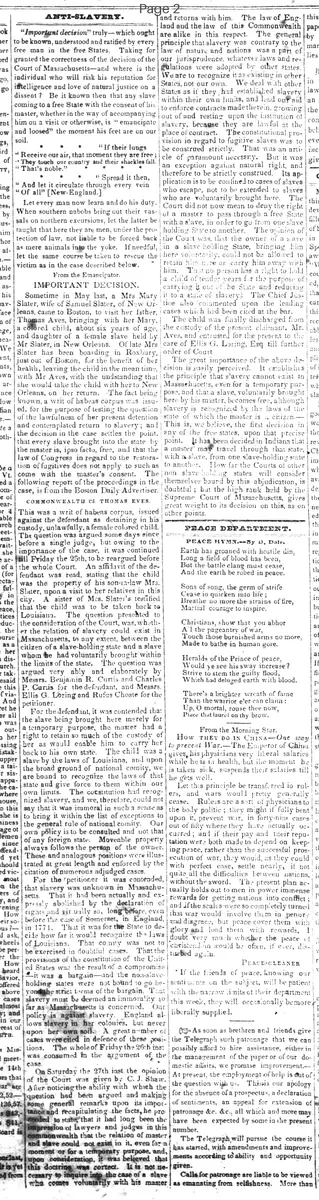
"Important decision" truly—which ought to be known, understood and ratified by every free man in the free States. Taking for granted the correctness of the decision of the Court of Massachusetts—and where is the individual who will risk his reputation for intelligence and love of natural justice on a dissent? Be it known then that any slave coming to a free State with the consent of his master, whether in the way of accompanying him on a visit or otherwise, is "emancipated and loosed" the moment his feet are on our soil.
"If their lungs
Receive our air, that moment they are free;
… They touch our country and their shackles fall."
"That's noble."
"Spread it then,
And let it circulate through every vein
Of all [New-England.]"
Let every man now learn and do his duty. When southern nabobs bring out their vassals on northern excursions, let the latter be taught that here they are men, under the protection of law, not liable to be forced back as mere animals into the yoke. If needful, let the same course be taken to rescue the victim as in the case described below.
IMPORTANT DECISION.
Sometime in May last, a Mrs. Mary Slater, wife of Samuel Slater, of New Orleans, came to Boston, to visit her father, Thomas Aves, bringing with her Mary, a colored child, about six years of age, and daughter of a female slave held by Mr. Slater, in New Orleans. Of late Mrs. Slater has been boarding in Roxbury, just out of Boston, for the benefit of her health, leaving the child in the mean time, with Mr. Aves, with the understanding that she would take the child with her to New Orleans, on her return. The fact being known, a writ of habeas corpus was issued, for the purpose of testing the question of the lawfulness of her present detention and contemplated return to slavery; and the decision in the case settles the point, that every slave brought into the state by the master is, ipso facto, free, and that the law of Congress in regard to the restoration of fugitives does not apply to such as come with the master's consent. The following report of the proceedings in the case, is from the Boston Daily Advertiser.
COMMONWEALTH vs. THOMAS AVES.
This was a writ of habeas corpus, issued against the defendant as detaining in his custody, unlawfully, a female colored child. The question was argued some days since before a single judge, but owing to the importance of the case, it was continued till Friday the 26th, to be reargued before the whole Court. An affidavit of the defendant was read, stating that the child was the property of his son-in-law Mrs. Slater, upon a visit to her relatives in this city. A sister of Mrs. Slater's testified that the child was to be taken back to Louisiana. The question presented to the consideration of the Court, was, whether the relation of slavery could exist in Massachusetts, to any extent, between the citizen of a slave-holding state and a slave whom he had voluntarily brought within the limits of the state. The question was argued very ably and elaborately by Messrs. Benjamin R. Curtis and Charles P. Curtis for the defendant, and Messrs. Ellis G. Loring and Rufus Choate for the petitioner.
For the defendant, it was contended that the slave being brought here merely for a temporary purpose, the master had a right to retain so much of the custody of her as would enable him to carry her back to his own state. The child was a slave by the laws of Louisiana, and upon the broad ground of national comity, we are bound to recognize the laws of that state and give force to them within our own limits. The constitution had recognized slavery, and we, therefore, could not say that it was immoral in such a sense as to bring it within the list of exceptions to the general rule of national comity. Our own policy is to be consulted and not that of any foreign state. Moveable property always follows the person of the owner. These and analogous positions were illustrated at great length and enforced by the citation of numerous adjudged cases.
For the petitioner it was contended that slavery was unknown in Massachusetts. That it had been actually and expressly abolished by the declaration of rights and virtually so, long before, even before the case of Somerset, in England, in 1772. That it was for the State to decide how far it would recognize the laws of Louisiana. That comity was not to be exercised in doubtful cases. That the provisions of the constitution of the United States was the result of a compromise it was a bargain—and the non-slaveholding states were not bound to go beyond the strict terms of the bargain. That slavery must be deemed an immorality so far as Massachusetts is concerned. Our policy is against slavery. England allows slavery in her colonies, but never upon her own soil. A great number of cases were cited in defence of these positions. The whole of Friday the 26th inst. was consumed in the argument of the case.
On Saturday the 27th inst. the opinion of the Court was given by C. J. Shaw. After noticing the ability with which the question had been argued and making some general remarks upon its importance and recapitulating the facts, he proceeded to state, that it had long been the impression of lawyers and judges in this commonwealth that the relation of master and slave could not exist in it, even for a moment or for a temporary purpose, and, upon consideration, it was believed that this doctrine was correct. It is not necessary to inquire into the case of a slave who comes voluntarily with his master and returns with him. The law of England and the law of this Commonwealth are alike in this respect. The general principle that slavery was contrary to the law of nature and nations was a part of our jurisprudence, whatever laws and regulations were adopted by other states. We are to recognize it as existing in other States, not our own. We deal with other States as if they had established slavery within their own limits, and lend our aid to enforce contracts made therein, growing out of and resting upon the institution of slavery, because they are lawful at the place of contract. The constitutional provision in regard to fugitive slaves was to be construed strictly. That was an article of paramount necessity. But it was an exception against natural right, and therefore to be strictly construed. Its application is to be confined to cases of slaves who escape, not to be extended to slaves who are voluntarily brought here. The Court did not now mean to deny the right of a master to pass through a free State with a slave, in order to go from one slave holding State to another. The opinion of the Court was, that the owner of a slave in a slave-holding State, bringing him here voluntarily, could not be allowed to retain him here or carry him away with him. That no person has a right to hold a child of tender years for the purpose of carrying it out of the State and reducing it to a state of slavery. The Chief Justice also commented upon the leading cases which had been cited at the bar. The child was finally discharged from the custody of the present claimant, Mr. Aves, and entrusted for the present to the care of Ellis G. Loring, Esq. till further order of Court.
The great importance of the above decision is easily perceived. It establishes the principle that slavery cannot exist in Massachusetts, even for a temporary purpose, and that a slave, voluntarily brought here by his master, becomes free, although slavery is recognized by the laws of the state of which the master is citizen.— This is, we believe, the first decision in any of the free states, upon that precise point. It has been decided in Indiana that a master may travel through that state, with a slave, from one slave-holding state to another. How far the Courts of other non slave holding states will consider themselves bound by this adjudication, is doubtful : but the high rank held by the Supreme Court of Massachusetts, gives great weight to its decision on this, as on other points.
What sub-type of article is it?
What themes does it cover?
What keywords are associated?
What entities or persons were involved?
Where did it happen?
Story Details
Key Persons
Location
Boston, Massachusetts; Roxbury; New Orleans, Louisiana
Event Date
Sometime In May Last; Court Decision On Friday The 26th And Saturday The 27th Inst.
Story Details
Mrs. Mary Slater brought a six-year-old slave child named Mary from New Orleans to visit her father Thomas Aves in Boston. A habeas corpus writ tested the child's detention, and the Massachusetts Supreme Court ruled that the child was free upon entering the state, as slavery cannot exist even temporarily in Massachusetts, distinguishing from fugitive slave laws.