Thank you for visiting SNEWPapers!
Sign up free
Literary
April 13, 1822
Winchester Gazette
Winchester, Virginia
What is this article about?
An essay praising Dr. Blair's portrait of true honor as rooted in a virtuous, religiously guided mind superior to fear, corruption, and selfishness, emphasizing integrity, compassion, and duty in all circumstances.
Merged-components note: Continuation of the essay on virtue and honor across page break; relabeled from editorial to literary as it is an opinionated essay.
Clippings
1 of 2
OCR Quality
95%
Excellent
Full Text
[FOR THE GAZETTE.]
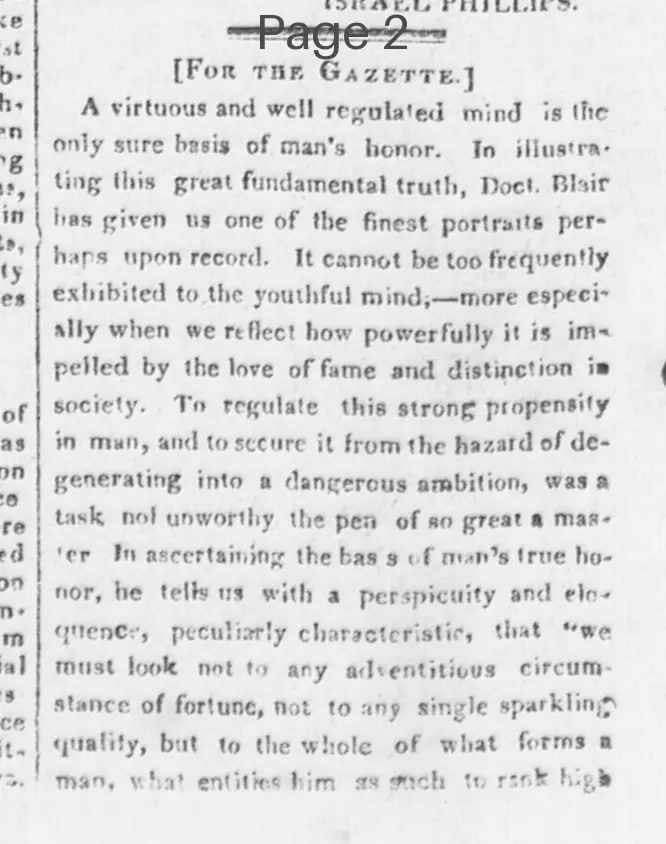
A virtuous and well regulated mind is the only sure basis of man's honor. In illustrating this great fundamental truth, Doct. Blair has given us one of the finest portraits perhaps upon record. It cannot be too frequently exhibited to the youthful mind,—more especially when we reflect how powerfully it is impelled by the love of fame and distinction in society. To regulate this strong propensity in man, and to secure it from the hazard of degenerating into a dangerous ambition, was a task not unworthy the pen of so great a master In ascertaining the basis of man's true honor, he tells us with a perspicuity and eloquence, peculiarly characteristic, that
"we must look not to any adventitious circumstance of fortune, not to any single sparkling quality, but to the whole of what forms a man, what entitles him as such to rank high in the estimation of others.
Among that class of beings to which he belongs: in a word, we must look to the mind and the soul. A mind superior to fear, to selfish interest and corruption, a mind governed by the principles of uniform rectitude and integrity, the same in prosperity and adversity; which no bribe can seduce nor terror over-awe; neither by pleasure melted into effeminacy, nor by distress sunk into dejection; such is the mind that forms the distinction and eminence of man. One who in no situation of life is either ashamed or afraid of discharging his duty and acting his proper part with firmness and constancy; true to the God whom he worships and true to the faith in which he professes to believe; full of affection to his brethren of mankind; faithful to his friends; generous to his enemies; warm with compassion to the unfortunate; self-denying to little private interests and pleasures, but zealous for public interest and happiness; magnanimous without being proud; humble without being mean; just without being harsh; simple in his manners but manly in his feelings; on whose word you can entirely rely; whose countenance never deceives you; whose professions of kindness are the effusions of his heart; one, in fine, whom, independent of any views of advantage, you would choose for a superior, could trust in as a friend and could love as a brother. This is the man whom, in your heart, above all others, you do, you must honor. Such a character, imperfectly as it has now been drawn, all must acknowledge to be formed solely by the influence of steady religion and virtue. It is the effect of principles, which, operating upon conscience, determine it uniformly to pursue whatever things are true, whatever things are honest, whatever things are just, whatever things are pure, whatever things are lovely, whatever things are of good report; if there be any virtue and if there be any praise."
Y.
A virtuous and well regulated mind is the only sure basis of man's honor. In illustrating this great fundamental truth, Doct. Blair has given us one of the finest portraits perhaps upon record. It cannot be too frequently exhibited to the youthful mind,—more especially when we reflect how powerfully it is impelled by the love of fame and distinction in society. To regulate this strong propensity in man, and to secure it from the hazard of degenerating into a dangerous ambition, was a task not unworthy the pen of so great a master In ascertaining the basis of man's true honor, he tells us with a perspicuity and eloquence, peculiarly characteristic, that
"we must look not to any adventitious circumstance of fortune, not to any single sparkling quality, but to the whole of what forms a man, what entitles him as such to rank high in the estimation of others.
Among that class of beings to which he belongs: in a word, we must look to the mind and the soul. A mind superior to fear, to selfish interest and corruption, a mind governed by the principles of uniform rectitude and integrity, the same in prosperity and adversity; which no bribe can seduce nor terror over-awe; neither by pleasure melted into effeminacy, nor by distress sunk into dejection; such is the mind that forms the distinction and eminence of man. One who in no situation of life is either ashamed or afraid of discharging his duty and acting his proper part with firmness and constancy; true to the God whom he worships and true to the faith in which he professes to believe; full of affection to his brethren of mankind; faithful to his friends; generous to his enemies; warm with compassion to the unfortunate; self-denying to little private interests and pleasures, but zealous for public interest and happiness; magnanimous without being proud; humble without being mean; just without being harsh; simple in his manners but manly in his feelings; on whose word you can entirely rely; whose countenance never deceives you; whose professions of kindness are the effusions of his heart; one, in fine, whom, independent of any views of advantage, you would choose for a superior, could trust in as a friend and could love as a brother. This is the man whom, in your heart, above all others, you do, you must honor. Such a character, imperfectly as it has now been drawn, all must acknowledge to be formed solely by the influence of steady religion and virtue. It is the effect of principles, which, operating upon conscience, determine it uniformly to pursue whatever things are true, whatever things are honest, whatever things are just, whatever things are pure, whatever things are lovely, whatever things are of good report; if there be any virtue and if there be any praise."
Y.
What sub-type of article is it?
Essay
What themes does it cover?
Moral Virtue
Religious
Friendship
What keywords are associated?
Virtue
Honor
Integrity
Religion
Conscience
Duty
Compassion
What entities or persons were involved?
Y.
Literary Details
Author
Y.
Subject
Illustration Of Dr. Blair's Portrait Of A Virtuous Mind As The Basis Of True Honor
Key Lines
A Virtuous And Well Regulated Mind Is The Only Sure Basis Of Man's Honor.
We Must Look Not To Any Adventitious Circumstance Of Fortune, Not To Any Single Sparkling Quality, But To The Whole Of What Forms A Man...
Such A Character... All Must Acknowledge To Be Formed Solely By The Influence Of Steady Religion And Virtue.