Thank you for visiting SNEWPapers!
Sign up free
Literary
October 30, 1913
Eastern Utah Advocate
Price, Carbon County, Utah
What is this article about?
Biographical essay on Benjamin Franklin, covering his early struggles with publishing, personal mistakes (errata), marriage to Miss Read, vegetarianism, family epitaph, views on complainers, and his thirteen maxims of conduct emphasizing virtues like temperance and humility.
Clipping
OCR Quality
98%
Excellent
Full Text
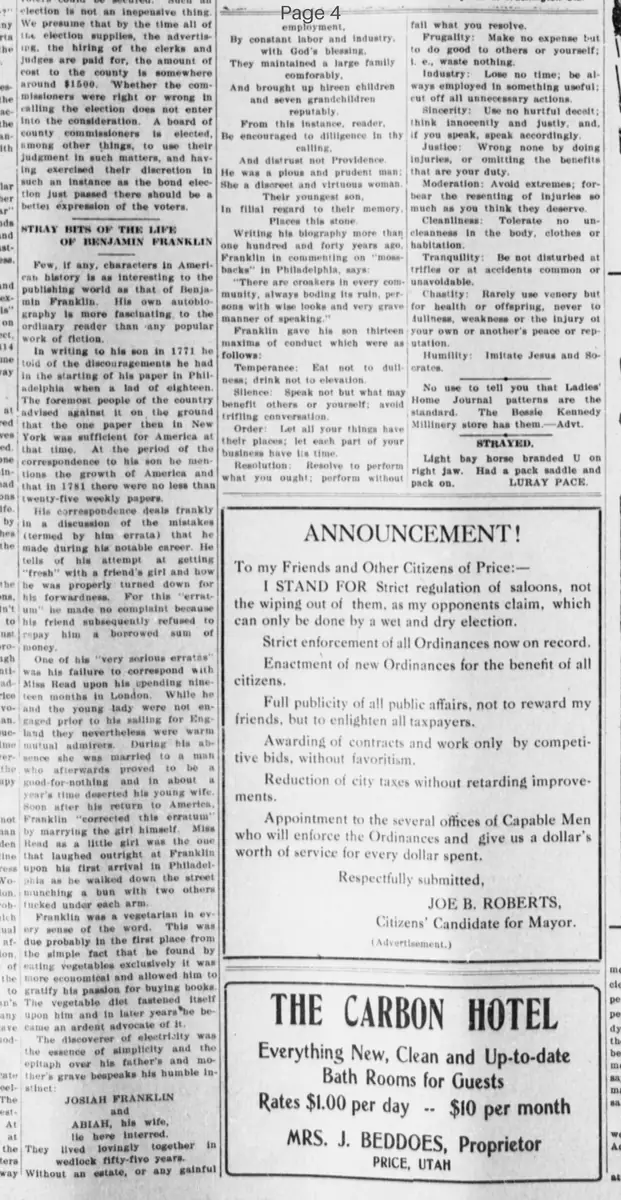
STRAY BITS OF THE LIFE OF BENJAMIN FRANKLIN
Few, if any, characters in American history is as interesting to the publishing world as that of Benjamin Franklin.
His own autobiography is more fascinating to the ordinary reader than any popular work of fiction.
In writing to his son in 1771 he told of the discouragements he had in the starting of his paper in Philadelphia when a lad of eighteen.
The foremost people of the country advised against it on the ground that the one paper then in New York was sufficient for America at that time.
At the period of the correspondence to his son he mentions the growth of America and that in 1781 there were no less than twenty-five weekly papers.
His correspondence deals frankly in a discussion of the mistakes (termed by him errata) that he made during his notable career.
He tells of his attempt at getting "fresh" with a friend's girl and how he was properly turned down for his forwardness.
For this "erratum" he made no complaint because his friend subsequently refused to repay him a borrowed sum of money.
One of his "very serious erratas" was his failure to correspond with Miss Read upon his spending nineteen months in London.
While he and the young lady were not engaged prior to his sailing for England they nevertheless were warm mutual admirers.
During his absence she was married to a man who afterwards proved to be a good-for-nothing and in about a year's time deserted his young wife.
Soon after his return to America, Franklin "corrected this erratum" by marrying the girl himself.
Miss Read as a little girl was the one that laughed outright at Franklin upon his first arrival in Philadelphia as he walked down the street munching a bun with two others tucked under each arm.
Franklin was a vegetarian in every sense of the word.
This was due probably in the first place from the simple fact that he found by eating vegetables exclusively it was more economical and allowed him to gratify his passion for buying books.
The vegetable diet fastened itself upon him and in later years he became an ardent advocate of it.
The discoverer of electricity was the essence of simplicity and the epitaph over his father's and mother's grave bespeaks his humble instinct:
JOSIAH FRANKLIN and ABIAH, his wife, lie here interred.
They lived lovingly together in wedlock fifty-five years.
Without an estate, or any gainful employment,
By constant labor and industry, with God's blessing,
They maintained a large family comfortably,
And brought up thirteen children and seven grandchildren reputably.
From this instance, reader,
Be encouraged to diligence in thy calling,
And distrust not Providence.
He was a pious and prudent man;
She a discreet and virtuous woman.
Their youngest son,
In filial regard to their memory,
Places this stone.
Writing his biography more than one hundred and forty years ago, Franklin in commenting on "moan-backs" in Philadelphia, says:
"There are croakers in every community, always boding its ruin, persons with wise looks and very grave manner of speaking."
Franklin gave his son thirteen maxims of conduct which were as follows:
Temperance:
Eat not to dullness; drink not to elevation.
Silence:
Speak not but what may benefit others or yourself; avoid trifling conversation.
Order:
Let all your things have their places; let each part of your business have its time.
Resolution:
Resolve to perform what you ought; perform without fail what you resolve.
Frugality:
Make no expense but to do good to others or yourself; i.e., waste nothing.
Industry:
Lose no time; be always employed in something useful; cut off all unnecessary actions.
Sincerity:
Use no hurtful deceit; think innocently and justly, and, if you speak, speak accordingly.
Justice:
Wrong none by doing injuries, or omitting the benefits that are your duty.
Moderation:
Avoid extremes; forbear resenting injuries so much as you think they deserve.
Cleanliness:
Tolerate no uncleanness in the body, clothes or habitation.
Tranquility:
Be not disturbed at trifles, or at accidents common or unavoidable.
Chastity:
Rarely use venery but for health or offspring, never to dullness, weakness or the injury of your own or another's peace or reputation.
Humility:
Imitate Jesus and Socrates.
Few, if any, characters in American history is as interesting to the publishing world as that of Benjamin Franklin.
His own autobiography is more fascinating to the ordinary reader than any popular work of fiction.
In writing to his son in 1771 he told of the discouragements he had in the starting of his paper in Philadelphia when a lad of eighteen.
The foremost people of the country advised against it on the ground that the one paper then in New York was sufficient for America at that time.
At the period of the correspondence to his son he mentions the growth of America and that in 1781 there were no less than twenty-five weekly papers.
His correspondence deals frankly in a discussion of the mistakes (termed by him errata) that he made during his notable career.
He tells of his attempt at getting "fresh" with a friend's girl and how he was properly turned down for his forwardness.
For this "erratum" he made no complaint because his friend subsequently refused to repay him a borrowed sum of money.
One of his "very serious erratas" was his failure to correspond with Miss Read upon his spending nineteen months in London.
While he and the young lady were not engaged prior to his sailing for England they nevertheless were warm mutual admirers.
During his absence she was married to a man who afterwards proved to be a good-for-nothing and in about a year's time deserted his young wife.
Soon after his return to America, Franklin "corrected this erratum" by marrying the girl himself.
Miss Read as a little girl was the one that laughed outright at Franklin upon his first arrival in Philadelphia as he walked down the street munching a bun with two others tucked under each arm.
Franklin was a vegetarian in every sense of the word.
This was due probably in the first place from the simple fact that he found by eating vegetables exclusively it was more economical and allowed him to gratify his passion for buying books.
The vegetable diet fastened itself upon him and in later years he became an ardent advocate of it.
The discoverer of electricity was the essence of simplicity and the epitaph over his father's and mother's grave bespeaks his humble instinct:
JOSIAH FRANKLIN and ABIAH, his wife, lie here interred.
They lived lovingly together in wedlock fifty-five years.
Without an estate, or any gainful employment,
By constant labor and industry, with God's blessing,
They maintained a large family comfortably,
And brought up thirteen children and seven grandchildren reputably.
From this instance, reader,
Be encouraged to diligence in thy calling,
And distrust not Providence.
He was a pious and prudent man;
She a discreet and virtuous woman.
Their youngest son,
In filial regard to their memory,
Places this stone.
Writing his biography more than one hundred and forty years ago, Franklin in commenting on "moan-backs" in Philadelphia, says:
"There are croakers in every community, always boding its ruin, persons with wise looks and very grave manner of speaking."
Franklin gave his son thirteen maxims of conduct which were as follows:
Temperance:
Eat not to dullness; drink not to elevation.
Silence:
Speak not but what may benefit others or yourself; avoid trifling conversation.
Order:
Let all your things have their places; let each part of your business have its time.
Resolution:
Resolve to perform what you ought; perform without fail what you resolve.
Frugality:
Make no expense but to do good to others or yourself; i.e., waste nothing.
Industry:
Lose no time; be always employed in something useful; cut off all unnecessary actions.
Sincerity:
Use no hurtful deceit; think innocently and justly, and, if you speak, speak accordingly.
Justice:
Wrong none by doing injuries, or omitting the benefits that are your duty.
Moderation:
Avoid extremes; forbear resenting injuries so much as you think they deserve.
Cleanliness:
Tolerate no uncleanness in the body, clothes or habitation.
Tranquility:
Be not disturbed at trifles, or at accidents common or unavoidable.
Chastity:
Rarely use venery but for health or offspring, never to dullness, weakness or the injury of your own or another's peace or reputation.
Humility:
Imitate Jesus and Socrates.
What sub-type of article is it?
Essay
What themes does it cover?
Moral Virtue
Political
Temperance
What keywords are associated?
Benjamin Franklin
Autobiography
Errata
Vegetarianism
Epitaph
Maxims
Philadelphia
Temperance
Literary Details
Title
Stray Bits Of The Life Of Benjamin Franklin
Subject
Biographical Anecdotes From Benjamin Franklin's Life And Writings
Key Lines
His Own Autobiography Is More Fascinating To The Ordinary Reader Than Any Popular Work Of Fiction.
One Of His "Very Serious Erratas" Was His Failure To Correspond With Miss Read Upon His Spending Nineteen Months In London.
Josiah Franklin And Abiah, His Wife, Lie Here Interred.
They Lived Lovingly Together In Wedlock Fifty Five Years.
Without An Estate, Or Any Gainful Employment,
By Constant Labor And Industry, With God's Blessing,
They Maintained A Large Family Comfortably,
And Brought Up Thirteen Children And Seven Grandchildren Reputably.
From This Instance, Reader,
Be Encouraged To Diligence In Thy Calling,
And Distrust Not Providence.
He Was A Pious And Prudent Man;
She A Discreet And Virtuous Woman.
Their Youngest Son,
In Filial Regard To Their Memory,
Places This Stone.
Temperance:
Eat Not To Dullness; Drink Not To Elevation.
Humility:
Imitate Jesus And Socrates.