Thank you for visiting SNEWPapers!
Sign up free
Gazette Of The United States, & Philadelphia Daily Advertiser
Philadelphia, Philadelphia County, Pennsylvania
What is this article about?
U.S. House of Representatives sessions July 4-6, 1797: Passed bills on mileage, consuls, appropriations; debated and approved 8-cent salt duty with fishery drawback after votes (46-41 yeas); authorized 800,000-dollar loan (43-34); reported impeachment resolution against Sen. William Blount for high crimes.
Clipping
OCR Quality
Full Text
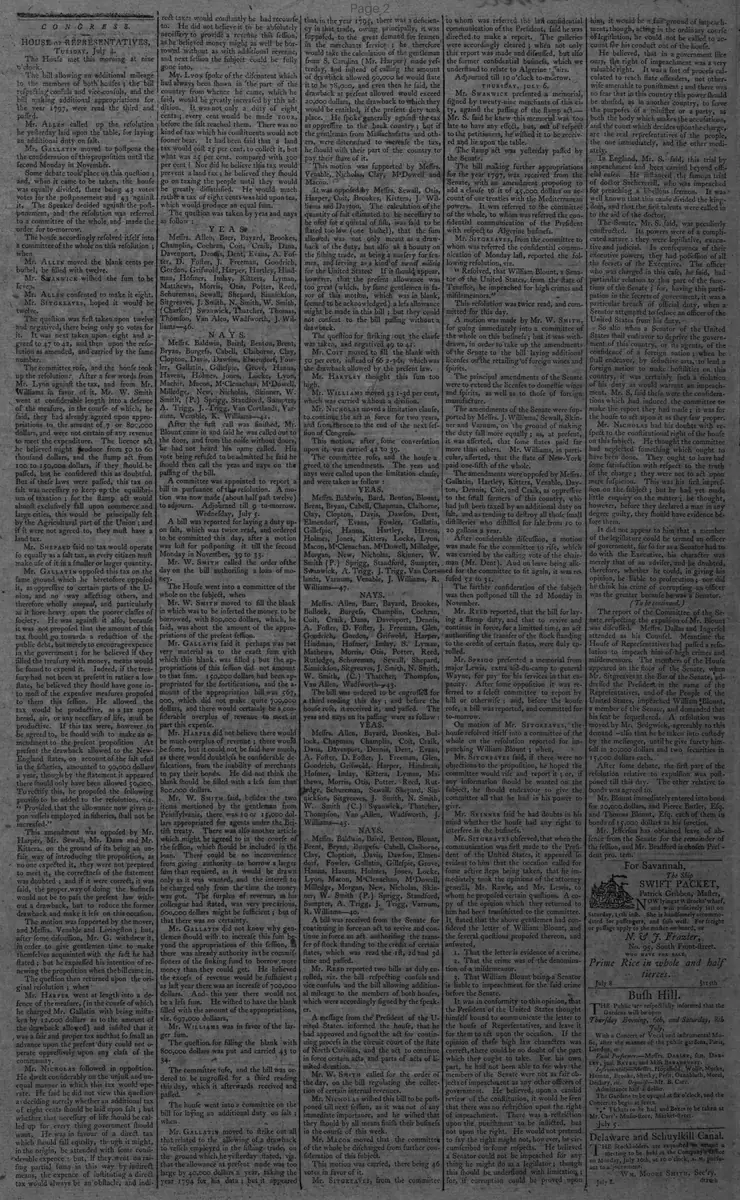
Tuesday, July 4.
The House met this morning at nine o'clock.
The bill allowing an additional mileage to the members of both houses, the bill respecting consuls and vice-consuls, and the bill making additional appropriations for the year 1797, were read the third time and passed.
Mr. Allen called up the resolution he yesterday laid upon the table, for laying an additional duty on salt.
Mr. Gallatin moved to postpone the consideration of this proposition until the second Monday in November.
Some debate took place on this question; and, when it came to be taken, the house was equally divided, there being 43 votes for the postponement and 43 against it. The Speaker decided against the postponement, and the resolution was referred to a committee of the whole and made the order for to-morrow.
The house accordingly resolved itself into a committee of the whole on this resolution; when
Mr. Allen moved the blank cents per bushel, be filled with twelve.
Mr. Swanwick wished the sum to be even.
Mr. Allen consented to make it eight.
Mr. Sitgreaves hoped it would be twelve.
The question was first taken upon twelve and negatived, there being only 30 votes for it. It was next taken upon eight and agreed to 47 to 42, and then upon the resolution as amended, and carried by the same number.
The committee rose, and the house took up the resolution. After a few words from Mr. Lyon against the tax, and from Mr. Williams in favor of it, Mr. W. Smith went at considerable length into a defence of the measure, in the course of which, he said, they had already agreed upon appropriations to the amount of 7 or 800,000 dollars, and were not certain of any revenue to meet the expenditure. The licence act he believed might produce from 50 to 60 thousand dollars, and the stamp act from 100 to 150,000 dollars, if they should be passed, but he considered this as doubtful.
But if these laws were passed, this tax on salt was necessary to keep up the equilibrium of taxation; for the stamp act would almost exclusively fall upon commerce and large cities, this would be principally felt by the Agricultural part of the Union; and if it were not agreed to, they must have a land tax.
Mr. Shepard said no tax would operate so equally as a salt tax, as every citizen must make use of it in a smaller or larger quantity.
Mr. Gallatin opposed this tax on the same ground which he heretofore opposed it, as oppressive to certain parts of the Union, and no way affecting others, and therefore wholly unequal, and particularly as it bore heavy upon the poorer classes of society. He was against it also, because it was not proposed that the amount of this tax should go towards a reduction of the public debt, but merely to encourage expense in the government; for he believed if they filled the treasury with money, means would be found to expend it. Indeed, if the treasury had not been at present in rather a low state, he believed they should have gone into most of the expensive measures proposed to them this session. He allowed the tax would be productive, as a tax upon bread, air, or any necessary of life, must be productive. If this tax were, however to be agreed to, he should wish to make an amendment to the present proposition. At present the drawback allowed to the New-England states, on account of the salt used in the fisheries, amounted to 90,000 dollars a year, though by the statement it appeared there should only have been allowed 20,000. To rectify this, he proposed the following proviso to be added to the resolution, viz.
"Provided that the allowance now given upon vessels employed in fisheries, shall not be increased."
This amendment was opposed by Mr. Harper, Mr. Sewall, Mr. Dana and Mr. Kittera, on the ground of its being an unfair way of introducing the proposition, as no one expected it, they were not prepared to meet it, the correctness of the statement was doubted; and if it were correct, it was said, the proper way of doing the business would not be to pass the present law without a drawback, but to reduce the former drawback and make it less on this occasion.
The motion was supported by the mover, and Messrs. Venable and Livingston; but, after some discussion, Mr. G. withdrew it, in order to give gentlemen time to make themselves acquainted with the fact he had stated; but he expressed his intention of renewing the proposition when the bill came in.
The question then returned upon the original resolution; when
Mr. Harper went at length into a defence of the measure, (in the course of which he charged Mr. Gallatin with being mistaken by 12,000 dollars as to the amount of the drawback allowed) and insisted that it was a fair and proper tax and that so small an advance upon the present duty could not operate oppressively upon any class of the community.
Mr. Nicholas followed in opposition. He dwelt considerably on the unjust and unequal manner in which this tax would operate. He said he did not view this question as deciding merely whether an additional tax of eight cents should be laid upon salt; but whether that necessary of life should be called up for every thing government should want. He was in favour of a direct tax which should fall equally, though it might, in the origin, be attended with some considerable expense: but, if they went on raising partial sums in this way by indirect means, the expense of instituting a direct tax would always be an obstacle, and indirect taxes would constantly be had recourse to. He did not believe it to be absolutely necessary to provide a revenue this session, as he believed money might as well be borrowed without as with additional revenue, and next session the subject could be fully gone into.
Mr. Lyon spoke of the discontent which had always been shewn in the part of the country from whence he came, which he said, would be greatly increased by this addition. It was not only a duty of eight cents; every cent would be made four, before the salt reached them. There was no kind of tax which his constituents would not sooner bear. It had been said that a land tax would cost 25 per cent. to collect it, but what was 25 per cent. compared with 300 per cent! Nor did he believe this tax would prevent a land tax; he believed they should go on taxing the people until they would be greatly dissatisfied. He would much rather a tax of eight cents was laid upon tea, which would produce an equal sum.
The question was taken by yeas and nays as follow:
YEAS.
Messrs. Allen, Baer, Bayard, Brookes, Champlin, Cochran, Coit, Craik, Dana, Davenport, Dennis, Dent, Evans, A. Foster, D. Foster, J. Freeman, Goodrich, Gordon, Griswold, Harper, Hartley, Hindman, Homer, Imlay, Kittera, Lyman, Matthews, Morris, Otis, Potter, Reed, Schureman, Sewall, Shepard, Sinnickson, Sitgreaves, J. Smith, N. Smith, W. Smith, (Charles.) Swanwick, Thatcher, Thomas, Thompson, Van Alen, Wadsworth, I. Williams—46.
NAYS.
Messrs. Baldwin, Baird, Benton, Brent, Bryan, Burgess, Cabell, Claiborne, Clay, Clopton, Davis, Dawson, Elmendorf, Fowler, Gallatin, Gillespie, Grove, Hanna, Havens, Holmes, Jones, Locke, Lyon, Machir, Macon, M'Clenachan, M'Dowell, Milledge, New, Nicholas, Skinner, W. Smith, (P.) Sprigg, Stanford, Sumpter, A. Trigg, J. Trigg, Van Cortlandt, Varnum, Venable, K. Williams—41.
After the first call was finished, Mr. Blount came in and said he was called out to the door, and from the noise without doors, he had not heard his name called. His vote being refused to be admitted he said he should then call the yeas and nays on the passing of the bill.
A committee was appointed to report a bill in pursuance of this resolution. A motion was now made (about half past twelve) to adjourn. Adjourned till 9 to-morrow.
Wednesday, July 5.
A bill was reported for laying a duty upon salt, which was twice read, and ordered to be committed this day, after a motion was lost for postponing it till the second Monday in November, 39 to 33.
Mr. W. Smith called the order of the day on the bill authorising a loan of money.
The House went into a committee of the whole on the subject, when
Mr. W. Smith moved to fill the blank in which was to be inserted the money to be borrowed, with 800,000 dollars, which, he said, was about the amount of the appropriations of the present session.
Mr. Gallatin said it perhaps was not very material as to the exact sum with which this blank was filled; but the appropriations of this session did not amount to that sum. 150,000 dollars had been appropriated for the fortifications, and the amount of the appropriation bill was 567,000, which did not make quite 700,000 dollars, and there would certainly be a considerable overplus of revenue to meet in part this expense.
Mr. Harper did not believe there would be much overplus of revenue; there would be some, but it could not be said how much, as there would doubtless be considerable defalcations, from the inability of merchants to pay their bonds. He did not think the blank should be filled with a less sum than 800,000 dollars.
Mr. W. Smith said, besides the two items mentioned by the gentleman from Pennsylvania, there was 10 or 15,000 dollars appropriated for agents under the British treaty. There was also another article which might be agreed to in the course of the session, which should be included in the loan. There could be no inconvenience from giving authority to borrow a larger sum than required, as it would be drawn only as it was wanted, and the interest to be charged only from the time the money was got. The surplus of revenue, as his colleague had stated, was very precarious, 600,000 dollars might be sufficient; but of that there was no certainty.
Mr. Gallatin did not know why gentlemen should wish to increase this sum beyond the appropriations of this session, as there was already authority in the commissioners of the sinking fund to borrow more money than they could get. He believed the excess of revenue would be sufficient; as last year there was an increase of 700,000 dollars. And this year there would not be a less sum. He wished to have the blank filled with the amount of the appropriations, viz. 697,000 dollars.
Mr. Williams was in favor of the larger sum.
The question for filling the blank with 800,000 dollars was put and carried 43 to 34.
The committee rose, and the bill was ordered to be engrossed for a third reading this day, which it afterwards received and passed.
The house went into a committee on the bill for laying an additional duty on salt; when
Mr. Gallatin moved to strike out all that related to the allowing of a drawback to vessels employed in the fishing trade, on the ground which he yesterday stated, viz. that the allowance at present made was too large by 40,000 dollars a year, taking the year 1794 for his data; but it appeared that in the year 1795, there was a deficiency in that trade, owing principally, it was supposed, to the great demand for seamen in the merchants service; he therefore would take the calculation of the gentleman from S. Carolina (Mr. Harper) made yesterday, and instead of calling the amount of drawback allowed 90,000 he would state it to be 78,000, and even then he said, the drawback at present allowed would exceed 20,000 dollars, the drawback to which they would be entitled, if the present duty took place. He spoke generally against the tax as oppressive to the back country; but if the gentleman from Massachusetts and others, were determined to increase the tax, he should wish their part of the country to pay their share of it.
This motion was supported by Messrs. Venable, Nicholas, Clay, M'Dowell and Macon.
It was opposed by Messrs. Sewall, Otis, Harper, Coit, Brookes, Kittera, J. Williams and Dayton. The calculation of the quantity of salt estimated to be necessary to be used for a quintal of fish, was said to be stated too low (one bushel), that the sum allowed, was not only meant as a drawback of the duty, but also as a bounty on the fishing trade, as being a nursery for seamen, and serving as a kind of naval militia for the United States. If it should appear, however, that the present allowance was too great (which, by some gentlemen in favor of this motion, which was in blank, seemed to be acknowledged) a less allowance might be made in this bill; but they could not consent to the bill passing without a drawback.
The question for striking out the clause was taken, and negatived 49 to 41.
Mr. Coit moved to fill the blank with 50 per cent, instead of 66 2-3ds, which was the drawback allowed by the present law.
Mr. Hartley thought this sum too high.
Mr. Williams moved 33 1-3d per cent, which was carried without a division.
Mr. Nicholas moved a limitation clause, to continue the act in force for two years, and from thence to the end of the next session of Congress.
This motion, after some conversation upon it, was carried 42 to 39.
The committee rose, and the house agreed to the amendments. The yeas and nays were called upon the limitation clause, and were taken as follow:
YEAS.
Messrs. Baldwin, Bard, Benton, Blount, Brent, Bryan, Cabell, Chapman, Claiborne, Clay, Clopton, Davis, Dawson, Dent, Elmendorf, Evans, Fowler, Gallatin, Gillespie, Hanna, Hartley, Havens, Holmes, Jones, Kittera, Locke, Lyon, Macon, M'Clenachan, M'Dowell, Milledge, Morgan, New, Nicholas, Skinner, W. Smith (P.) Sprigg, Stanford, Sumpter, Swanwick, A. Trigg, J. Trigg, Van Cortlandt, Varnum, Venable, J. Williams, R. Williams—47.
NAYS.
Messrs. Allen, Baer, Bayard, Brookes, Bullock, Burgess, Champlin, Cochran, Coit, Craik, Dana, Davenport, Dennis, A. Foster, D. Foster, J. Freeman, Glen, Goodrich, Gordon, Griswold, Harper, Hindman, Homer, Imlay, S. Lyman, Mathews, Morris, Otis, Potter, Reed, Rutledge, Schureman, Sewall, Shepard, Sinnickson, Sitgreaves, J. Smith, N. Smith, W. Smith, (C.) Thatcher, Thompson, Van Allen, Wadsworth—43.
The bill was ordered to be engrossed for a third reading this day; and before the house rose, it received it, and passed. The yeas and nays on its passing were as follow:
YEAS.
Messrs. Allen, Bayard, Brookes, Bullock, Chapman, Champlin, Coit, Craik, Dana, Davenport, Dennis, Dent, Evans, A. Foster, D. Foster, J. Freeman, Glen, Goodrich, Griswold, Harper, Hindman, Homer, Imlay, Kittera, Lyman, Mathews, Morris, Otis, Potter, Reed, Rutledge, Schureman, Sewall, Shepard, Sinnickson, Sitgreaves, J. Smith, N. Smith, W. Smith (C.) Swanwick, Thatcher, Thompson, Van Allen, Wadsworth, J. Williams—45.
NAYS.
Messrs. Baldwin, Baird, Benton, Blount, Brent, Bryan, Burgess, Cabell, Claiborne, Clay, Clopton, Davis, Dawson, Elmendorf, Fowler, Gallatin, Gillespie, Grove, Hanna, Havens, Holmes, Jones, Locke, Lyon, Macon, M'Clenachan, M'Dowell, Milledge, Morgan, New, Nicholas, Skinner, W. Smith (P.), Sprigg, Stanford, Sumpter, A. Trigg, J. Trigg, Varnum, R. Williams—40.
A bill was received from the Senate for continuing in force an act to revive and continue in force an act authorising the transfer of stock standing to the credit of certain states, which was read the 1st, 2d and 3d time and passed.
Mr. Reed reported two bills as duly enrolled, viz. the bill respecting consuls and vice consuls, and the bill allowing additional mileage to the members of both houses, which were accordingly signed by the speaker.
A message from the President of the United States, informed the house, that he had approved and signed the act for continuing process in the circuit court of the state of North Carolina, and the act to continue in force certain acts and parts of acts of limited duration.
Mr. W. Smith called for the order of the day, on the bill regulating the collection of certain internal revenues.
Mr. Nicholas wished this bill to be postponed till next session, as it was not of any immediate importance, and he wished that they should by all means finish their business in the course of this week.
Mr. Macon moved that the committee of the whole be discharged from further consideration of this subject.
This motion was carried, there being 46 votes in favor of it.
Mr. Sitgreaves, from the committee to whom was referred the last confidential communication of the President, said he was directed to make a report. The galleries were accordingly cleared; when not only this report was made and discussed, but also the former confidential business, which we understand to relate to Algerine affairs.
Adjourned till 10 o'clock to-morrow.
THURSDAY, JULY 6.
Mr. Swanwick presented a memorial, signed by twenty-nine merchants of this city, against the passing of the stamp act.—
Mr. S. said he knew this memorial was too late to have any effect, but, out of respect to the petitioners, he wished it to be received and lie upon the table.
The stamp act was yesterday passed by the Senate.
The bill making further appropriations for the year 1797, was received from the Senate, with an amendment proposing to add a clause to it of 45,000 dollars on account of our treaties with the Mediterranean powers. It was referred to the committee of the whole, to whom was referred the confidential communication of the President with respect to Algerine business.
Mr. Sitgreaves, from the committee to whom was referred the confidential communication of Monday last, reported the following resolution, viz.
"Resolved, that William Blount, a Senator of the United States, from the state of Tennessee, be impeached for high crimes and misdemeanors."
This resolution was twice read, and committed for this day.
A motion was made by Mr. W. Smith, for going immediately into a committee of the whole on this business: but it was withdrawn, in order to take up the amendments of the Senate to the bill laying additional licenses on the retailing of foreign wines and spirits.
The principal amendments of the Senate were to extend the licenses to domestic wines and spirits, as well as to those of foreign manufacture.
The amendments of the Senate were supported by Messrs. J. Williams, Sewall, Skinner and Varnum, on the ground of making the duty fall more equally; as, at present, it was asserted, that some states paid far more than others. Mr. Williams, in particular, asserted, that the state of New-York paid one-fifth of the whole.
The amendments were opposed by Messrs. Gallatin, Hartley, Kittera, Venable, Dayton, Dennis, Coit, and Craik, as oppressive to the small farmers of this country, who had just been taxed by an additional duty on salt, and as tending to destroy all those small distilleries who distilled for sale from 10 to 20 gallons a year.
After considerable discussion, a motion was made for the committee to rise, which was carried by the casting vote of the chairman (Mr. Dent). And on leave being asked for the committee to sit again, it was refused 52 to 31.
The farther consideration of the subject was then postponed till the 2d Monday in November.
Mr. Reed reported, that the bill for laying a stamp duty, and that to revive and continue in force, for a limited time, an act authorising the transfer of the stock standing to the credit of certain states, were duly enrolled.
Mr. Sprigg presented a memorial from major Lewis, extra aid-du-camp to general Wayne, for pay for his services in that capacity. After some opposition it was referred to a select committee to report by bill or otherwise; and, before the house rose, a bill was reported, and committed for to-morrow.
On motion of Mr. Sitgreaves, the house resolved itself into a committee of the whole on the resolution reported for impeaching William Blount; when,
Mr. Sitgreaves said, if there were no objections to the proposition, he hoped the committee would rise and report it; or, if any information should be wanted on the subject, he should endeavour to give the committee all that he had in his power to give.
Mr. Skinner said he had doubts in his mind whether the house had any right to interfere in the business.
Mr. Sitgreaves observed, that when the communication was first made to the President of the United States, it appeared so evident to him that the occasion called for some active steps being taken, that he immediately took the opinions of the attorney general, Mr. Rawle, and Mr. Lewis, to whom he proposed certain questions. A copy of the opinion which they returned to him had been transmitted to the committee. It stated that the above gentlemen had considered the letter of William Blount, and the several questions proposed thereon, and answered,
1. That the letter is evidence of a crime.
2. That the crime was of the denomination of a misdemeanor.
3. That William Blount being a Senator is liable to impeachment for the said crime before the Senate.
It was in conformity to this opinion, that the President of the United States thought himself bound to communicate the letter to the house of Representatives, and leave it for them to act upon the occasion. If the opinion of these high law characters was correct, there could be no doubt of the part which they ought to take. For his own part, he had not been able to see why the members of the Senate were not as fair objects of impeachment as any other officers of government. He believed, upon a candid review of the constitution, it would be seen that there was no restriction upon the right of impeachment. There was a restriction upon the punishment to be inflicted, but not upon the right. He would not pretend to say the right might not, however, be circumscribed in some respects. He believed a Senator could not be impeached for any thing he might do as a legislator; though this should be understood with limitation; for, if corruption could be proved upon him, it would be a fair ground of impeachment, though, acting in the ordinary course of legislation, he could not be called to account for his conduct out of the house.
He believed, that in a government like ours, the right of impeachment was a very valuable right. It was a sort of process calculated to reach state offenders, not otherwise amenable to punishment; and there was no fear that in this country this power should be abused, as in another country, to serve the purposes of a minister or a party, as both the body which makes the accusations, and the court which decides upon the charge, are the real representatives of the people, the one immediately, and the other mediately.
In England, Mr. S. said, this trial by impeachment had been carried beyond official cases. He instanced the famous trial of doctor Sacheverell, who was impeached for preaching a libellous sermon. It was well known that this cause divided the kingdom, and that the first talents were called in to the aid of the doctor.
The Senate, Mr. S. said, was peculiarly constructed. Its powers were of a complicated nature: they were legislative, executive and judicial. In consequence of their executive powers, they had possession of all the secrets of the Executive. The officer who was charged in this case, he said, had particular relation to this part of the functions of the Senate; for, having this participation in the secrets of government, it was a particular breach of official duty, when a Senator attempted to seduce an officer of the United States from his duty.
So also when a Senator of the United States shall endeavor to deprive the government of this country, or its agents, of the confidence of a foreign nation; when he shall endeavor, by seductive arts, to lead a foreign nation to make hostilities on this country, it was certainly such a violation of his duty as would warrant an impeachment. Mr. S. said these were the considerations which had induced the committee to make the report they had made; it was for the house to act upon it as they saw proper.
Mr. Nicholas had his doubts with respect to the constitutional right of the house on this subject. He thought the committee had neglected something which ought to have been done. They ought to have had some satisfaction with respect to the truth of the charge; they were not to act upon mere suspicion. This was his first impression on the subject; but he had yet made little enquiry on the matter; he thought, however, before they declared a man in any degree guilty, they should have evidence before them.
It did not appear to him that a member of the legislature could be termed an officer of government, for so far as a Senator had to do with the Executive, his character was merely that of an adviser, and he doubted, therefore, whether he could, in giving his opinion, be liable to prosecution; nor did he think his crime of corrupting an officer was the greater because he was a Senator.
(To be continued.)
The report of the Committee of the Senate respecting the expulsion of Mr. Blount was discussed. Messrs. Dallas and Ingersoll attended as his Counsel. Meantime the House of Representatives had passed a resolution to impeach him of high crimes and misdemeanors. The members of the House appeared on the floor of the Senate, when Mr. Sitgreaves at the Bar of the Senate, addressed the President in the name of the Representatives, and of the People of the United States, impeached William Blount, a member of the Senate, and demanded that his seat be sequestered. A resolution was moved by Mr. Sedgwick, agreeably to this demand—also that he be taken into custody by the messenger, until he give surety himself in 20,000 dollars and two securities in 15,000 dollars each.
After some debate, the first part of the resolution relative to expulsion was postponed till this day. The other relative to bonds was agreed to.
Mr. Blount immediately entered into bond for 20,000 dollars, and Pierce Butler, Esq. and Thomas Blount, Esq. each of them in bonds of 15,000 dollars as his sureties.
Mr. Jefferson has obtained leave of absence from the Senate for the remainder of the session, and Mr. Bradford is chosen President pro. tem.
What sub-type of article is it?
What keywords are associated?
What entities or persons were involved?
Domestic News Details
Event Date
July 4 6, 1797
Key Persons
Outcome
bills passed: additional mileage, consuls and vice-consuls, appropriations for 1797, duty on salt (8 cents per bushel with fishery drawback), loan of 800,000 dollars, continuing stock transfer act. resolution to impeach william blount for high crimes and misdemeanors. other bills postponed or amended.
Event Details
Proceedings of the U.S. House of Representatives on July 4-6, 1797, including passage of bills on member mileage, consuls, appropriations; debates and votes on additional duty on salt with amendments for fishery drawback; authorization of 800,000 dollar loan; discussions on internal revenues and stamp act memorials; report and debate on impeaching Senator William Blount based on confidential communication regarding misconduct.