Thank you for visiting SNEWPapers!
Sign up free
Editorial
December 9, 1842
The Liberator
Boston, Suffolk County, Massachusetts
What is this article about?
An editorial exhorting persistence in anti-slavery efforts, drawing from Dickens' Nicholas Nickleby and historical examples like Garrison's Liberator and a recent fugitive slave rescue in Boston, urging continued vigilance until slavery ends nationwide and globally.
Clipping
OCR Quality
98%
Excellent
Full Text
Keep Trying.
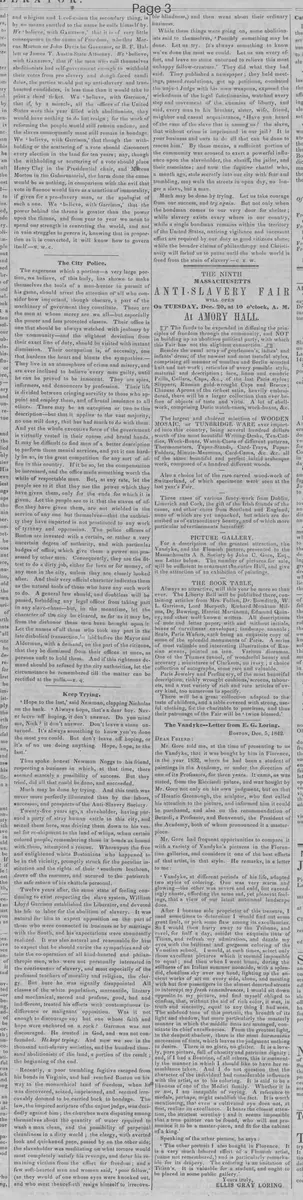
'Hope to the last,' said Newman, clapping Nicholas on the back. 'Always hope, that's a dear boy. Never leave off hoping, it don't answer. Do you mind me, Nick? it don't answer. Don't leave a stone unturned. It's always something to know you've done the most you could. But don't leave off hoping, or it's of no use doing anything. Hope, hope, to the last.'
Thus spoke honest Newman Noggs to his friend, respecting a business in which, at that time, there seemed scarcely a possibility of success. But they tried, did all that could be done, and succeeded.
Much may be done by trying. And this truth was never more perfectly illustrated than by the labors, successes, and prospects of the Anti-Slavery Society. Twenty-five years ago, a slaveholder, having pursued a party of stray human cattle to this city, and seized them here, was driving them down to his vessel for re-shipment to the land of whips, when certain colored people, remembering those in bonds as bound with them, attempted a rescue. Whereupon the free and enlightened white Bostonians who happened to be in the vicinity, promptly struck for the peculiar institution and the rights of their 'southern brethren,' drove off the rescuers, and secured to the patriarch the safe return of his chattels personal.
Twelve years after, the same state of feeling continuing to exist respecting the slave system, William Lloyd Garrison established the Liberator, and devoted his life to labor for the abolition of slavery. It was natural for him to expect opposition on the part of those who were connected in business or by marriage with the South, and his expectations were abundantly realized. It was also natural and reasonable for him to expect that he should excite the sympathies and obtain the co-operation of all kind-hearted and philanthropic men, who were not personally interested in the continuance of slavery, and most especially of the professed teachers of morality and religion, the clergy. But here he was signally disappointed. All classes of the white population, mercantile, literary and mechanical, sacred and profane, good, bad and indifferent, treated his efforts with contemptuous indifference or malignant opposition. Was it not enough to discourage any but one whose faith and hope were anchored on a rock? Garrison was not discouraged. He trusted in God, and was not confounded. He kept trying. And now we see in the thousand anti-slavery societies, and the hundred thousand abolitionists of the land, a portion of the result; the beginning of the end.
Recently, a poor trembling fugitive escaped from his bonds in Virginia, and had reached Boston on his way to the monarchical land of freedom, when he was discovered, seized, imprisoned, and seemed irrecoverably doomed to be carried back to bondage. The law, the inspired scripture of the unjust judge, was decidedly against him; the churches were disputing among themselves about the quantity of water required to wash a man clean, and the possibility of perpetual cleanliness in a dirty world; the clergy, with averted look and quickened pace, passed by on the other side; the slaveholder was meditating on what torture would most completely satisfy his revenge, and deter his remaining victims from the effort for freedom; and a few soft-hearted men and women said, 'poor fellow,' (as they would of one whose eyes were knocked out and who must thenceforth resign himself to irrecoverable blindness,) and then went about their ordinary business.
While these things were going on, some abolitionists said to themselves, 'Possibly something may be done. Let us try. It's always something to know we've done the most we could. Let us use every effort, and leave no stone unturned to relieve this most unhappy fellow-creature.' They did what they had said. They published a newspaper; they held meetings, passed resolutions, got up petitions, combated the unjust Judge with his own weapons, exposed the wickedness of the legal functionaries, watched every step and movement of the enemies of liberty, and said, every man to his brother, sister, wife, friend, neighbor and casual acquaintance, 'Have you heard of the case of the slave that is among us? the slave, that without crime is imprisoned in our jail? It is your business and ours to do all that can be done to rescue him.' By these means, a sufficient portion of the community was aroused to exert a powerful influence upon the slaveholder, the sheriff, the jailor, and their associates; and now the fugitive chattel who, a month ago, stole secretly into our city with fear and trembling, may walk the streets in open day, no longer a slave, but a man.
Much may be done by trying. Let us take courage from our success, and try again. But not only when the bondman comes to our very door for shelter; while slavery exists every where in our country, while a single bondman remains within the territory of the United States, untiring vigilance and incessant effort are required by our duty as good citizens alone; while the broader claims of philanthropy and Christianity will forbid us to pause until the whole world is freed from the stain of slavery.—G. K. W.
'Hope to the last,' said Newman, clapping Nicholas on the back. 'Always hope, that's a dear boy. Never leave off hoping, it don't answer. Do you mind me, Nick? it don't answer. Don't leave a stone unturned. It's always something to know you've done the most you could. But don't leave off hoping, or it's of no use doing anything. Hope, hope, to the last.'
Thus spoke honest Newman Noggs to his friend, respecting a business in which, at that time, there seemed scarcely a possibility of success. But they tried, did all that could be done, and succeeded.
Much may be done by trying. And this truth was never more perfectly illustrated than by the labors, successes, and prospects of the Anti-Slavery Society. Twenty-five years ago, a slaveholder, having pursued a party of stray human cattle to this city, and seized them here, was driving them down to his vessel for re-shipment to the land of whips, when certain colored people, remembering those in bonds as bound with them, attempted a rescue. Whereupon the free and enlightened white Bostonians who happened to be in the vicinity, promptly struck for the peculiar institution and the rights of their 'southern brethren,' drove off the rescuers, and secured to the patriarch the safe return of his chattels personal.
Twelve years after, the same state of feeling continuing to exist respecting the slave system, William Lloyd Garrison established the Liberator, and devoted his life to labor for the abolition of slavery. It was natural for him to expect opposition on the part of those who were connected in business or by marriage with the South, and his expectations were abundantly realized. It was also natural and reasonable for him to expect that he should excite the sympathies and obtain the co-operation of all kind-hearted and philanthropic men, who were not personally interested in the continuance of slavery, and most especially of the professed teachers of morality and religion, the clergy. But here he was signally disappointed. All classes of the white population, mercantile, literary and mechanical, sacred and profane, good, bad and indifferent, treated his efforts with contemptuous indifference or malignant opposition. Was it not enough to discourage any but one whose faith and hope were anchored on a rock? Garrison was not discouraged. He trusted in God, and was not confounded. He kept trying. And now we see in the thousand anti-slavery societies, and the hundred thousand abolitionists of the land, a portion of the result; the beginning of the end.
Recently, a poor trembling fugitive escaped from his bonds in Virginia, and had reached Boston on his way to the monarchical land of freedom, when he was discovered, seized, imprisoned, and seemed irrecoverably doomed to be carried back to bondage. The law, the inspired scripture of the unjust judge, was decidedly against him; the churches were disputing among themselves about the quantity of water required to wash a man clean, and the possibility of perpetual cleanliness in a dirty world; the clergy, with averted look and quickened pace, passed by on the other side; the slaveholder was meditating on what torture would most completely satisfy his revenge, and deter his remaining victims from the effort for freedom; and a few soft-hearted men and women said, 'poor fellow,' (as they would of one whose eyes were knocked out and who must thenceforth resign himself to irrecoverable blindness,) and then went about their ordinary business.
While these things were going on, some abolitionists said to themselves, 'Possibly something may be done. Let us try. It's always something to know we've done the most we could. Let us use every effort, and leave no stone unturned to relieve this most unhappy fellow-creature.' They did what they had said. They published a newspaper; they held meetings, passed resolutions, got up petitions, combated the unjust Judge with his own weapons, exposed the wickedness of the legal functionaries, watched every step and movement of the enemies of liberty, and said, every man to his brother, sister, wife, friend, neighbor and casual acquaintance, 'Have you heard of the case of the slave that is among us? the slave, that without crime is imprisoned in our jail? It is your business and ours to do all that can be done to rescue him.' By these means, a sufficient portion of the community was aroused to exert a powerful influence upon the slaveholder, the sheriff, the jailor, and their associates; and now the fugitive chattel who, a month ago, stole secretly into our city with fear and trembling, may walk the streets in open day, no longer a slave, but a man.
Much may be done by trying. Let us take courage from our success, and try again. But not only when the bondman comes to our very door for shelter; while slavery exists every where in our country, while a single bondman remains within the territory of the United States, untiring vigilance and incessant effort are required by our duty as good citizens alone; while the broader claims of philanthropy and Christianity will forbid us to pause until the whole world is freed from the stain of slavery.—G. K. W.
What sub-type of article is it?
Slavery Abolition
Moral Or Religious
Social Reform
What keywords are associated?
Anti Slavery
Abolitionism
Garrison
Fugitive Slave
Boston Rescue
Persistence
Trying
Christian Duty
What entities or persons were involved?
William Lloyd Garrison
Newman Noggs
Anti Slavery Society
Liberator
G. K. W.
Fugitive Slave From Virginia
Boston Abolitionists
Editorial Details
Primary Topic
Persistence In Anti Slavery Efforts Through Trying
Stance / Tone
Hopeful Exhortation To Continued Abolitionist Action
Key Figures
William Lloyd Garrison
Newman Noggs
Anti Slavery Society
Liberator
G. K. W.
Fugitive Slave From Virginia
Boston Abolitionists
Key Arguments
Trying Leads To Success, As Illustrated By Newman Noggs
Anti Slavery Society's Progress Despite Initial Opposition
Garrison Faced Contempt But Persisted, Leading To Thousands Of Societies
Recent Fugitive Rescue In Boston Succeeded Through Abolitionist Efforts
Vigilance Required Until Slavery Ends In The U.S. And Worldwide
Duty As Citizens And Christians Demands Incessant Effort