Thank you for visiting SNEWPapers!
Sign up free
The Enquirer
Richmond, Henrico County, Virginia
What is this article about?
European news from late 1808 to early 1809 reports French military successes in Spain, including the surrender of Madrid on Dec 4; British political shifts with Canning's removal, potential regency under Prince of Wales; peace propositions rejected; naval escapes from Brest; and tensions over US non-importation law. Dispatches via ship Union from L'Orient and Falmouth.
Merged-components note: Continuation of detailed foreign news reports on European events, particularly Spain and Britain, across sequential reading orders.
Clippings
1 of 2
OCR Quality
Full Text
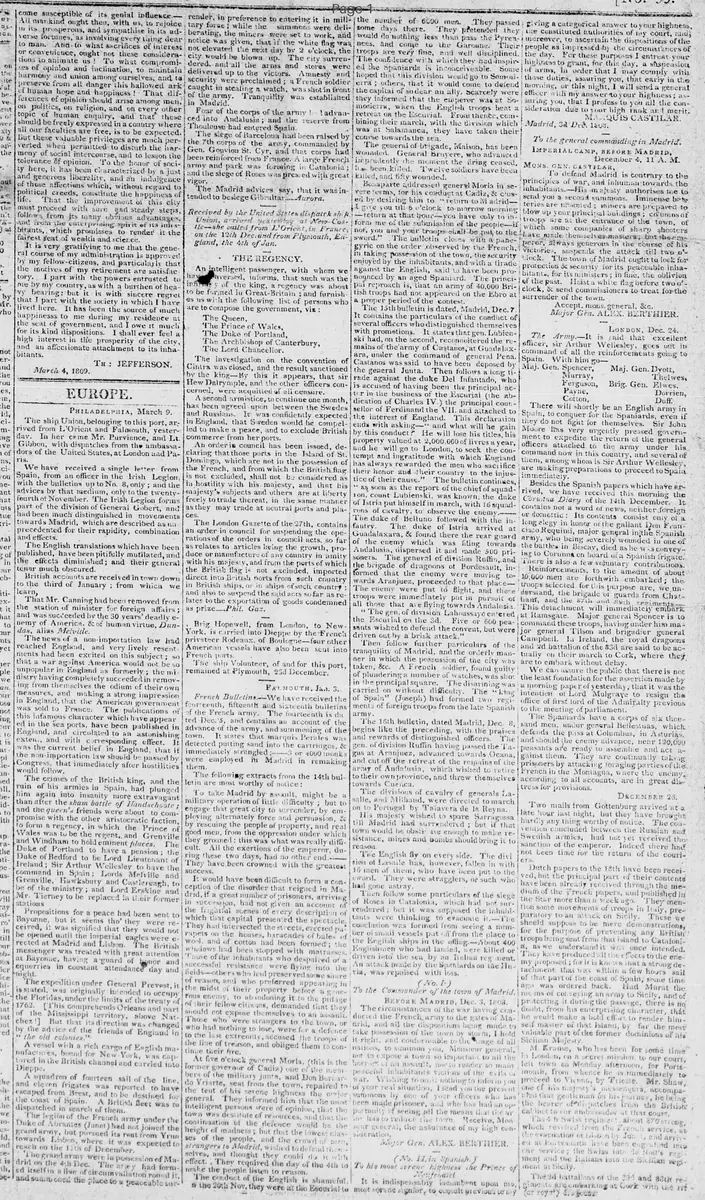
PHILADELPHIA, March 9.
The ship Union, belonging to this port, arrived from L'Orient and Falmouth, yesterday. In her came Mr. Purviance, and Lt. Gibbon, with dispatches from the ambassadors of the United States, at London and Paris.
We have received a single letter from Spain, from an officer in the Irish Legion, with the bulletins up to No. 8, only; and the advices by that medium, only to the twenty-fourth of November. The Irish Legion forms part of the division of General Gobert, and had been much distinguished in movements towards Madrid, which are described as unprecedented for their rapidity, combination and effects.
The English translations which have been published, have been pitifully mutilated, and the effects diminished; and their general tenor much obscured.
British accounts are received in town down to the third of January; from which we learn,
That Mr. Canning had been removed from the station of minister for foreign affairs; and was succeeded by the 30 years' deadly enemy of America & of human virtue, Dundas, alias Melville.
The news of a non-importation law had reached England, and very lively resentments had been excited on this subject; so that a war against America would not be so unpopular in England as formerly; the ministry having completely succeeded in removing from themselves the odium of their own measures, and making a strong impression in England, that the American government was sold to France. The publications of this infamous character which have appeared in the sea ports, have been published in England, and circulated to an astonishing extent, and with corresponding effect. It was the current belief in England, that if the non-importation law should be passed by Congress, that immediately after hostilities would follow.
The crimes of the British king, and the ruin of his armies in Spain, had plunged him again into insanity more extravagant than after the sham battle of Hondschoote; and the queen's friends were about to compromise with the other aristocratic faction, to form a regency, in which the Prince of Wales was to be the regent, and Grenville and Windham to hold eminent places. The Duke of Portland to have a pension; the Duke of Bedford to be Lord Lieutenant of Ireland; Sir Arthur Wellesley to have the command in Spain: Lords Melville and Grenville, Hawksbury and Castlereagh, to be of the ministry: and Lord Erskine and Mr. Tierney to be replaced in their former stations.
Propositions for a peace had been sent to Bayonne, but it seems tho' they were received, it was signified that they would not be opened until the imperial eagles were erected at Madrid and Lisbon. The British messenger was treated with great attention at Bayonne, having a guard of honour and equerries in constant attendance day and night.
The expedition under General Prevost, it is stated, was originally intended to occupy the Floridas, under the limits of the treaty of 1762. [This comprehends Orleans and part of the Mississippi territory, above Natchez!] But that its direction was changed by the advice of the friends of England in 'the old colonies.'
A vessel with a rich cargo of English manufactures, bound for New York, was captured in the British channel and carried into Dieppe.
A squadron of fourteen sail of the line, and eleven frigates was reported to have escaped from Brest, and to be destined for the coast of Spain. A British fleet was dispatched in search of them.
The legion of the French army under the Duke of Abrantes (Junot) had not joined the grand army, but pursued its route from Yrun towards Lisbon, where it was expected to reach on the 11th of December.
The grand army were in possession of Madrid on the 4th Dec. The army had formed itself in a line of circumvallation round it, and summoned the place to a peaceable surrender, in preference to entering it in military force; while the summons were deliberating, the miners were set to work, and notice was given, that if the white flag was not elevated the next day by 2 o'clock, the city would be blown up. The city surrendered,--and all the arms and stores were delivered up to the victors. Amnesty and security were proclaimed; a French soldier caught in stealing a watch, was shot in front of the army. Tranquility was established in Madrid.
Four of the corps of the army had advanced into Andalusia; and the reserve from Toulouse had entered Spain.
The siege of Barcelona had been raised by the 7th corps of the army, commanded by Gen. Gouvion St. Cyr, and that corps had been reinforced from France. A large French army and park was forming in Catalonia; and the siege of Roses was pressed with great vigor.
The Madrid advices say, that it was intended to besiege Gibraltar...-Aurora.
Received by the United States dispatch ship Union, arrived yesterday at New-Castle--she sailed from L'Orient, in France, on the 12th Dec. and from Plymouth, England, the 4th of Jan.
THE REGENCY.
An intelligent passenger, with whom we conversed, informs, that such was the infirmity of the king, a regency was about to be formed in Great-Britain; and furnishes us with the following list of persons who are to compose the government, viz:
The Queen,
The Prince of Wales,
The Duke of Portland,
The Archbishop of Canterbury,
The Lord Chancellor.
The investigation on the convention of Cintra was closed, and the result sanctioned by the king--By this it appears, that sir Hew Dalrymple, and the other officers concerned, were acquitted of all censure.
A second armistice, to continue one month, has been agreed upon between the Swedes and Russians. It was confidently expected in England, that Sweden would be compelled to make a peace, and to exclude British commerce from her ports.
An order in council has been issued, declaring that those ports in the Island of St. Domingo, which are not in the possession of the French, and from which the British flag is not excluded, shall not be considered as in hostility with his majesty, and that his majesty's subjects and others are at liberty freely to trade thereat, in the same manner as they may trade at neutral ports and places.
The London Gazette of the 27th, contains an order in council for suspending the operations of the orders in council acts, so far as relates to articles being the growth, produce or manufacture of any country in amity with his majesty, and from the ports of which the British flag is not excluded, imported direct into British ports from such country in British ships, or in ships of such country; and also to suspend the said acts so far as relates to the exportation of goods condemned as prize.....Phil. Gaz.
Brig Hopewell, from London, to New-York, is carried into Dieppe by the French privateer Bordeaux, of Boulogne--four other American vessels have also been sent into French ports.
The ship Volunteer, of and for this port, remained at Plymouth, 23d December.
FALMOUTH, Jan. 3.
French Bulletins--We have received the fourteenth, fifteenth and sixteenth bulletins of the French army. The fourteenth is dated Dec. 5, and contains an account of the advance of the army, and summoning of the town. It states that marquis Perales was detected putting sand into the cartridges, & immediately strangled:--3 or 4000 monks were employed in Madrid in remaking them.
The following extracts from the 14th bulletin are most worthy of notice:
To take Madrid by assault, might be a military operation of little difficulty; but to engage that great city to surrender, by employing alternately force and persuasion, & by rescuing the people of property, and real good men, from the oppression under which they groaned: this was what was really difficult. All the exertions of the emperor, during these two days, had no other end. They have been crowned with the greatest success.
It would have been difficult to form a conception of the disorder that reigned in Madrid, if a great number of prisoners, arriving in succession, had not given an account of the frightful scenes of every description of which that capital presented the spectacle. They had intersected the streets, erected parapets on the houses, barricades of bales of wool, and of cotton had been formed; the windows had been stopped with mattresses.
Those of the inhabitants who despaired of a successful resistance were flying into the fields--others who had preserved some share of reason, and who preferred appearing in the midst of their property before a generous enemy, to abandoning it to the pillage of their fellow citizens, demanded that they should not expose themselves to an assault. Those who were strangers to the town, or who had nothing to lose, were for a defence to the last extremity, accused the troops of the line of treason, and obliged them to continue their fire.
At five o'clock general Morla, (this is the former governor of Cadiz) one of the members of the military junta, and Don Bernardo Yriarte, sent from the town, repaired to the tent of his serene highness the major general. They informed him that the most intelligent persons were of opinion, that the town was destitute of resources, and that the continuation of the defence would be the height of madness; but that the lowest classes of the people, and the crowd of sent, strangers to Madrid, wished to defend themselves, and thought they could do it with effect. They required the day of the 4th to make the people listen to reason.
The 2d Battalions of the 3d and 8th regiments embarking at Cork with the 1st.
The conduct of the English is shameful. It is indispensably incumbent upon me, to consult previous to giving a categorical answer to your highness the constituted authorities of my country, and moreover, to ascertain the dispositions of the people as impressed by the circumstances of the day. For these purposes I entreat your highness to grant, for this day, a suspension of arms, in order that I may comply with those duties, assuring you, that early in the morning, or this night, I will send a general officer with my answer to your highness; assuring you, that I profess to you all the consideration due to your rank and merit.
MARQUIS CASTILAR.
Madrid, 3d Dec. 1808.
To the general commanding in Madrid.
IMPERIAL CAMP, BEFORE MADRID,
December 4, 11 A. M.
MONS. GEN. CASTILAR,
To defend Madrid is contrary to the principles of war, and inhuman towards the inhabitants.--His majesty authorises me to send you a second summons. Immense batteries are mounted; miners are prepared to blow up your principal buildings; columns of troops are at the entrance of the town, of which some companies of sharp shooters have made themselves masters; but the emperor, always generous in the course of his victories, suspends the attack till two o'clock. The town of Madrid ought to look for protection & security for its peaceable inhabitants, for its ministers; in fine, the oblivion of the past. Hoist a white flag before two o'clock, & send commissioners to treat for the surrender of the town.
Accept, mons. general, &c.
Major Gen. ALEX. BERTHIER.
London, Dec. 24.
The Army.--It is said that excellent officer, sir Arthur Wellesley, goes out in command of all the reinforcements going to Spain. With him go--
Maj. Gen. Spencer,
Maj. Gen. Dyott,
Murray,
Thelwes,
Ferguson,
Brig. Gen. Elwes,
Payne.
Dorrien.
Cotton,
Duff.
There will shortly be an English army in Spain, to conquer for the Spaniards, even if they do not fight for themselves. Sir John Moore has very urgently pressed government to expedite the return of the general officers attached to the army under his command now in this country, and several of them, among whom is Sir Arthur Wellesley, are making preparations to proceed to Spain immediately.
Besides the Spanish papers which have arrived, we have received this morning the Corunna Diary of the 14th December. It contains not a word of news, neither foreign or domestic: Its contents consist only of a long elegy in honor of the gallant Don Francisco Requimi, major general in the Spanish army, who being severely wounded in one of the battles in Biscay, died as he was conveying to Corunna on board of a Spanish frigate.
There is also a few voluntary contributions.
Reinforcements, to the amount of about 10,000 men are forthwith embarked; the troops selected for this purpose are, we understand, the brigade of guards from Chatham, and the 7th and 5th regiments--
This detachment will immediately embark at Ramsgate. Major general Spencer is to command these troops, having under him major general Tilson and brigadier general Campbell. In Ireland, the royal dragoons and 2d battalion of the 83d are said to be actually on their march to Cork, where they are to embark without delay.
We can assure the public that there is not the least foundation for the assertion made by a morning paper of yesterday, that it was the intention of Lord Mulgrave to resign the office of first lord of the Admiralty previous to the meeting of parliament.
The Spaniards have a corps of six thousand men, under general Ballesteros, which defends the pass at Collados, in Asturias, and should the enemy advance, near 130,000 peasants are ready to assemble and act against them. They are continually taking prisoners by attacking foraging parties of the French in the Montana, where the enemy, according to all accounts, are in great distress for provisions.
DECEMBER 26.
Two mails from Gottenburg arrived at a late hour last night, but they have brought hardly any thing worthy of notice. The convention concluded between the Russian and Swedish armies, had not yet received the sanction of the emperor. Indeed there had not been time for the return of the couriers.
Dutch papers to the 18th have been received, but the principal part of their contents have been already received through the medium of the French papers, and published in the Star more than a week ago. They mention some movements of troops in Italy, preparatory to an attack on Sicily. These we should suppose to be mere demonstrations, for the purpose of preventing any British troops being sent from that island to Catalonia, as we understand it was once intended.
They have produced all the effects to the enemy proposed; for it is known that a strong detachment that was within a few hours sail of that part of the coast of Spain, some time ago was ordered back. Had Murat the means of conveying an army to Sicily, and of protecting it during the passage, there is no doubt, from his enterprising character, that he would make a bold effort to render himself master of that Island, by far the most valuable part of the former dominions of his Sicilian Majesty.
Mr. Krause, who has been for some time in London, on a secret mission to our court, left town on Monday afternoon, for Portsmouth, from whence he is immediately to proceed to Vienna, by Treste. Mr. Shaw, one of his majesty's messengers, accompanied that gentleman on his journey, he being the bearer of dispatches from the British cabinet to our ambassador at that court.
The 4th Swiss regiment about 870 strong, which revolted from the French service, at the evacuation of Lisbon by Junot, and arrived at Lisbon, have been engaged into our service; the Swiss De Roll's regiment and the Italians into the Sicilian regiment at Sicily.
The Dacre transport has arrived from Cadiz and Corunna. On the 24th of November she left the former, with about twenty sail, under convoy of the Eagle, Captain Rowley. From the latter port we have advices of a much later date than the time of her departure. At Cadiz when she sailed, they were wholly unacquainted with the rapid progress of Bonaparte towards the centre of the kingdom.
Dec. 29.
The duty on the exportation of goods, the produce of countries in amity with G. Britain and from which British ships are not excluded has been taken off by an order in council, suspending in that respect the operation of the acts of parliament founded on the orders in council of November last. This seems to be an important alteration in the system on which the orders in council were founded, and which is rendered necessary by our relations with Spain and the Spanish colonies. It will also tend to remove the natural objections made by the Americans to pay what they call tribute, and will so far contribute to conciliate the U. States. This order in council is dated Dec. 21, and is one of the intended changes hinted at by Mr. Canning in his letter to Mr. Pinkney.
December 31.
Dispatches were yesterday afternoon received from Admiral De Courcy, at Corunna, dated the 23d ult., inclosing dispatches from Sir David Baird, dated the 17th. It was rumored in consequence, that accounts of the actual junction of the British troops had been received. This event, there is reason to believe, has before this time taken place: but when Sir David Baird wrote it had not. He was, however, on the point of joining Sir John Moore, whose head quarters were then at a distance of about twenty-four miles.
This intelligence is highly satisfactory. The communication between the two armies was already established: nor did it experience any interruption: and they might be said to have formed a line extending from Benevento to Toro. The Marquis de la Romana, who had collected a well organized force of between twenty and thirty thousand men at Leon, had marched from thence, for the purpose, it was supposed, of attacking a French division at Burgos, and which, it was generally supposed, he would have very little difficulty in subduing; and the position of the British army was at the same time so advantageous, as to promise the most favorable result from their future operations. The French army may prosecute their advantages in a line towards the south; but whilst the British forces possess the means of pressing upon any particular part of the line of their communication with France, the enemy must at all times be exposed to the possibility of being cut off from those points whence they are to expect the arrival of reinforcements. Besides which, it is said that such a communication had been established with the army of Romana, as would enable the British and Spanish forces to effect a direct concentration, whenever such a measure should be deemed necessary: and thus would the allies, in case of emergency, be able to oppose to the enemy an army of 50,000 men, including 40,000 British troops, a force competent, we trust, to the task of maintaining itself against any division which the enemy can now spare to send against it and certainly capable of successfully encountering the reinforcements now on their march to join the French army in the heart of Spain.
The above accounts were brought by the Swallow, of 18 guns, arrived at Plymouth. She left Corunna on Saturday last, and we are happy to add, brings a confirmation of the report that all the males, capable of bearing arms have been called out to be enrolled. The levy includes all from sixteen to sixty years: and of these the whole number from 16 to 40, have been ordered to join the armies. This looks well, and furnishes ground to hope, that at length the people in the northern provinces will be roused into action.
A proclamation from Lisbon, dated, the Palace of Government, Dec. 9 calls on the whole nation to rise in a mass to defend their country, and oppose an insurmountable barrier against the French. The Lisbon Gazette of the 13th Dec. also contains a decree issued by the council at war, and dated Dec. 11, requiring the whole Portuguese people to arm themselves in every manner in their power, and especially with pikes of six or seven feet in length. The military governors of the provinces are requested to make out and transmit lists of such persons as, by their activity and abilities, are proper to receive a command. Their general arming is to include all persons from the age of fifteen to sixty.
The troops embarking at Ramsgate with those ordered for embarkation at Cork, will amount to about 15,000 men, and their destination, should no ulterior circumstances intervene, is certainly Cadiz, in order to co-operate with the Spanish forces in the defence of the passes of Sierra Morena. Sir Arthur Wellesley, who is gone to Ireland for the purpose of urging the embarkation from that point, has the command of this division, with major gen. Spencer as his second in command; and much may be expected from the talents and combined powers of these officers.
Price of stocks this day at 1 o'clock—Consols, for Jan. 66 5-8 3-4 Reduced 65 5-8—Omnium 1 1-4 1-2 dis.
Exchequer bills, 2s. 4s. prem.
Specie is very plenty throughout the French empire, and there never was a period known, particularly at Paris, either before the French revolution under Louis XIV, or since, when gold and silver were so abundant. The subjects of Napoleon have become nearly reconciled to their privations with respect to sugar and coffee, the consumption of those articles having been diminished one half at least; but the want of cotton for their manufactories was a circumstance which excited great uneasiness: and to this incident was attributed the relaxation of the Milan decree in favor of the Tunisian flag, a relaxation which it was supposed was intended more for the great neutral power of America, (at length by connivance) than for so petty a state as Tunis. The Union, (U. S. dispatch ship) was the vessel which conveyed the information of that modification of the Milan decree to England, and that, with the disasters in Spain, are supposed to have been the moving considerations for the late alterations of the orders of council. Joachim Murat, the king of Naples, was making formidable preparations to invade and conquer Sicily; and since the reduction of Capri, it was the universal opinion that he would succeed. He carried it off with a high hand in his new kingdom, and he was considered as the exact counterpart of the emperor, who is his brother-in-law. In England it was believed that a treaty had been signed between Russia and Sweden, immediately after the convention of Oudinot. Neither France nor England appeared to have any serious disposition to go to war with us; at the
What sub-type of article is it?
What keywords are associated?
What entities or persons were involved?
Where did it happen?
Foreign News Details
Primary Location
Spain
Event Date
November 1808 To January 1809
Key Persons
Outcome
madrid surrendered on dec 4, 1808 without assault; arms and stores delivered; amnesty proclaimed; french soldier shot for theft; tranquility established; british regency formation planned; peace propositions to bayonne rejected until madrid and lisbon captured; american vessels captured by french privateers; british reinforcements to spain; spanish levies called up.
Event Details
French forces advanced rapidly towards Madrid, distinguished by Irish Legion under General Gobert; city summoned to surrender on Dec 3-4, 1808, with threats of mining; surrendered peacefully; advances into Andalusia and Catalonia; siege of Barcelona raised; British accounts detail Canning's removal, replaced by Melville; king's insanity leading to regency under Prince of Wales with specified ministers; resentments over US non-importation; peace proposals to Bayonne deferred; French squadron escaped Brest; Junot's legion to Lisbon; British reinforcements under Wellesley to Spain; Spanish and Portuguese calls to arms; orders in council adjustments.