Thank you for visiting SNEWPapers!
Sign up free
Editorial
March 19, 1814
Virginia Argus
Richmond, Virginia
What is this article about?
An editorial criticizes the Federalist minority in Congress for opposing a 1814 loan bill to fund the war, arguing it undermines national credit and public faith, potentially leading to bankruptcy and dishonor. It urges Federalists to support the war effort on honorable terms.
Clipping
OCR Quality
98%
Excellent
Full Text
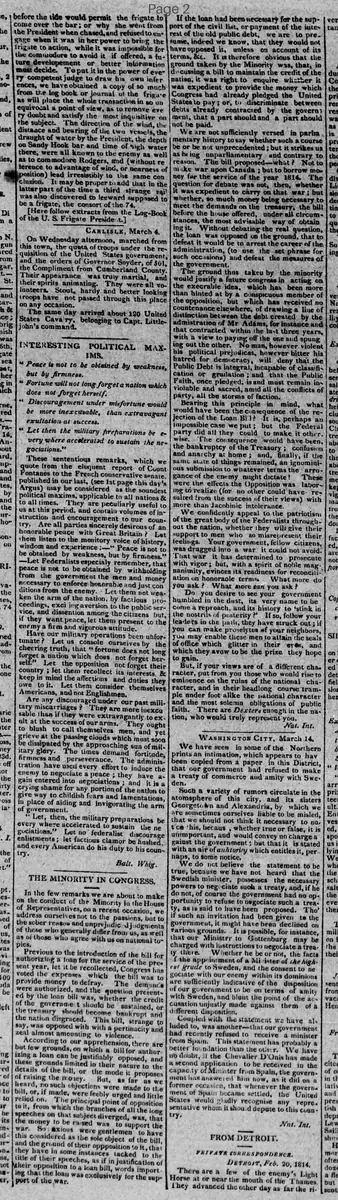
THE MINORITY IN CONGRESS.
In the few remarks we are about to make on the conduct of the Minority in the House of Representatives, on a recent occasion, we address ourselves not to the passions, but to the sober reason and unprejudiced judgments of those who generally differ from us, as well as of those who agree with us on national topics.
Previous to the introduction of the bill for authorising a loan for the service of the present year, let it be recollected, Congress has voted the expenses which the bill was to provide money to defray. The demands were authorized, and the question presented by the loan bill was, whether the credit of the government should be sustained, or the treasury should become bankrupt and the nation disgraced. This bill, strange to say, was opposed with a pertinacity and zeal almost amounting to violence.
According to our apprehension, there are but few grounds, on which a bill for authorising a loan can be justifiably opposed, and these grounds limited in their nature to the details of the bill, or the mode it proposes of raising the money. But, as far as we heard, no such objections were made to the bill, or, if made, were feebly urged and little relied on. The principal point of opposition to it, from which the branches of all the long speeches on that subject diverged, was, that the money to be raised was to support the war. So anxious were gentlemen to have this considered as the sole object of the bill, and the ground of their opposition to it, that they have in some instances tacked to the title of their speeches, as if in justification of their opposition to a loan bill, words importing that the loan was exclusively for the support of the war.
If the loan had been necessary for the support of the civil list, or payment of the interest of the old public debt, we are to presume, indeed we know, that they would not have opposed it, unless on account of its terms, &c. It is therefore obvious that the ground taken by the Minority was, that, in discussing a bill to maintain the credit of the nation, it was right to enquire whether it was expedient to provide the money which Congress had already pledged the United States to pay; or, to discriminate between debts already contracted by the government, that a part should and a part should not be paid.
We are not sufficiently versed in parliamentary history to say whether such a course be or be not unprecedented; but it strikes us as being unparliamentary and contrary to reason. The bill proposed what? Not to make war upon Canada; but to borrow money for the service of the year 1814. The question for debate was not, then, whether it was expedient to carry on that war; but whether, so much money being necessary to meet the demands on the treasury, the bill before the house offered, under all circumstances, the most advisable way of obtaining it. Without debating the real question, the loan was opposed on the ground, that to defeat it would be to arrest the career of the administration, (to use the set phrase for such occasions) and defeat the measures of the government.
The ground thus taken by the minority would justify a future congress in acting on the execrable idea, which has been more than hinted at by a conspicuous member of the opposition, but which has received no countenance elsewhere, of drawing a line of distinction between the debt created by the administration of Mr Adams, for instance and that contracted within the last three years, with a view to paying off the one and sponging out the other. No man, however violent his political prejudices, however bitter his hatred for democracy, will deny that the Public-Debt is integral, incapable of classification or gradation; and that the Public Faith, once pledged, is and must remain inviolable and sacred, amid all the conflicts of party, all the storms of faction.
Bearing this principle in mind, what would have been the consequence of the rejection of the Loan Bill? It is, perhaps an impossible case we put; but the Federal party did all they could to make it otherwise. The consequence would have been, the bankruptcy of the Treasury; confusion and anarchy at home; and, finally, if the same state of things remained, an ignominious submission to whatever terms the arrogance of the enemy might dictate! These were the effects the Opposition was laboring to realize (for no other could have resulted from the success of their views) with more than Jacobinic intolerance.
We confidently appeal to the patriotism of the great body of the Federalists throughout the nation, whether they will give their support to men who so misrepresent their feelings. Your government, fellow citizens, was dragged into a war it could not avoid. That war it has determined to prosecute with vigor; but, with a spirit of noble magnanimity, evinces its readiness for reconciliation on honorable terms What more do you ask? What more can you ask?
Do you desire to see your government humbled in the dust, its very name to become a reproach, and its history to stink in the nostrils of posterity? If so, follow your leaders in the path, they have struck out; if you can make proselytes of your neighbors, you may enable these men to attain the seals of office which glitter in their eyes, and which they avow to be the prize they hope to gain.
But, if your views are of a different character, put from you those who would rise to eminence on the ruins of the national character, and in their headlong course trample under foot alike the national character and the most solemn obligations of public faith. There are Dexters enough in the nation; who would truly represent you.
Nat. Int.
In the few remarks we are about to make on the conduct of the Minority in the House of Representatives, on a recent occasion, we address ourselves not to the passions, but to the sober reason and unprejudiced judgments of those who generally differ from us, as well as of those who agree with us on national topics.
Previous to the introduction of the bill for authorising a loan for the service of the present year, let it be recollected, Congress has voted the expenses which the bill was to provide money to defray. The demands were authorized, and the question presented by the loan bill was, whether the credit of the government should be sustained, or the treasury should become bankrupt and the nation disgraced. This bill, strange to say, was opposed with a pertinacity and zeal almost amounting to violence.
According to our apprehension, there are but few grounds, on which a bill for authorising a loan can be justifiably opposed, and these grounds limited in their nature to the details of the bill, or the mode it proposes of raising the money. But, as far as we heard, no such objections were made to the bill, or, if made, were feebly urged and little relied on. The principal point of opposition to it, from which the branches of all the long speeches on that subject diverged, was, that the money to be raised was to support the war. So anxious were gentlemen to have this considered as the sole object of the bill, and the ground of their opposition to it, that they have in some instances tacked to the title of their speeches, as if in justification of their opposition to a loan bill, words importing that the loan was exclusively for the support of the war.
If the loan had been necessary for the support of the civil list, or payment of the interest of the old public debt, we are to presume, indeed we know, that they would not have opposed it, unless on account of its terms, &c. It is therefore obvious that the ground taken by the Minority was, that, in discussing a bill to maintain the credit of the nation, it was right to enquire whether it was expedient to provide the money which Congress had already pledged the United States to pay; or, to discriminate between debts already contracted by the government, that a part should and a part should not be paid.
We are not sufficiently versed in parliamentary history to say whether such a course be or be not unprecedented; but it strikes us as being unparliamentary and contrary to reason. The bill proposed what? Not to make war upon Canada; but to borrow money for the service of the year 1814. The question for debate was not, then, whether it was expedient to carry on that war; but whether, so much money being necessary to meet the demands on the treasury, the bill before the house offered, under all circumstances, the most advisable way of obtaining it. Without debating the real question, the loan was opposed on the ground, that to defeat it would be to arrest the career of the administration, (to use the set phrase for such occasions) and defeat the measures of the government.
The ground thus taken by the minority would justify a future congress in acting on the execrable idea, which has been more than hinted at by a conspicuous member of the opposition, but which has received no countenance elsewhere, of drawing a line of distinction between the debt created by the administration of Mr Adams, for instance and that contracted within the last three years, with a view to paying off the one and sponging out the other. No man, however violent his political prejudices, however bitter his hatred for democracy, will deny that the Public-Debt is integral, incapable of classification or gradation; and that the Public Faith, once pledged, is and must remain inviolable and sacred, amid all the conflicts of party, all the storms of faction.
Bearing this principle in mind, what would have been the consequence of the rejection of the Loan Bill? It is, perhaps an impossible case we put; but the Federal party did all they could to make it otherwise. The consequence would have been, the bankruptcy of the Treasury; confusion and anarchy at home; and, finally, if the same state of things remained, an ignominious submission to whatever terms the arrogance of the enemy might dictate! These were the effects the Opposition was laboring to realize (for no other could have resulted from the success of their views) with more than Jacobinic intolerance.
We confidently appeal to the patriotism of the great body of the Federalists throughout the nation, whether they will give their support to men who so misrepresent their feelings. Your government, fellow citizens, was dragged into a war it could not avoid. That war it has determined to prosecute with vigor; but, with a spirit of noble magnanimity, evinces its readiness for reconciliation on honorable terms What more do you ask? What more can you ask?
Do you desire to see your government humbled in the dust, its very name to become a reproach, and its history to stink in the nostrils of posterity? If so, follow your leaders in the path, they have struck out; if you can make proselytes of your neighbors, you may enable these men to attain the seals of office which glitter in their eyes, and which they avow to be the prize they hope to gain.
But, if your views are of a different character, put from you those who would rise to eminence on the ruins of the national character, and in their headlong course trample under foot alike the national character and the most solemn obligations of public faith. There are Dexters enough in the nation; who would truly represent you.
Nat. Int.
What sub-type of article is it?
Partisan Politics
War Or Peace
Economic Policy
What keywords are associated?
Congress Minority
Loan Bill
War Of 1814
Federalist Opposition
Public Debt
National Credit
What entities or persons were involved?
Minority In Congress
Federalists
Administration
Mr Adams
Dexters
Editorial Details
Primary Topic
Criticism Of Minority Opposition To 1814 War Loan Bill
Stance / Tone
Strongly Pro Administration And Pro War, Critical Of Federalist Minority
Key Figures
Minority In Congress
Federalists
Administration
Mr Adams
Dexters
Key Arguments
Opposition To Loan Bill Ignores Authorized Expenses And Risks National Bankruptcy
Loan Opposition Is Unparliamentary As It Debates War Expediency Instead Of Funding Methods
Public Debt Is Inviolable Regardless Of Party Or Administration
Defeating The Bill Would Lead To Anarchy And Dishonorable Peace
Federalists Should Support Honorable Prosecution Of Unavoidable War