Thank you for visiting SNEWPapers!
Sign up free
Editorial
February 27, 1923
The Alaska Daily Empire
Juneau, Alaska
What is this article about?
Editorial argues that party affiliations are necessary for U.S. presidential candidates, citing historical uncertainties with figures like Ford, Hoover, Dewey, and Grant, and noting all presidents have been party members. Concludes with remark on vanishing treasury surpluses.
Clipping
OCR Quality
95%
Excellent
Full Text
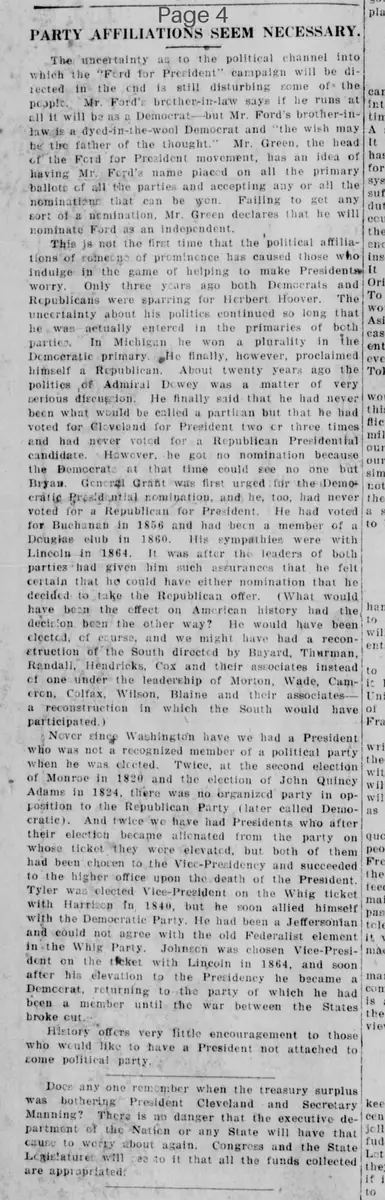
PARTY AFFILIATIONS SEEM NECESSARY.
The uncertainty as to the political channel into which the "Ford for President" campaign will be directed in the end is still disturbing some of the people. Mr. Ford's brother-in-law says if he runs at all it will be as a Democrat—but Mr. Ford's brother-in-law is a dyed-in-the-wool Democrat and "the wish may be the father of the thought." Mr. Green, the head of the Ford for President movement, has an idea of having Mr. Ford's name placed on all the primary ballots of all the parties and accepting any or all the nominations that can be won. Failing to get any sort of a nomination, Mr. Green declares that he will nominate Ford as an independent.
This is not the first time that the political affiliations of someone of prominence has caused those who indulge in the game of helping to make Presidents worry. Only three years ago both Democrats and Republicans were sparring for Herbert Hoover. The uncertainty about his politics continued so long that he was actually entered in the primaries of both parties. In Michigan he won a plurality in the Democratic primary. He finally, however, proclaimed himself a Republican. About twenty years ago the politics of Admiral Dewey was a matter of very serious discussion. He finally said that he had never been what would be called a partisan but that he had voted for Cleveland for President two or three times and had never voted for a Republican Presidential candidate. However, he got no nomination because the Democrats at that time could see no one but Bryan. General Grant was first urged for the Democratic Presidential nomination, and he, too, had never voted for a Republican for President. He had voted for Buchanan in 1856 and had been a member of a Douglas club in 1860. His sympathies were with Lincoln in 1864. It was after the leaders of both parties had given him such assurances that he felt certain that he could have either nomination that he decided to take the Republican offer. (What would have been the effect on American history had the decision been the other way? He would have been elected, of course, and we might have had a reconstruction of the South directed by Bayard, Thurman, Randall, Hendricks, Cox and their associates instead of one under the leadership of Morton, Wade, Cameron, Colfax, Wilson, Blaine and their associates—a reconstruction in which the South would have participated.)
Never since Washington have we had a President who was not a recognized member of a political party when he was elected. Twice, at the second election of Monroe in 1820 and the election of John Quincy Adams in 1824, there was no organized party in opposition to the Republican Party (later called Democratic). And twice we have had Presidents who after their election became alienated from the party on whose ticket they were elevated, but both of them had been chosen to the Vice-Presidency and succeeded to the higher office upon the death of the President.
Tyler was elected Vice-President on the Whig ticket with Harrison in 1840, but he soon allied himself with the Democratic Party. He had been a Jeffersonian and could not agree with the old Federalist element in the Whig Party. Johnson was chosen Vice-President on the ticket with Lincoln in 1864, and soon after his elevation to the Presidency he became a Democrat, returning to the party of which he had been a member until the war between the States broke out.
History offers very little encouragement to those who would like to have a President not attached to some political party.
Does any one remember when the treasury surplus was bothering President Cleveland and Secretary Manning? There is no danger that the executive department of the Nation or any State will have that cause to worry about again. Congress and the State Legislatures will see to it that all the funds collected are appropriated.
The uncertainty as to the political channel into which the "Ford for President" campaign will be directed in the end is still disturbing some of the people. Mr. Ford's brother-in-law says if he runs at all it will be as a Democrat—but Mr. Ford's brother-in-law is a dyed-in-the-wool Democrat and "the wish may be the father of the thought." Mr. Green, the head of the Ford for President movement, has an idea of having Mr. Ford's name placed on all the primary ballots of all the parties and accepting any or all the nominations that can be won. Failing to get any sort of a nomination, Mr. Green declares that he will nominate Ford as an independent.
This is not the first time that the political affiliations of someone of prominence has caused those who indulge in the game of helping to make Presidents worry. Only three years ago both Democrats and Republicans were sparring for Herbert Hoover. The uncertainty about his politics continued so long that he was actually entered in the primaries of both parties. In Michigan he won a plurality in the Democratic primary. He finally, however, proclaimed himself a Republican. About twenty years ago the politics of Admiral Dewey was a matter of very serious discussion. He finally said that he had never been what would be called a partisan but that he had voted for Cleveland for President two or three times and had never voted for a Republican Presidential candidate. However, he got no nomination because the Democrats at that time could see no one but Bryan. General Grant was first urged for the Democratic Presidential nomination, and he, too, had never voted for a Republican for President. He had voted for Buchanan in 1856 and had been a member of a Douglas club in 1860. His sympathies were with Lincoln in 1864. It was after the leaders of both parties had given him such assurances that he felt certain that he could have either nomination that he decided to take the Republican offer. (What would have been the effect on American history had the decision been the other way? He would have been elected, of course, and we might have had a reconstruction of the South directed by Bayard, Thurman, Randall, Hendricks, Cox and their associates instead of one under the leadership of Morton, Wade, Cameron, Colfax, Wilson, Blaine and their associates—a reconstruction in which the South would have participated.)
Never since Washington have we had a President who was not a recognized member of a political party when he was elected. Twice, at the second election of Monroe in 1820 and the election of John Quincy Adams in 1824, there was no organized party in opposition to the Republican Party (later called Democratic). And twice we have had Presidents who after their election became alienated from the party on whose ticket they were elevated, but both of them had been chosen to the Vice-Presidency and succeeded to the higher office upon the death of the President.
Tyler was elected Vice-President on the Whig ticket with Harrison in 1840, but he soon allied himself with the Democratic Party. He had been a Jeffersonian and could not agree with the old Federalist element in the Whig Party. Johnson was chosen Vice-President on the ticket with Lincoln in 1864, and soon after his elevation to the Presidency he became a Democrat, returning to the party of which he had been a member until the war between the States broke out.
History offers very little encouragement to those who would like to have a President not attached to some political party.
Does any one remember when the treasury surplus was bothering President Cleveland and Secretary Manning? There is no danger that the executive department of the Nation or any State will have that cause to worry about again. Congress and the State Legislatures will see to it that all the funds collected are appropriated.
What sub-type of article is it?
Partisan Politics
What keywords are associated?
Party Affiliations
Presidential Candidates
Historical Precedents
Democrats
Republicans
Nominations
Treasury Surplus
What entities or persons were involved?
Ford
Hoover
Dewey
Grant
Monroe
John Quincy Adams
Tyler
Johnson
Cleveland
Bryan
Buchanan
Douglas
Lincoln
Harrison
Editorial Details
Primary Topic
Necessity Of Party Affiliations For Presidential Candidates
Stance / Tone
Advocates For Party Affiliation In Presidential Politics
Key Figures
Ford
Hoover
Dewey
Grant
Monroe
John Quincy Adams
Tyler
Johnson
Cleveland
Bryan
Buchanan
Douglas
Lincoln
Harrison
Key Arguments
Uncertainty In Ford's Party Affiliation Mirrors Past Cases Like Hoover And Dewey
Historical Figures With Ambiguous Politics Rarely Succeeded Without Party Ties
All Presidents Since Washington Were Party Members At Election
Non Partisan Aspirations Face Little Historical Success
Congress Ensures No Treasury Surpluses Persist