Thank you for visiting SNEWPapers!
Sign up free
Editorial
April 11, 1955
Trainman News
Indianapolis, Marion County, Indiana
What is this article about?
This editorial eulogizes Franklin D. Roosevelt on the 10th anniversary of his death, praising his roles in defeating Nazism and Fascism, implementing the New Deal to strengthen democracy and economy, and countering communism. It defends his legacy against Republican accusations of treason and blame for current communist threats.
Clipping
OCR Quality
98%
Excellent
Full Text
FDR's Name Untarnished
TEN YEARS AGO the man who did more than any other to defeat Nazism and Fascism abroad and to forestall the growth of Communism in this country died.
That man was Franklin D. Roosevelt.
It is customary for labor in eulogizing Mr. Roosevelt's life to tell what a great friend he was of the working men and women of America. Of course, that he was, but his consideration for labor was only incidental to his devotion to the dignity of the individual generally and to the principles of human decency that are inseparable from the democratic system.
Early in the game FDR recognized the threat to America's security, well-being and freedom in the ruthless march of conquest of Hitler and Mussolini. He saw the evil, the cruelty and the arrogance of the dictators' sweep across Europe and he made it clear to our people what they had to do if the lamp of liberty was not also to be snuffed out in our country.
By rallying the moral, economic and later the military support of the United States to the cause of the beleaguered allies, Roosevelt played the key role in insuring their ultimate victory over the dictators.
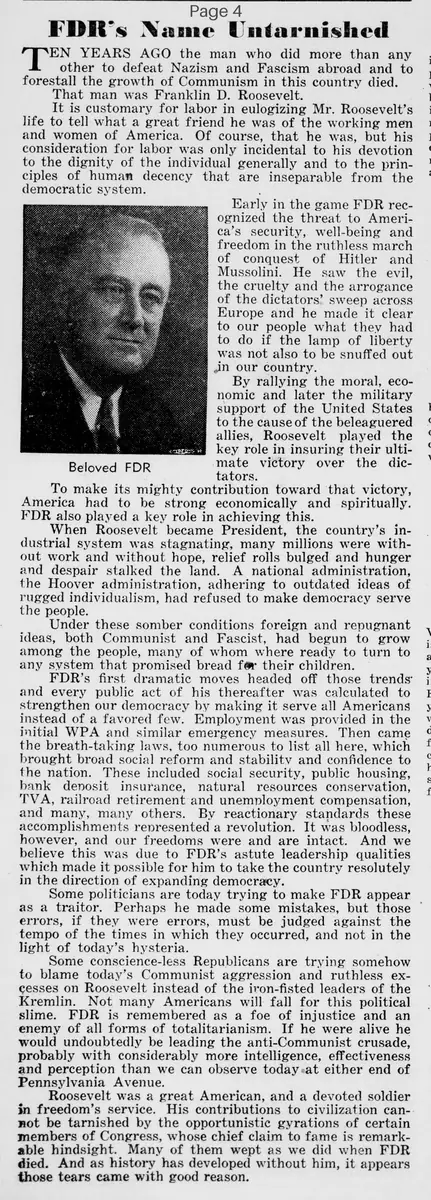
Beloved FDR
To make its mighty contribution toward that victory, America had to be strong economically and spiritually. FDR also played a key role in achieving this.
When Roosevelt became President, the country's industrial system was stagnating, many millions were without work and without hope, relief rolls bulged and hunger and despair stalked the land. A national administration, the Hoover administration, adhering to outdated ideas of rugged individualism, had refused to make democracy serve the people.
Under these somber conditions foreign and repugnant ideas, both Communist and Fascist, had begun to grow among the people, many of whom were ready to turn to any system that promised bread for their children.
FDR's first dramatic moves headed off those trends and every public act of his thereafter was calculated to strengthen our democracy by making it serve all Americans instead of a favored few. Employment was provided in the initial WPA and similar emergency measures. Then came the breath-taking laws, too numerous to list all here, which brought broad social reform and stability and confidence to the nation. These included social security, public housing, bank deposit insurance, natural resources conservation, TVA, railroad retirement and unemployment compensation, and many, many others. By reactionary standards these accomplishments represented a revolution. It was bloodless, however, and our freedoms were and are intact. And we believe this was due to FDR's astute leadership qualities which made it possible for him to take the country resolutely in the direction of expanding democracy.
Some politicians are today trying to make FDR appear as a traitor. Perhaps he made some mistakes, but those errors, if they were errors, must be judged against the tempo of the times in which they occurred, and not in the light of today's hysteria.
Some conscience-less Republicans are trying somehow to blame today's Communist aggression and ruthless excesses on Roosevelt instead of the iron-fisted leaders of the Kremlin. Not many Americans will fall for this political slime. FDR is remembered as a foe of injustice and an enemy of all forms of totalitarianism. If he were alive he would undoubtedly be leading the anti-Communist crusade, probably with considerably more intelligence, effectiveness and perception than we can observe today at either end of Pennsylvania Avenue.
Roosevelt was a great American, and a devoted soldier in freedom's service. His contributions to civilization cannot be tarnished by the opportunistic gyrations of certain members of Congress, whose chief claim to fame is remarkable hindsight. Many of them wept as we did when FDR died. And as history has developed without him, it appears those tears came with good reason.
TEN YEARS AGO the man who did more than any other to defeat Nazism and Fascism abroad and to forestall the growth of Communism in this country died.
That man was Franklin D. Roosevelt.
It is customary for labor in eulogizing Mr. Roosevelt's life to tell what a great friend he was of the working men and women of America. Of course, that he was, but his consideration for labor was only incidental to his devotion to the dignity of the individual generally and to the principles of human decency that are inseparable from the democratic system.
Early in the game FDR recognized the threat to America's security, well-being and freedom in the ruthless march of conquest of Hitler and Mussolini. He saw the evil, the cruelty and the arrogance of the dictators' sweep across Europe and he made it clear to our people what they had to do if the lamp of liberty was not also to be snuffed out in our country.
By rallying the moral, economic and later the military support of the United States to the cause of the beleaguered allies, Roosevelt played the key role in insuring their ultimate victory over the dictators.
Beloved FDR
To make its mighty contribution toward that victory, America had to be strong economically and spiritually. FDR also played a key role in achieving this.
When Roosevelt became President, the country's industrial system was stagnating, many millions were without work and without hope, relief rolls bulged and hunger and despair stalked the land. A national administration, the Hoover administration, adhering to outdated ideas of rugged individualism, had refused to make democracy serve the people.
Under these somber conditions foreign and repugnant ideas, both Communist and Fascist, had begun to grow among the people, many of whom were ready to turn to any system that promised bread for their children.
FDR's first dramatic moves headed off those trends and every public act of his thereafter was calculated to strengthen our democracy by making it serve all Americans instead of a favored few. Employment was provided in the initial WPA and similar emergency measures. Then came the breath-taking laws, too numerous to list all here, which brought broad social reform and stability and confidence to the nation. These included social security, public housing, bank deposit insurance, natural resources conservation, TVA, railroad retirement and unemployment compensation, and many, many others. By reactionary standards these accomplishments represented a revolution. It was bloodless, however, and our freedoms were and are intact. And we believe this was due to FDR's astute leadership qualities which made it possible for him to take the country resolutely in the direction of expanding democracy.
Some politicians are today trying to make FDR appear as a traitor. Perhaps he made some mistakes, but those errors, if they were errors, must be judged against the tempo of the times in which they occurred, and not in the light of today's hysteria.
Some conscience-less Republicans are trying somehow to blame today's Communist aggression and ruthless excesses on Roosevelt instead of the iron-fisted leaders of the Kremlin. Not many Americans will fall for this political slime. FDR is remembered as a foe of injustice and an enemy of all forms of totalitarianism. If he were alive he would undoubtedly be leading the anti-Communist crusade, probably with considerably more intelligence, effectiveness and perception than we can observe today at either end of Pennsylvania Avenue.
Roosevelt was a great American, and a devoted soldier in freedom's service. His contributions to civilization cannot be tarnished by the opportunistic gyrations of certain members of Congress, whose chief claim to fame is remarkable hindsight. Many of them wept as we did when FDR died. And as history has developed without him, it appears those tears came with good reason.
What sub-type of article is it?
War Or Peace
Economic Policy
Partisan Politics
What keywords are associated?
Fdr Legacy
New Deal
World War Ii
Anti Communism
Republican Criticism
Democracy Expansion
What entities or persons were involved?
Franklin D. Roosevelt
Hitler
Mussolini
Hoover
Republicans
Kremlin Leaders
Editorial Details
Primary Topic
Defense Of Fdr's Legacy Against Republican Attacks
Stance / Tone
Strongly Supportive Of Fdr And Critical Of Republicans
Key Figures
Franklin D. Roosevelt
Hitler
Mussolini
Hoover
Republicans
Kremlin Leaders
Key Arguments
Fdr Defeated Nazism And Fascism And Prevented Communism's Growth In America
New Deal Programs Strengthened Democracy And Economy During The Depression
Fdr's Leadership Expanded Democracy Without Bloodshed
Republicans Wrongly Portray Fdr As A Traitor And Blame Him For Communism
Fdr Would Lead Anti Communist Efforts More Effectively Today